Comparing Liberal & Conservative Viewpoints
In American politics, the terms liberal and conservative are used constantly in news coverage and everyday conversation. But what do these labels actually mean?
While no two people have identical political views, liberals and conservatives tend to approach the role of government, individual rights, and social issues in consistently different ways. Understanding these differences is important for making sense of American political debates.
The Core Difference
At the most fundamental level, the difference between liberals and conservatives comes down to a disagreement about the role of government in society.
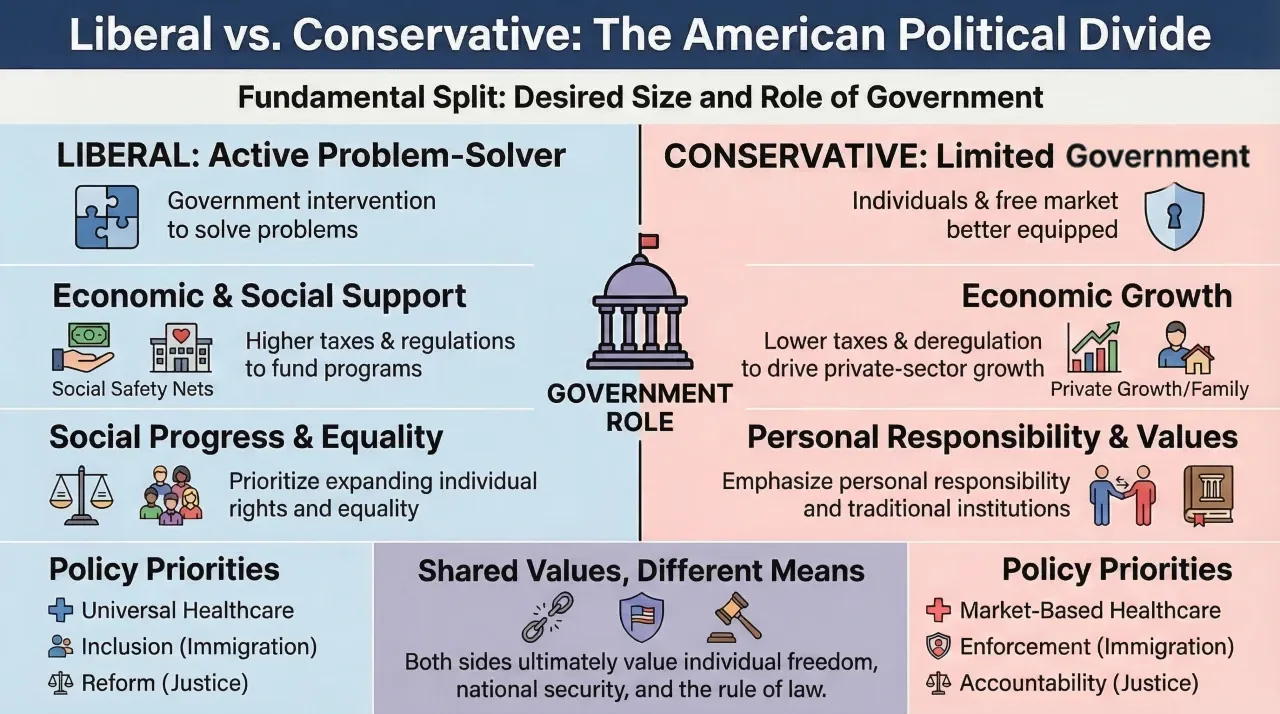
Liberals generally believe that government can and should play an active role in addressing social and economic problems. That includes reducing inequality, protecting the environment, and expanding access to healthcare and education.
Conservatives generally believe that government intervention creates more problems than it solves, and that individuals, families, and the free market are better equipped to handle most challenges than the government is.
This is a simplification, of course. Both liberals and conservatives believe in limited government to some degree, and both support government action in certain areas. The disagreement is about where the line should be drawn.
The Role of Government
On economic issues, liberals tend to support higher taxes on wealthy individuals and corporations to fund social programs, stronger regulation of businesses to protect workers and consumers, and a robust safety net of government assistance for those in need. Conservatives tend to favor lower taxes across the board, less government regulation of the economy, and the belief that economic growth driven by the private sector does more to help people than government programs.
On social issues, liberals tend to support policies that expand individual rights and promote equality across different groups in society. Conservatives tend to emphasize traditional values, personal responsibility, and the importance of institutions like family and religion in maintaining social order.
Key Policy Differences
These differing philosophies translate into different positions on specific policy issues. On healthcare, liberals generally support expanding government-provided or government-regulated healthcare to ensure universal access. Conservatives generally prefer market-based solutions and are skeptical of government-run healthcare systems. Both sides do find common ground in demanding more transparency from pharmaceutical companies and insurance 'middlemen' to lower costs for families.
On immigration, liberals tend to favor more inclusive policies and pathways to citizenship for undocumented immigrants. Conservatives tend to prioritize stricter border enforcement and deporting undocumented immigrants.
On criminal justice, liberals often emphasize rehabilitation, systemic reform, and addressing root causes of crime. Conservatives often emphasize law enforcement, personal accountability, and stricter sentencing.
Where They Agree
It is worth noting that liberals and conservatives agree on more than the political debate often suggests. Both value individual freedom, national security, economic opportunity, and the rule of law.
Their disagreements are often about means rather than ends. For example, how best to achieve a safe, prosperous, and fair society, not whether those things are worth pursuing. Both also contain significant internal diversity.
There are moderate liberals and progressive liberals, moderate conservatives and far-right conservatives. The labels are useful as a starting point, but they don't capture the full complexity of any individual's views.
Beyond the Labels
One of the dangers of the liberal-conservative framework is that it can reduce complex issues to simple team loyalties.
Real political thinking requires engaging with the actual arguments on different sides of an issue, not just adopting a position because it aligns with a political identity.
Understanding what liberals and conservatives actually believe (and why) is the first step toward that kind of thoughtful, informed citizenship.