
Early Human Migration
Every person on the planet today can trace their family tree back to Africa. That is where our species, Homo sapiens, first appeared. Scientists and historians believe that the first humans developed there about 400,000 to 100,000 years ago. Fossils found in African countries like Ethiopia and Morocco help us understand what likely happened.
For a long time, these early humans stayed in Africa. Then, slowly, they began to move.
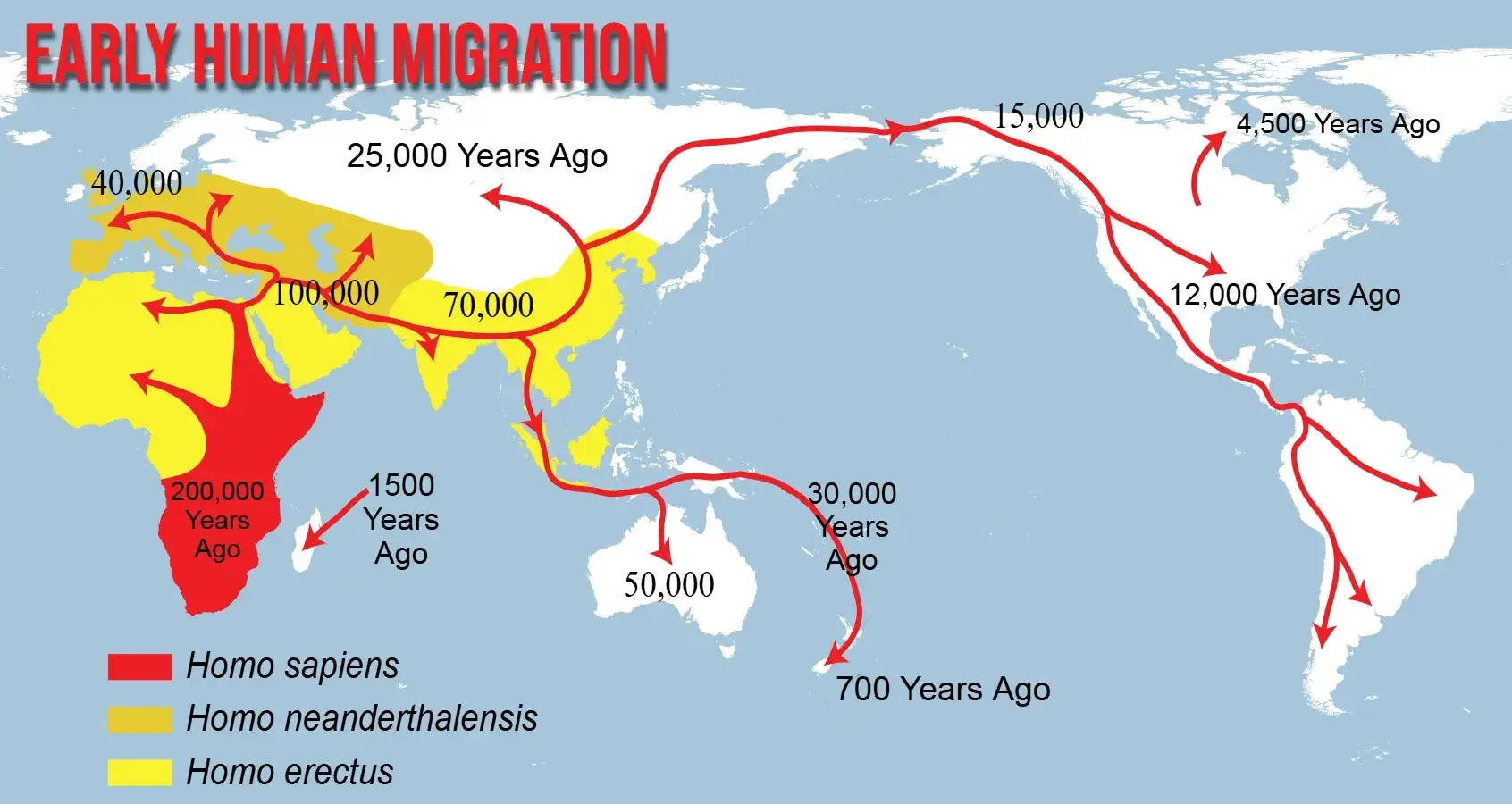
However, Homo sapiens were not the first humans to leave Africa. An older relative known as Homo erectus did it almost two million years earlier.
Homo erectus means "upright man." As you might guess, they walked on two legs a d also made some of the first stone tools and were probably the first humans to use fire. Starting around 1.8 million years ago, they spread out of Africa and into Asia. Their fossils have been found as far away as China and the island of Java in Indonesia.
Homo erectus eventually died out. But their journey shows that leaving Africa was something humans had done long before our own species tried it.
Around 70,000 years ago, small groups of Homo sapiens began to leave the African continent. Groups of families and clans most likely moved a few miles at a time, over thousands of years, following food and water.
Here is the rough timeline of when these journeys were made by early humans:
- Southwest Asia (the Middle East): about 100,000 to 60,000 years ago
- Australia: about 50,000 years ago, which required crossing open water by boat
- Europe: about 40,000 years ago
- The Americas: about 15,000 to 12,000 years ago
Experts believe that early humans followed herds of animals they hunted and relied on for food and clothing. They also looked for better weather, fresh water, and plants to gather. When a group got too large for one area to feed everyone, some members split off and searched for a new home.
While humans were spreading out, the Earth was in an Ice Age. While it wasn't one long freeze ( temperatures rose and fell), the coldest stretch happened about 20,000 years ago.
During these frigid periods, huge sheets of ice called glaciers covered northern Europe, northern Asia, and much of what is now Canada and the northern United States. Some of that ice was more than a mile thick.
All that frozen water had to come from somewhere, and much came from the oceans. Sea levels were about 400 feet lower than they are today. This means that there was much more dry land and many places that are separated by bodies of water today, were at that time connected. This includes:
- A land bridge connected Russia to Alaska and allowed humans to migrate into North America.
- Southeast Asia was one large stretch of land instead of thousands of islands.
- Britain was connected to the rest of Europe.
The last Ice Age ended about 11,700 years ago. As temperatures began to rise, glaciers melted and ocean levels rose. Land bridges disappeared underwater, and the map began to look like the one you know today.