
The Ancient Hebrews
Empires rose and empires fell over thousands of years in Mesopotamia. The Babylonians, the Assyrians, and the Persians accumulated great wealth and power that allowed them to build capital cities of striking beauty.
But their cities and palaces eventually fell into decay and were covered by thousands of years of sand and dust.
One of their relatively powerless contemporary groups outlived those great empires. These people were the Hebrews, known also as Israelites or, later, Jews.
Their early contribution to humankind was not wealthy empires or groundbreaking technology. Rather, one of their most important contributions was the development of monotheism, the belief in one God. The Hebrew God was known as Yahweh. To the Hebrews, their god was all powerful and all knowing, yet beyond human understanding. The religion based around Yahweh influenced the founding of Christianity and Islam.
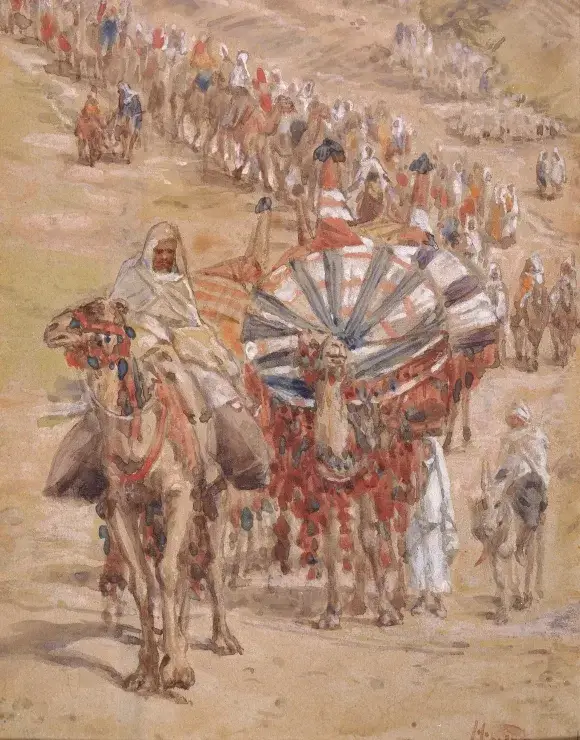
The history of the early Hebrews is known primarily from one of their sacred texts, the Torah, which comprises the first five books of the Old Testament of the Bible. According to the Torah, Abraham is the ancestral patriarch of the Hebrew people.
The Torah states that Abraham lived in the region of Mesopotamia and became the ancestral patriarch of the Hebrew people. Again, according to the Torah, Yahweh called Abraham to leave his homeland, worship one God, and travel with his family to Canaan.
Yahweh promised Abraham that if he did this, he would found a great nation that would live in a land flowing with milk and honey. Canaan, as it was known in ancient times, is roughly located in the same place as modern-day Israel.
Abraham's migration took place some time between 2000 B.C.E. and 1700 B.C.E. It occurred at a time when the Canaanites lived in relatively small, independently governed, walled cities. They were accustomed to outsiders coming into their territory. The Hebrews, who were nomadic herders, were tolerated by the Canaanites.
The land that Abraham and his followers found did not flow so easily with milk and honey. The dry climate and rough environment required considerable effort to survive. Drought forced Abraham and his family to move to Egypt.
The Torah tells how Abraham had two sons: Isaac by his wife Sarah, and Ishmael by his concubine Hagar. The Hebrews trace their heritage through Isaac. Isaac had a son Jacob, who in turn had 12 sons. These sons became the leaders of the 12 tribes of Israel. Jacob's most beloved son, Joseph, was sold into slavery by his jealous brothers. While in captivity, Joseph rose to be the Egyptian pharaoh's chief minister of the land.
When a severe drought plagued Canaan, his same brothers came to Egypt, begging for grain. Ignoring their past mistreatment of him, Joseph gave them grain and convinced them to stay in Egypt.
There, the Hebrews prospered and became a great nation. They became so numerous, that a pharaoh "who did not know Joseph" enslaved the Hebrews. This pharaoh is believed to be Ramses II (1290-1224 B.C.E.)
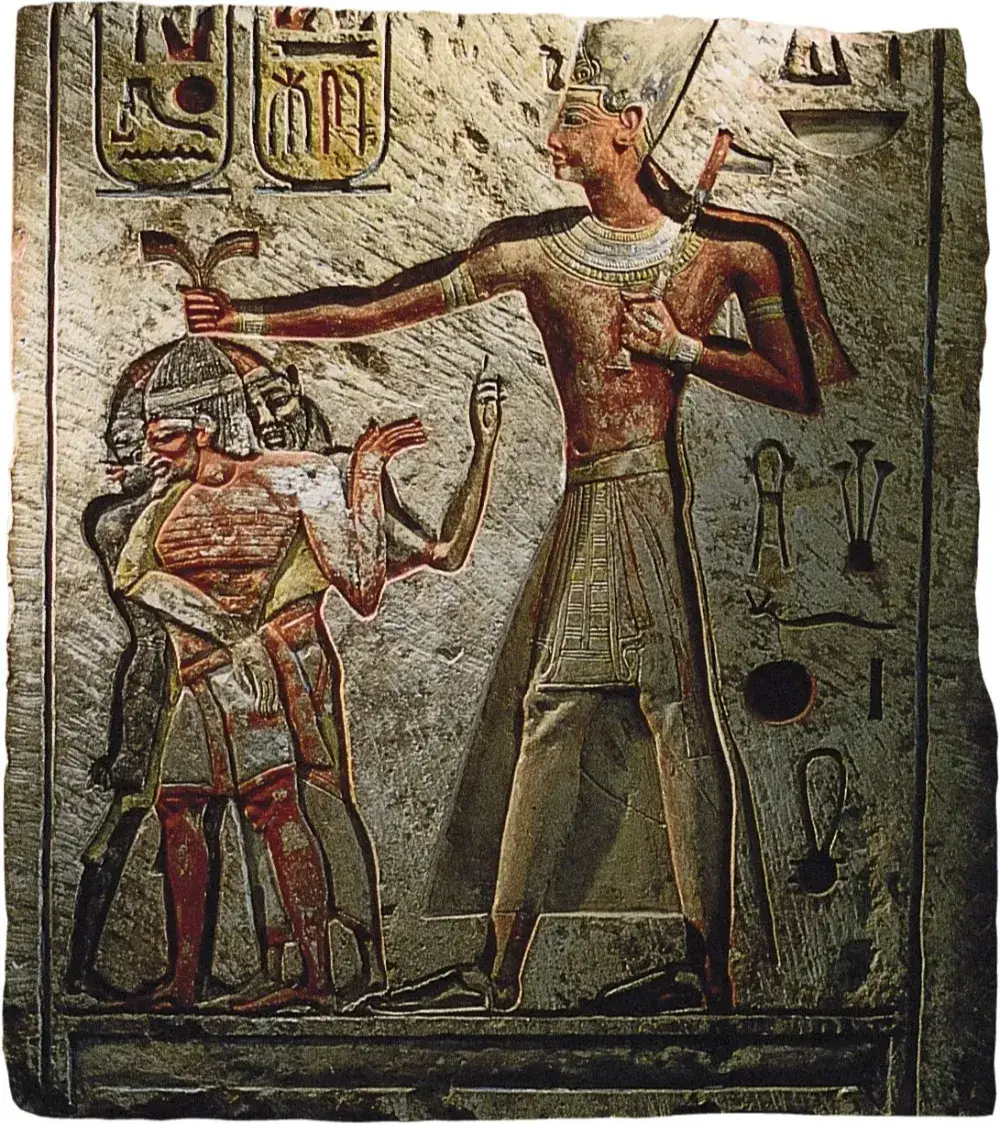
The Torah then recounts the story of Moses, who led the Hebrews out of Egypt and slavery. This event is known as the Exodus. Historians do not know exactly when it occurred, but some believe it to have taken place during the reign of the pharaoh Merneptah, between 1224 and 1211 B.C.E.
An Egyptian monument called the Merneptah Stele, dating to about 1208 B.C.E., provides the earliest known non-biblical reference to a people called Israel living in Canaan.
After what the Hebrews believed were a series of acts by Yahweh on their behalf, including various plagues on the Egyptians and their crops and livestock, Moses led his people out of Egypt.
According to the Old Testament, the Hebrews wandered in the desert of the Sinai Peninsula (which is between Egypt and Canaan) for 40 years. Moses received the Ten Commandments during this time, which outlined some basic laws governing behavior. He also struggled to keep his people from worshiping gods other than Yahweh. Moses died before he could enter Canaan.
Joshua led the Hebrews back into Canaan, where they settled among the Canaanites and the Philistines. The Old Testament describes Joshua leading battles against peoples living in Canaan.
Archaeologists have found evidence that some settlements were destroyed during this general period, although historians disagree about who caused the destruction and how closely the archaeological evidence matches the biblical account. Over time, the Hebrews began to learn the ways of the Canaanites and settled down to a life of farming and herding.
In 722 B.C.E., the northern half of Hebrew lands known as Israel was invaded and mostly destroyed by the Assyrians. The southern half, known as Judea, survived until around 597 B.C.E., when the Babylonians defeated the Judeans and carried most of them back as captives to Babylon.
During and after the Babylonian Exile, Hebrew scribes preserved and recorded important traditions about their people and their relationship with Yahweh.
After 539 B.C.E., the Persians under Cyrus II conquered Babylon. He allowed the Hebrews to return to their holy city of Jerusalem. But, the Hebrews continued to fall under the domination of other empires.
In 70 C.E., the Romans destroyed Jerusalem and the Second Temple. Jewish communities continued to live throughout the Roman Empire and the Middle East, while the Jewish diaspora expanded over the centuries that followed.