The Characteristics of a State
What makes a country a country?
The answer might seem obvious. It has a name, a flag, and maybe a national anthem. But political scientists use a more precise definition. When we talk about "states" when studying government, we don't just mean any place with a government.
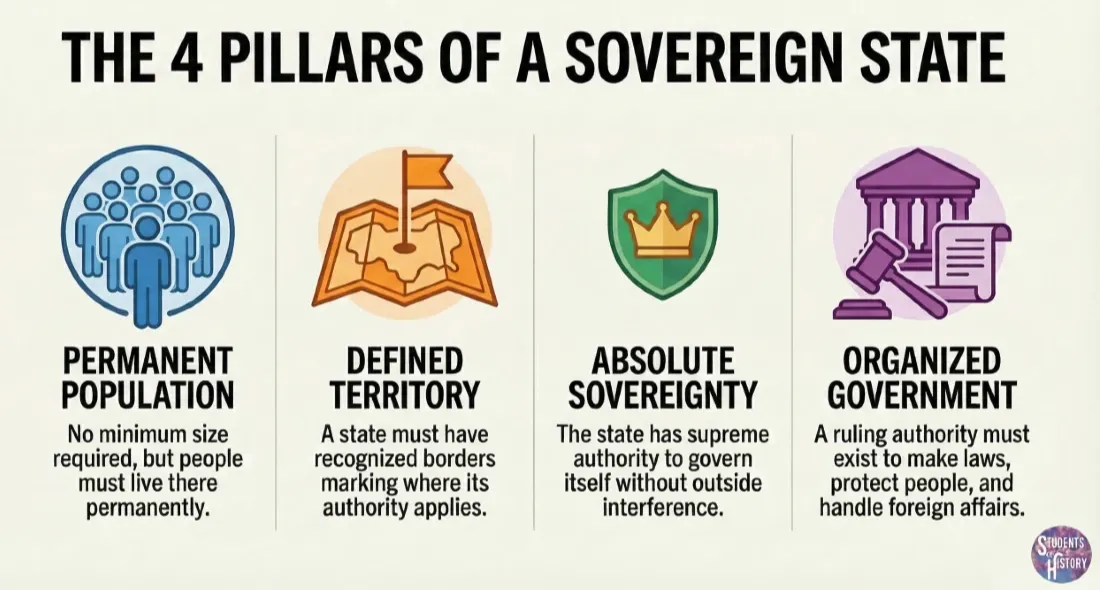
A "state" is a political community that meets four specific criteria: a population, territory, sovereignty, and a government.
These four characteristics help to explain how countries are organized and why some places struggle to get recognized on the global stage.
Population
The first characteristic of a state is population. There has to be people living there. This might seem obvious, but it's an important starting point. A state exists to serve the people within it. So,without a population, there's no reason for a state to exist at all.
There is no minimum number of people required though. The tiny Pacific island nation of Nauru has a population of less than 15,000 people, while India has over 1.4 billion. Both are recognized states. What matters is just that some people are permanently living inside the state's borders.
Territory
A state also needs territory: a defined geographic area with recognized borders. This is the physical space where the government's authority applies. Like with population, territory can vary in size. Russia is the largest country in the world by land area, while Vatican City covers less than half a square mile.
Size doesn't matter about whether a place qualifies as a state. Having clearly defined borders does matter. Disputes over territory are actually one of the leading causes of conflict between countries, which shows just how important this characteristic is.
Sovereignty
Sovereignty is perhaps the most important (and most complex) of the four characteristics.
A sovereign state has supreme authority to govern itself without interference from outside forces. In other words, no other country tells it what to do. The government of a sovereign state makes its own laws, controls its own military, and handles its own affairs.
Sovereignty is what separates a fully independent country from a territory or colony. Puerto Rico, for example, has a population, territory, and a local government, but it is not a sovereign state because it operates under the authority of the United States government. Sovereignty is also why countries take issues like foreign interference in elections so seriously- it is seen as a violation of their right to self-governance.
Government
The fourth characteristic is government: a ruling authority that makes and enforces laws for the population. Without government, there is no organized system to manage the state, protect its people, or represent it in dealings with other countries.
Government can take many forms. Some states are democracies where citizens elect their leaders. Others are ruled by monarchs or authoritarian regimes where power is concentrated in the hands of a single person or group. The type of government matters a great deal to the people living under it, but having some form of organized authority is what counts when defining a state.
Why These Four Characteristics Matter
Together, these four characteristics - population, territory, sovereignty, and government - form the foundation of what political scientists call a state. They are used by international organizations like the United Nations to determine whether a place can be recognized as an independent country. When one of these characteristics is missing or disputed, it can lead to serious political problems.
Consider a region that has a population and territory but no recognized government and no sovereignty. That region may experience instability, conflict, and a lack of basic services. The four characteristics aren't just an academic checklist. They represent the building blocks of a functioning, recognized political community in the modern world.