Jurisdiction of Federal Courts
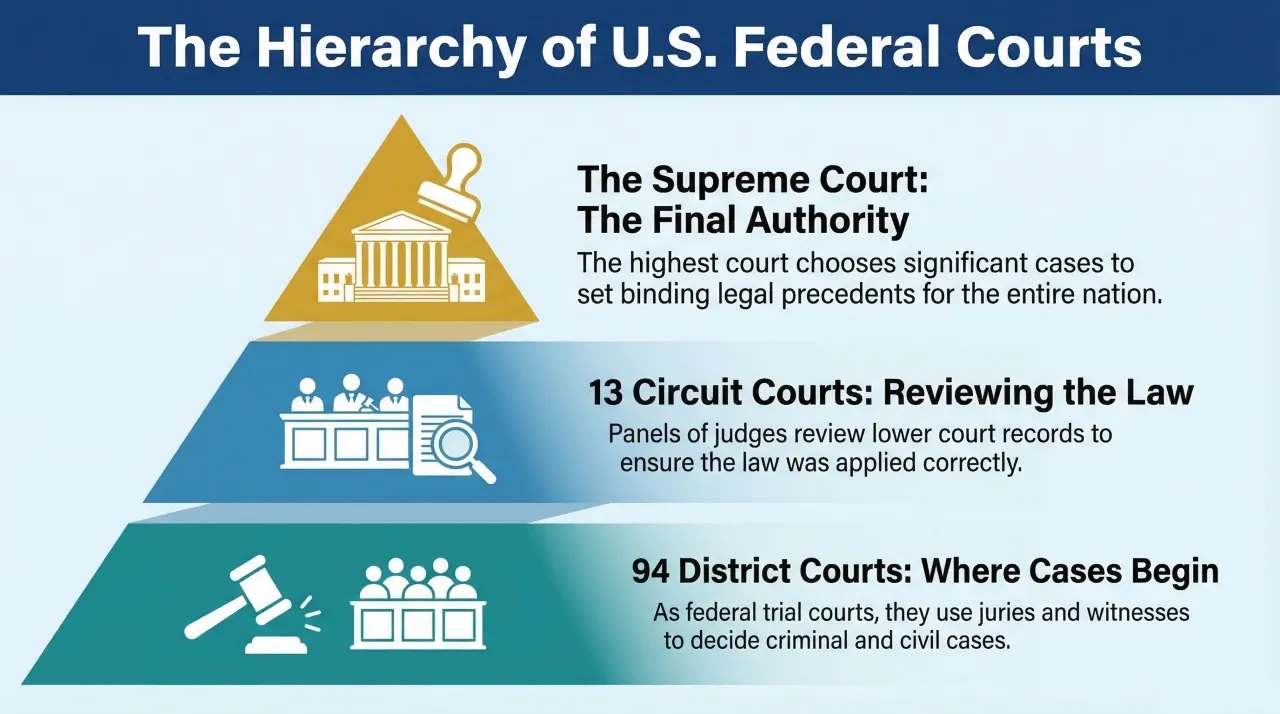
The federal court system is organized into three levels, each with its own role, authority, and jurisdiction.
Together, these three tiers form a hierarchy that handles everything from routine federal crimes to the most significant constitutional questions in American law.
District Courts
At the base of the federal court system are the district courts, the trial courts of the federal system. There are 94 federal judicial districts across the United States, with at least one in every state.
District courts have original jurisdiction over most federal cases, meaning they are where federal cases begin. They hear criminal cases involving violations of federal law, civil cases between citizens of different states involving significant sums of money, cases involving federal agencies, and cases raising constitutional questions.
District court proceedings look like what most people imagine when they think of a courtroom trial. A judge presides, attorneys present evidence and arguments, witnesses testify, and in criminal cases, a jury typically decides the verdict.
District court judges are appointed by the president and confirmed by the Senate, serving lifetime appointments. Each district court also has magistrate judges who handle preliminary matters and less serious cases.
Courts of Appeals
Above the district courts are the United States Courts of Appeals, also known as circuit courts. There are thirteen circuit courts in the federal system, each covering a geographic region of the country except for the Court of Appeals for the Federal Circuit, which handles specialized cases nationwide involving patents, international trade, and claims against the federal government.
Courts of Appeals exercise appellate jurisdiction, reviewing decisions made by district courts within their circuit. They do not hold new trials. Instead, a panel of three judges reviews the lower court record and written arguments from both sides, then issues a ruling on whether the law was correctly applied. Occasionally, especially important cases are heard by the full court rather than a three-judge panel, a process called an en banc hearing.
The circuit courts are enormously influential. Because the Supreme Court accepts so few cases each year, the Courts of Appeals have the final word on the vast majority of federal legal questions. Their rulings set precedent for all district courts within their circuit and carry significant weight even outside it.
The Supreme Court
At the top of the federal system sits the Supreme Court, exercising both original and appellate jurisdiction. As discussed in the previous article, the Supreme Court's original jurisdiction is narrow, covering disputes between states and cases involving foreign diplomats.
Its appellate jurisdiction is broad in theory but highly selective in practice, with the Court choosing to hear only the cases it considers most legally significant.
When the Supreme Court rules on a matter of federal law or constitutional interpretation, that ruling applies nationwide and binds every court in the country. No federal or state court can issue a ruling that conflicts with a Supreme Court decision.
This makes the Supreme Court the final authority on what the law means, a power that gives it unique significance in the American system of government.