Types of Jurisdiction

Before any court can hear a case, it must have jurisdiction over it. Jurisdiction is the legal authority a court has to hear and decide a particular type of case.
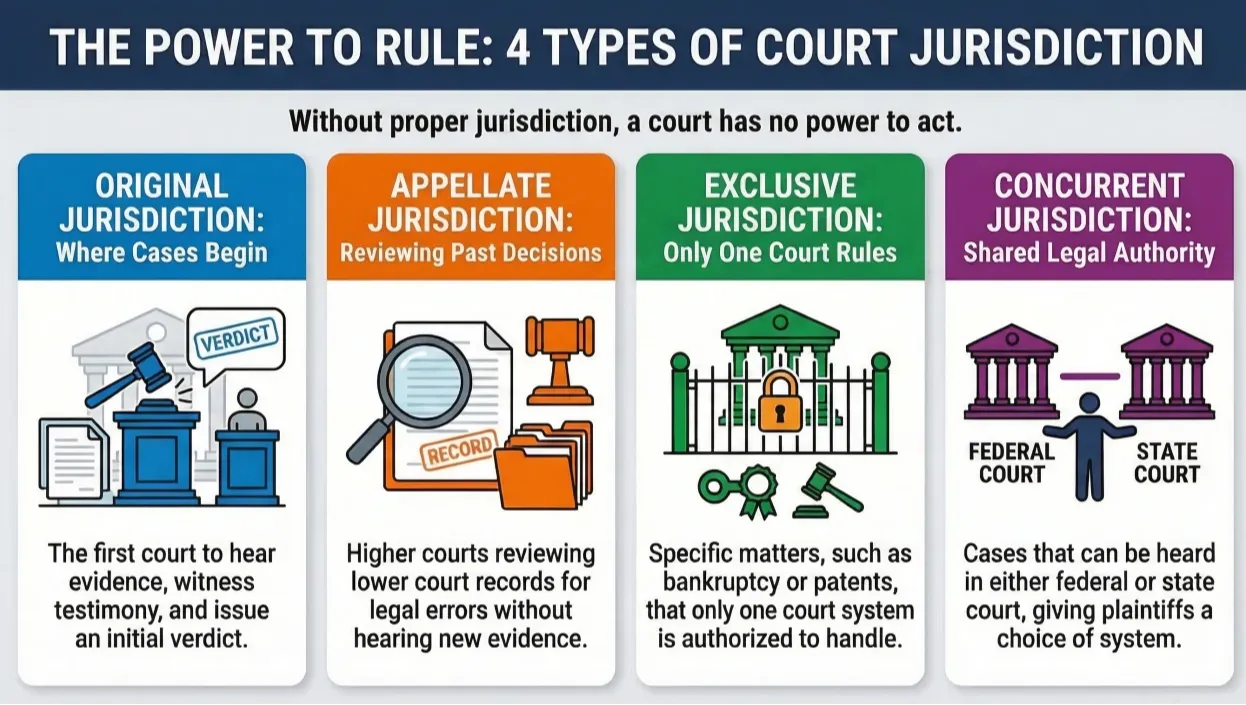
Without proper jurisdiction, a court has no power to act, and any ruling it issues would be invalid. The American court system divides jurisdiction into several categories, each defining a different aspect of a court's authority.
Original Jurisdiction
A court exercising original jurisdiction is the first court to hear a case. It is where the case begins, where evidence is presented, witnesses testify, and the initial verdict or ruling is made. Most cases start in trial courts, which exercise original jurisdiction.
In the federal system, district courts handle the vast majority of cases at the original jurisdiction level. The Supreme Court has original jurisdiction in a narrow category of cases, primarily those involving disputes between states or cases involving foreign ambassadors and diplomats.
Appellate Jurisdiction
Appellate jurisdiction is the authority to review decisions made by lower courts. A court exercising appellate jurisdiction does not hold a new trial or hear new evidence. Instead, it reviews the record of what happened in the lower court and determines whether legal errors were made. The losing party in a trial can appeal the decision to a higher court, asking it to review and potentially reverse the lower court's ruling.
Courts of appeals and the Supreme Court primarily exercise appellate jurisdiction, reviewing cases that have already been decided at a lower level.
Exclusive Jurisdiction
Some courts have exclusive jurisdiction over certain types of cases, meaning only that court can hear those particular matters. Federal courts have exclusive jurisdiction over cases involving federal crimes, bankruptcy, patents, copyrights, and cases involving foreign diplomats.
State courts cannot hear these cases. This exclusivity ensures that certain specialized or nationally significant matters are handled consistently by courts with the appropriate expertise and authority.
Concurrent Jurisdiction
Concurrent jurisdiction exists when more than one court has the authority to hear the same type of case. Many civil cases involving questions of both federal and state law can be heard in either federal or state court.
When concurrent jurisdiction exists, the party bringing the case typically has some choice in which court system to use. This flexibility can be strategically significant, as different courts may have different rules, tendencies, and track records on particular types of cases.
Why Jurisdiction Matters
Jurisdiction is not just a technicality. It is the foundation of an orderly court system. Without clear rules about which courts can hear which cases, the judicial system would quickly become chaotic, with conflicting rulings from courts at every level.
The careful division of jurisdiction between federal and state courts, between trial and appellate courts, and between courts of general and specialized authority reflects the same principle of divided power that runs throughout the American system of government.