The Supreme Court
Of the three branches of the federal government, the judicial branch is the least understood by most Americans. It holds no elections, commands no army, and controls no budget. Yet its power to interpret the Constitution makes it one of the most consequential institutions in the country.
At the top of the judicial branch sits the Supreme Court of the United States. It is the highest court in the nation and the final word on what the Constitution means.
Structure and Composition
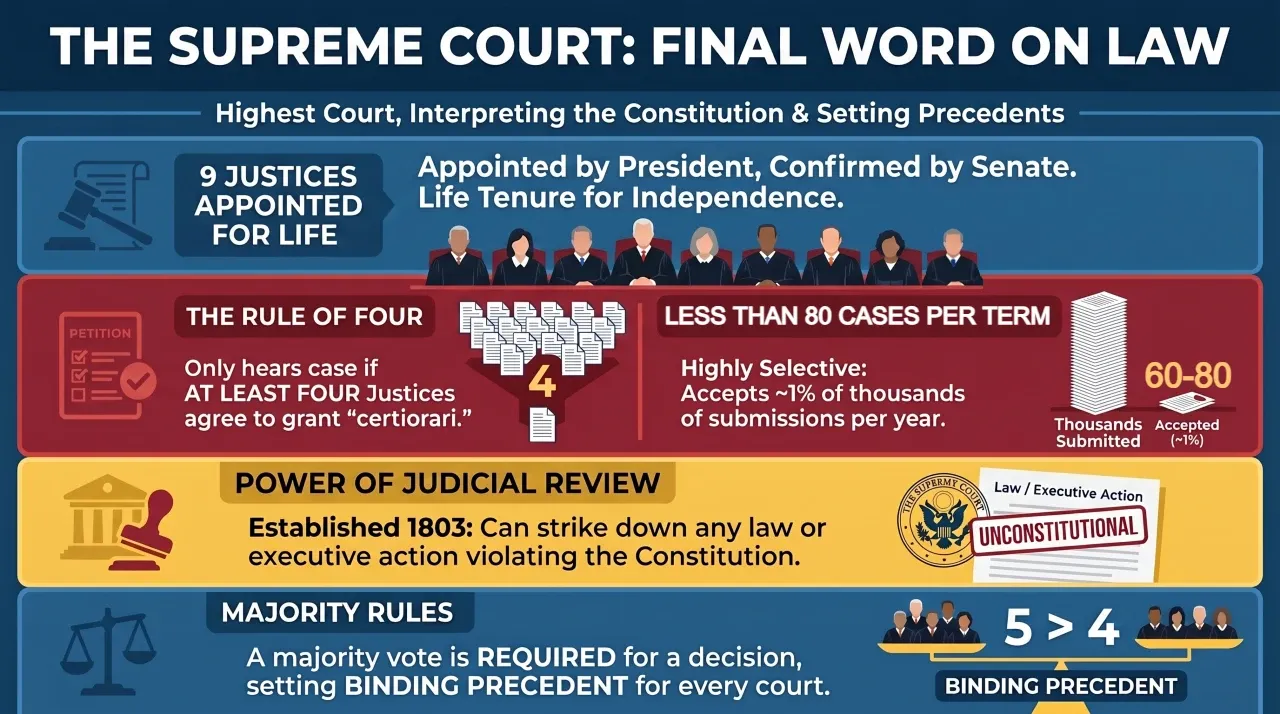
The Supreme Court is made up of nine justices: one Chief Justice and eight Associate Justices. The number nine is not written into the Constitution. Congress has the authority to set the size of the Court, and it has changed several times throughout history. The Court has had as few as six justices and as many as ten. Nine has been the standard since 1869.
The Chief Justice is a separate position on the Court. Like the Associate Justices, the Chief Justice is nominated by the president and confirmed by the Senate. The Chief Justice presides over oral arguments, leads the justices' private conferences, and, when in the majority, assigns who writes the Court's majority opinion. The Chief Justice also presides over Senate impeachment trials of a sitting president.
Appointment and Tenure
Supreme Court justices are all nominated by the president and must be confirmed by a majority vote of the Senate. The Constitution sets no requirements for the job. There is no age minimum, no law degree required, and no citizenship requirement written into the document, though in practice all justices have been lawyers and citizens.
Once confirmed, justices serve during "good behavior," which in practice means for life. They can only be removed through impeachment by the House and conviction by the Senate. The founders believed that protecting judges from elections and political pressure would allow them to make decisions based on law rather than public opinion.
Because appointments are lifetime positions, vacancies on the Court are rare and politically significant. A single appointment can shape the direction of constitutional law for decades.
How Cases Reach the Court
The Supreme Court has two types of jurisdiction. Original jurisdiction refers to cases the Court hears first, without going through lower courts. This is rare and typically involves disputes between states or cases involving foreign diplomats. Most of the Court's work falls under appellate jurisdiction, meaning it is reviewing decisions made by lower courts.
The Court receives thousands of petitions each year from parties asking it to review their case. These petitions are called writs of certiorari. The justices review them and vote on whether to accept each one. If four or more justices agree to hear a case, the Court grants certiorari. This is known as the Rule of Four. The Court typically accepts only about 60 to 80 cases per term out of the thousands submitted.
The Court tends to take cases that involve significant constitutional questions, conflicts between federal circuit courts, or issues of national importance that need a definitive ruling.
How the Court Decides Cases
Once the Court accepts a case, both sides submit written arguments called briefs. The justices then hear oral arguments, in which lawyers for each side have about 30 minutes to present their case and answer questions from the justices.
After oral arguments, the justices meet privately to discuss the case and take a preliminary vote. A decision requires a majority of the participating justices. The most senior justice in the majority assigns the task of writing the majority opinion. Other justices may write concurring opinions if they agree with the outcome but for different reasons, or dissenting opinions if they disagree. These opinions become part of the legal record and can be influential in shaping future cases.
The Court's Role and Power
The Supreme Court's most significant power is judicial review. This is the authority to strike down laws that violate the Constitution. This power, established in the landmark 1803 case of Marbury v. Madison, makes the Court the final arbiter of what the Constitution means. Whether a law passed by Congress, an action taken by the president, or a statute enacted by a state government conflicts with the Constitution is ultimately for the Supreme Court to decide.
This makes the Court's role fundamentally different from the other two branches. Congress passes laws. The president enforces them. The Court interprets them and has the authority to invalidate them.
The Court's decisions carry enormous weight. A ruling on voting rights, free speech, religious liberty, or the limits of government power does not just resolve the case at hand. It sets a precedent that guides courts across the country and shapes American law for generations.
That combination of independence, life tenure, and the power to interpret the nation's founding document gives the Supreme Court a unique and enduring place in American democracy.