Deciding Supreme Court Cases

When the Supreme Court agrees to hear a case, it sets in motion a careful, structured process for reaching a decision. The process is designed to ensure that all sides are heard, that the justices have complete information, and that decisions are thoroughly reasoned and clearly explained.
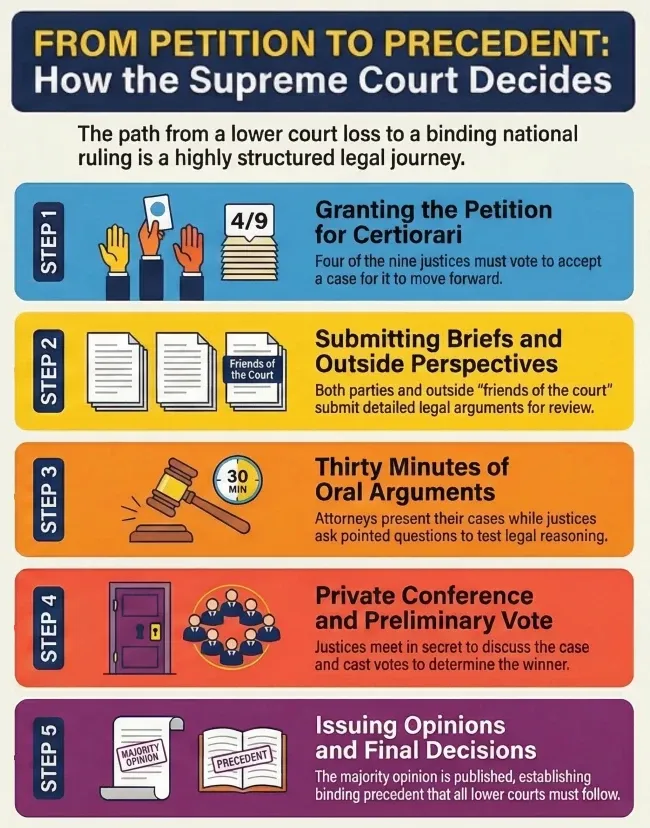
From the initial request for a hearing to the final published opinion, deciding a Supreme Court case involves six key steps.
Step 1: Petition for Certiorari
The process begins when a losing party in a lower court asks the Supreme Court to review their case by filing a petition for a writ of certiorari. This petition explains why the case raises important legal questions worthy of the Court's attention.
The opposing party can file a response arguing that the Court should decline to hear it. The justices review these petitions during their private conferences and vote on whether to accept the case. If at least four justices agree to hear it, the Court grants certiorari and the case moves forward.
Step 2: Briefs
Once the Court agrees to hear a case, both sides prepare written arguments called briefs. A brief is a detailed legal document that lays out a party's arguments, cites relevant laws and precedents, and explains why the Court should rule in their favor. Briefs can be lengthy and highly technical, drawing on constitutional text, previous court decisions, historical evidence, and legal theory.
In addition to the briefs filed by the two parties directly involved, outside groups with an interest in the outcome can file what are called amicus curiae briefs, Latin for "friend of the court."
These briefs allow outside organizations, other governments, or legal experts to provide additional perspectives and information the Court might find useful. Major Supreme Court cases often attract dozens of amicus briefs from a wide range of interested parties.
Step 3: Oral Arguments
After the briefs have been submitted, the Court holds oral arguments, one of the most distinctive features of Supreme Court proceedings. Each side is typically given 30 minutes to present their argument before the full Court. Attorneys rarely get to speak uninterrupted.
The justices ask pointed, sometimes challenging questions throughout the argument, probing the limits of each side's position and testing how their reasoning holds up.
Oral arguments are open to the public and are now made available as audio recordings shortly after they occur. They offer a rare window into how the justices are thinking about a case, though experienced Court watchers caution that the questions justices ask do not always predict how they will ultimately vote.
Step 4: The Conference
After oral arguments, the justices meet in private conference to discuss the case and take a preliminary vote. No one outside the nine justices is present. The Chief Justice speaks first, followed by the other justices in order of seniority. After discussion, the justices vote, and the side with five or more votes wins. If the Chief Justice is in the majority, they assign who will write the majority opinion. If the Chief Justice is in the minority, the most senior justice in the majority makes that assignment.
Step 5: Writing Opinions
The assigned justice drafts the majority opinion, a written explanation of the Court's decision and the legal reasoning behind it. This is one of the most important steps in the process. The majority opinion does not just announce a winner. It explains the legal principles the Court applied, interprets the relevant constitutional provisions or statutes, and establishes precedent that lower courts must follow in future cases.
Other justices may write separately. A concurring opinion agrees with the majority's outcome but offers different or additional reasoning. A dissenting opinion argues that the majority reached the wrong conclusion. Dissents have no immediate legal effect, but they can be influential over time. A well-reasoned dissent sometimes becomes the foundation for a future majority opinion when the Court revisits an issue years later.
Step 6: The Decision
Once the majority opinion is finalized and other justices have completed their concurrences and dissents, the decision is announced. Opinions are typically released on designated opinion days during the Court's term, with the most significant decisions often coming in the final weeks of June.
The ruling is published and immediately becomes the law of the land, binding on all lower courts. The decision also becomes part of the permanent legal record, cited in future cases and legal arguments for years or decades to come.