Judicial Activism and Restraint
One of the ongoing debates in American law and politics is about how judges should interpret the Constitution and exercise their power. Should courts take an active role in shaping public policy when they believe the Constitution requires it? Or should they defer to elected lawmakers and avoid straying beyond the clearest boundaries of the law?
These competing philosophies are known as judicial activism and judicial restraint, and the tension between them runs through some of the most significant legal debates in American history.
Judicial Activism
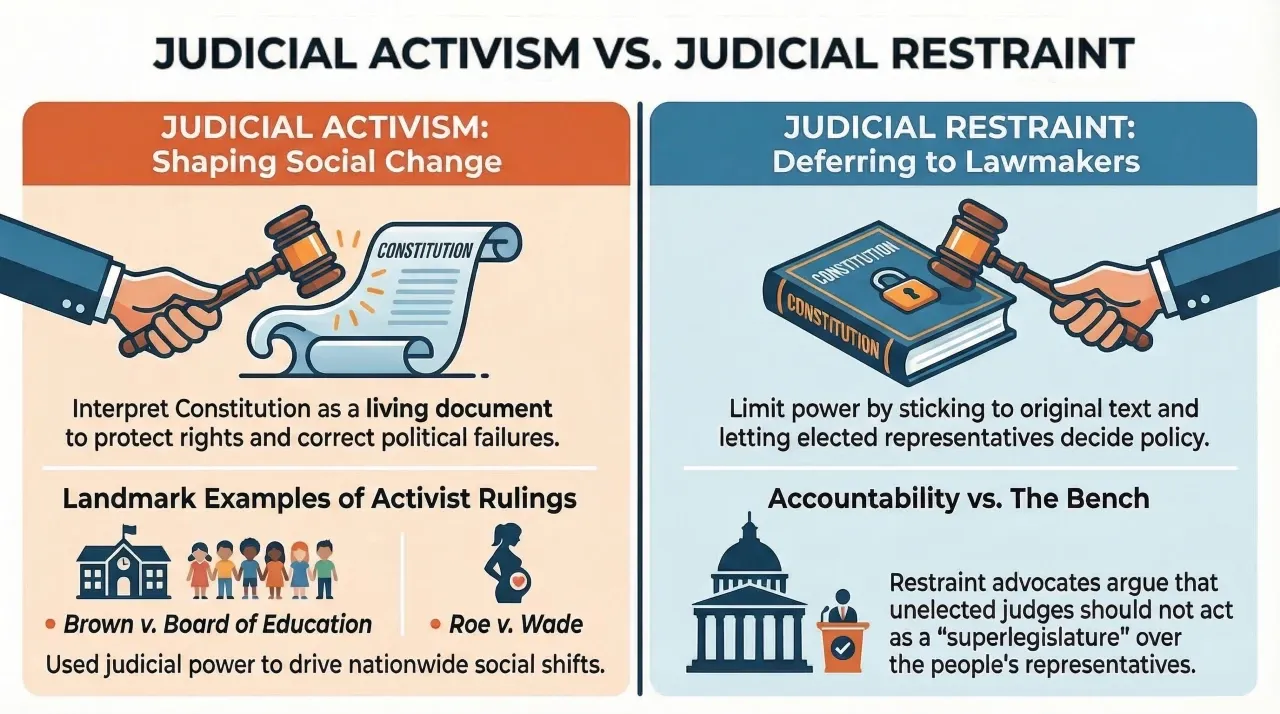
Judicial activism refers to a philosophy of judging in which courts are willing to go beyond a narrow reading of the constitutional text to strike down laws, overturn precedents, and issue rulings that bring about significant social or political change.
Activist judges tend to view the Constitution as a living document whose broad principles must be interpreted in light of changing times and circumstances. They are more willing to find constitutional protections for rights not explicitly listed in the text and to intervene when they believe government action has violated those rights.
Supporters of judicial activism argue that the courts have a responsibility to protect individual rights and correct injustices that the political process has failed to address.
The most celebrated example of judicial activism in American history is the Supreme Court's 1954 decision in Brown v. Board of Education, which struck down racial segregation in public schools. At the time, many state legislatures had no intention of ending segregation on their own. The Court's willingness to act in that moment led to a positive shift toward greater equality in American society.
Other landmark decisions associated with a more activist approach include Roe v. Wade (1973), which established a constitutional right to abortion, and Obergefell v. Hodges (2015), which recognized a constitutional right to same-sex marriage. In each case, the Court extended constitutional protections into areas not explicitly addressed by the text, acting in ways that reshaped public policy nationwide.
Judicial Restraint
Judicial restraint is the opposing philosophy. Judges who favor restraint believe courts should limit themselves to applying the law as written and avoid substituting their own judgment for that of elected legislators.
They tend to interpret the Constitution narrowly, sticking closely to the text and the original intentions of its authors. When the law is ambiguous, judges favoring restraint typically give deference to the elected branches rather than imposing their own interpretation.
Supporters of judicial restraint argue that in a democracy, major policy decisions should be made by elected representatives who are accountable to voters, not by unelected judges serving lifetime appointments. When courts venture too far into policy-making, the argument goes, they undermine democratic self-government and risk making decisions based on the personal preferences of a handful of judges rather than on the law itself.
A classic statement of judicial restraint came from Justice Oliver Wendell Holmes, who argued that the Court's job was to apply the law, not to act as a superlegislature imposing its own values on the country.
More recently, justices who favor an originalist approach to constitutional interpretation, meaning they try to understand what the Constitution's text meant at the time it was written, tend to align with the philosophy of restraint.
The Reality
In practice, the line between activism and restraint is often blurry. Critics point out that the labels are sometimes used politically rather than analytically.
A judge who strikes down a law they consider unconstitutional may be called an activist by those who supported the law and a principled defender of the Constitution by those who opposed it. Both liberal and conservative judges have been accused of activism when their rulings produced outcomes the other side disliked.
What the debate really reflects is a deeper question about the role of courts in a democratic society: when should unelected judges have the power to override the decisions of elected representatives, and when should they step back and let the political process work? That question has no simple answer, which is why the debate between activism and restraint has continued for as long as American courts have existed.