Civil Liberties Vs. Civil Rights
The terms civil liberties and civil rights are sometimes used interchangeably, but they mean different things in American law and political thought.
While both deal with protecting individuals from unfair treatment, they address different kinds of problems and draw on different parts of the Constitution.
Civil Liberties
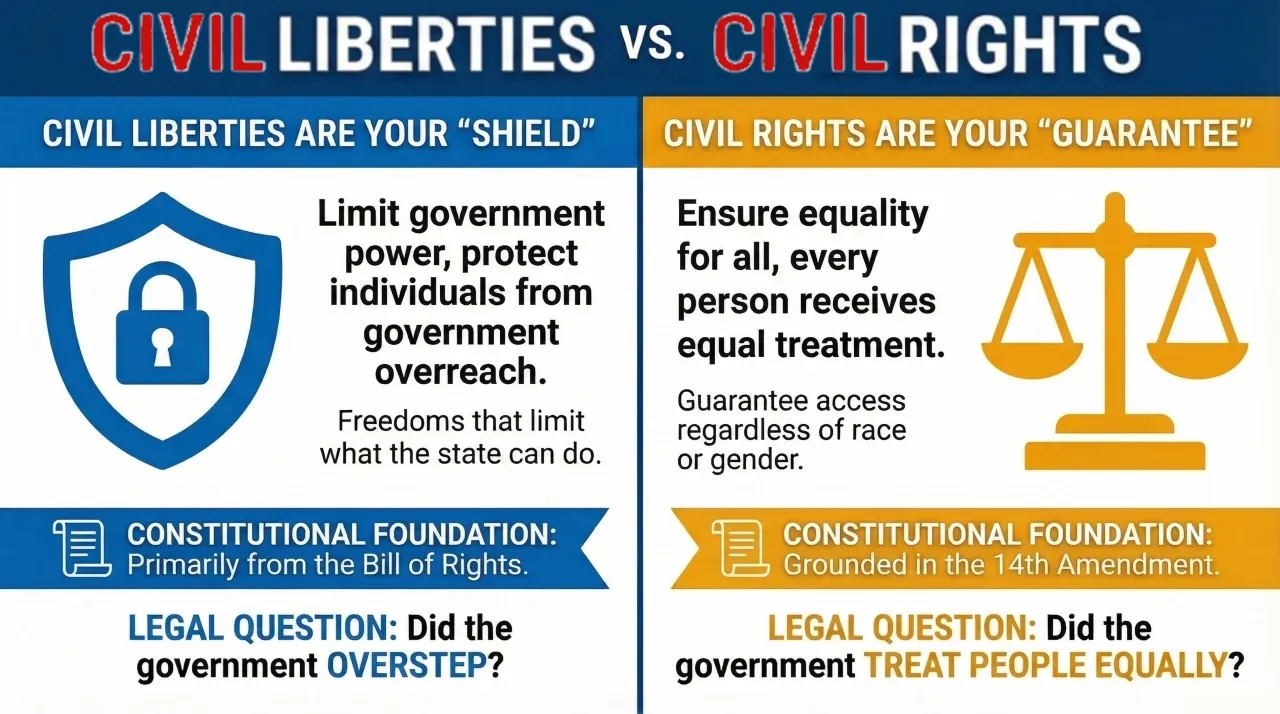
Civil liberties are protections from government overreach. They are the freedoms the government cannot take away from you.
The Bill of Rights is the primary source of civil liberties in the United States. It lists specific things the government is prohibited from doing. The government cannot silence your speech. It cannot establish an official religion. It cannot search your home without a warrant. It cannot imprison you without due process of law.
Think of civil liberties as a shield. They protect individuals from the power of the government by placing firm limits on what the government is allowed to do. These protections apply to everyone, regardless of who they are, because the concern is not about any particular group but about the relationship between the individual and the state.
Civil Rights
Civil rights are protections that guarantee equal treatment under the law.
Where civil liberties protect everyone from government overreach, civil rights focus specifically on ensuring that no person or group is discriminated against or treated unequally because of characteristics like race, gender, religion, or national origin.
Civil rights are grounded primarily in the Fourteenth Amendment's guarantee of equal protection under the law, as well as in landmark legislation like the Civil Rights Act of 1964.
Think of civil rights as a guarantee of equal access. They ensure that every person has the same rights and opportunities as everyone else, regardless of who they are. The civil rights movement of the mid-twentieth century was fundamentally a fight to make the promises of the Constitution real for Black Americans and other groups who had long been excluded from full participation in American society.
Where They Overlap
In practice, civil liberties and civil rights often intersect. A law that bans a particular religious group from owning property, for example, would violate both civil liberties (freedom of religion) and civil rights (equal protection).
Many landmark Supreme Court cases involve both concepts simultaneously. Brown v. Board of Education was a civil rights case about equal treatment, but it also touched on civil liberties by addressing the government's power to impose racial separation on individuals.
Why the Distinction Matters
The difference matters because the two concepts call for different legal analysis and different remedies.
A civil liberties claim asks whether the government has overstepped its authority. A civil rights claim asks whether the government has treated people equally.
Both are essential to a just and free society, and both continue to generate significant legal and political debate.