Civil Liberties & Rights for Women

The history of women's rights in the United States is a long struggle to close the gap between the founding ideals of equality and the reality of women's lives under the law.
From the earliest days of the republic, women were systematically excluded from political and legal rights that men took for granted. The path toward equality has been slow, contested, and driven by generations of determined activists, lawyers, and legislators.
The Early Exclusion
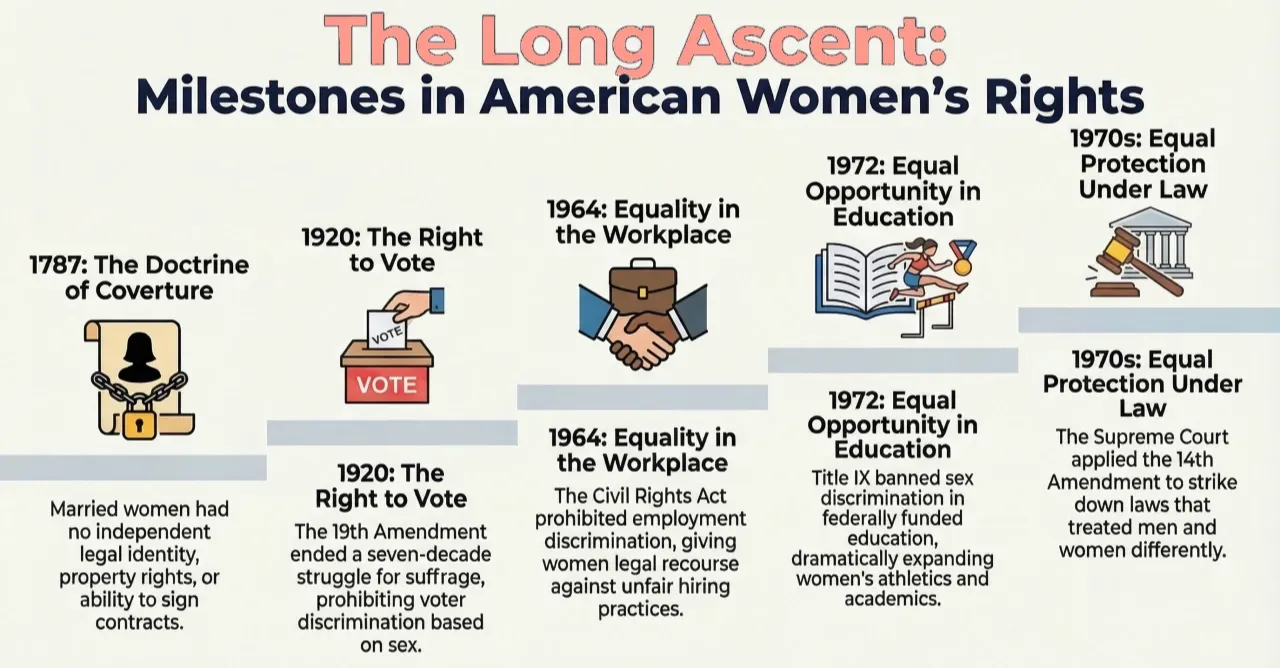
When the Constitution was written in 1787, women had virtually no political rights. They could not vote, could not hold public office, and in most states had severely limited legal rights in areas like property ownership and contract law. Married women in particular had almost no independent legal standing.
Under the legal doctrine of coverture inherited from English law, a married woman's legal identity was essentially absorbed into her husband's. She could not own property, sign contracts, or sue in court in her own name.
These restrictions were rarely questioned in the early republic. The prevailing view held that women's proper sphere was the home, and that political and economic life were naturally the domain of men. It would take more than a century of organized activism to overturn these assumptions in law.
The Suffrage Movement
The organized movement for women's rights in America is often traced to the Seneca Falls Convention of 1848, held in upstate New York. There, a group of activists led by Elizabeth Cady Stanton and Lucretia Mott issued the Declaration of Sentiments, a document modeled on the Declaration of Independence that declared all men and women are created equal and demanded a range of legal reforms, including the right to vote.
The fight for women's suffrage, the right to vote, took more than seven decades. It was won only with the ratification of the Nineteenth Amendment in 1920, which prohibited denying the right to vote on the basis of sex.
The amendment was a landmark achievement, but it did not end discrimination against women in other areas of law and public life.
The Civil Rights Era and Beyond
The modern women's rights movement gained momentum in the 1960s alongside the broader civil rights movement.
The Civil Rights Act of 1964, primarily aimed at racial discrimination, also prohibited employment discrimination on the basis of sex. This gave women a powerful legal tool to challenge workplace discrimination.
In the 1970s, the Supreme Court began applying the Equal Protection Clause of the Fourteenth Amendment to strike down laws that discriminated on the basis of gender.
Justice Ruth Bader Ginsburg, then a lawyer, argued several landmark cases before the Court that established the principle that sex-based discrimination requires strong legal justification. Her work helped dismantle a wide range of laws that treated men and women differently under the law.
Title IX, passed in 1972, prohibited sex discrimination in any educational program receiving federal funding. Its most visible effect has been the dramatic expansion of women's athletic programs in schools and universities, but its reach extends to all aspects of educational opportunity.
Where Things Stand
Women have made enormous strides in education, the workforce, and political representation since the early days of the republic. They now earn the majority of college and advanced degrees, hold a growing share of elected offices, and are represented at the highest levels of business and government.
At the same time, debates continue about issues like equal pay, workplace harassment, reproductive rights, and the persistence of gender-based discrimination in various forms. The legal framework for women's equality is far stronger than it was a century ago, but the work of making equality real in practice continues.