First Amendment Freedoms in Practice
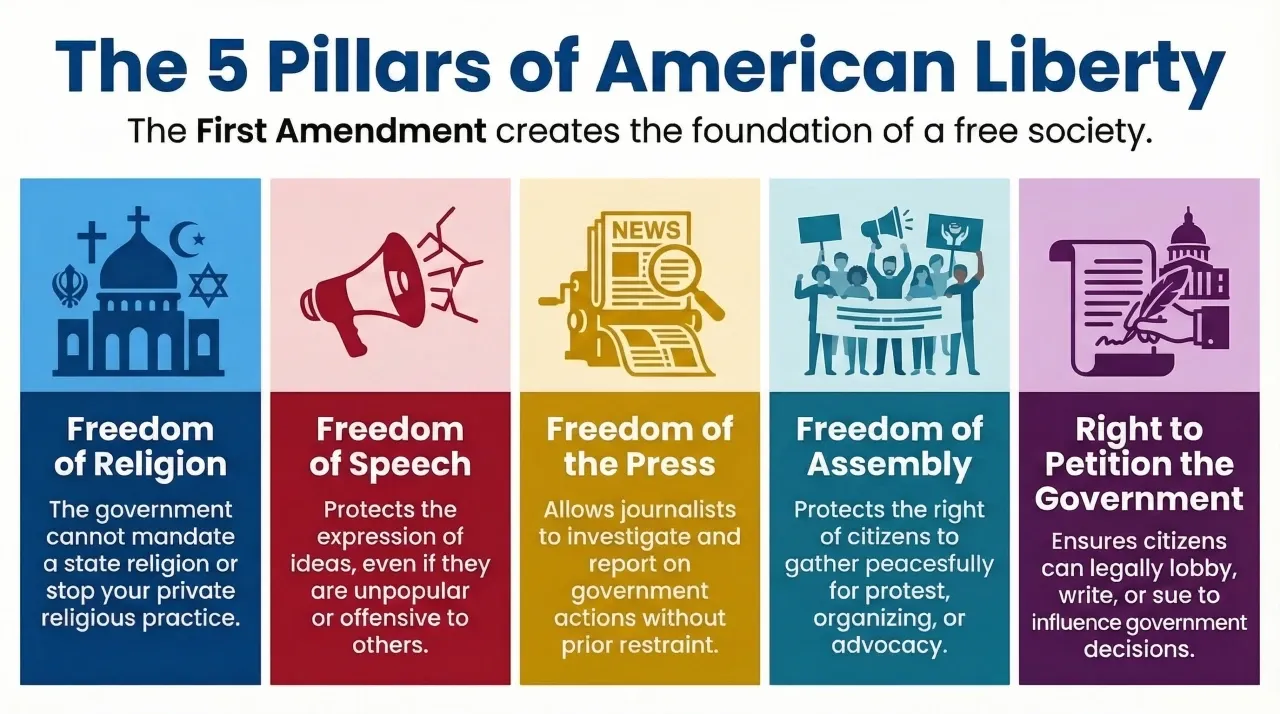
The First Amendment packs an enormous amount of constitutional protection into a single sentence. It protects freedom of religion, freedom of speech, freedom of the press, freedom of assembly, and the right to petition the government.
Together, these five freedoms form the foundation of American democracy. But none of them are absolute. In the real world, First Amendment freedoms regularly come into conflict with other values, and the courts have spent more than two centuries working out where the boundaries lie.
Freedom of Religion
The First Amendment addresses religion in two distinct clauses. The Establishment Clause prohibits the government from establishing an official religion or favoring one religion over another. The Free Exercise Clause prohibits the government from preventing people from practicing their religion.
Together, these clauses create a separation between government and religion that has been at the center of countless legal disputes.
Courts have ruled that public schools cannot sponsor official prayers or Bible readings, since these would amount to government endorsement of religion. At the same time, students have the right to pray privately and form voluntary religious clubs. The government cannot ban a religious practice simply because it disapproves of it, though it can enforce neutral laws that happen to affect religious behavior if there is a compelling enough reason.
Freedom of Speech
Freedom of speech is perhaps the most celebrated First Amendment right, but it has never been unlimited. The Supreme Court has identified several categories of speech that fall outside First Amendment protection.
True threats, incitement to imminent lawless action, and defamation are not protected. Neither is obscenity or so-called "fighting words" likely to provoke an immediate violent response.
Within those boundaries, however, the protection for speech is very broad. The government generally cannot punish speech simply because the ideas expressed are offensive, unpopular, or even deeply troubling to most people.
The Court has ruled repeatedly that the remedy for bad speech in a democracy is more speech, not enforced silence. This principle has protected everything from political dissent to controversial art to inflammatory rhetoric that most Americans find objectionable.
Freedom of the Press
A free press is essential to democratic accountability. The First Amendment provides strong protection for journalists to investigate, report, and publish information about public affairs, including information that government officials would prefer to keep quiet.
The landmark 1971 Pentagon Papers case established that the government faces an extremely high bar when it tries to prevent publication of information in advance, a restriction known as prior restraint. The Court ruled that even classified government documents related to the Vietnam War could be published, because the government had not met the heavy burden required to justify prior restraint.
Freedom of Assembly and Petition
The First Amendment also protects the right of people to gather peacefully and to ask the government to address their concerns. These rights are the foundation of political organizing, protest, and advocacy.
The government can impose reasonable restrictions on the time, place, and manner of public gatherings, requiring permits for large demonstrations or limiting protests to certain areas. But it cannot ban peaceful assembly simply because it disagrees with the message or fears the gathering will be controversial.
The right to petition covers everything from writing a letter to a congressperson to filing a lawsuit to organizing a lobbying campaign. It ensures that citizens always have a legal avenue to try to influence their government, regardless of whether those in power want to hear what they have to say.
Recent rulings have introduced new complexities for organizers, however. In 2026, some courts allowed lawsuits to proceed against protest leaders for the illegal actions of third-party attendees. This marks a significant shift in how assembly liability is balanced with individual rights.
Balancing Rights
What makes First Amendment law so complex and endlessly debated is that these freedoms do not exist in isolation. Free speech can conflict with national security, personal privacy, or protection from harassment. Religious freedom can conflict with anti-discrimination laws.
A free press can conflict with a defendant's right to a fair trial. The courts navigate these tensions case by case, and reasonable people often disagree strongly about where the balance should be struck.
That ongoing disagreement is itself a sign of a healthy democracy grappling seriously with the meaning of freedom.