The Rights of the Accused

The American legal system operates on a foundational principle: a person is innocent until proven guilty. This principle is not just a cultural attitude. It is built into the Constitution through a series of specific protections for people accused of crimes.
These rights were included in the Bill of Rights because the founders had experienced firsthand the abuses that governments could commit against individuals in the name of law and order.
The protections they wrote into the Constitution were designed to ensure that the government must follow fair and rigorous procedures before it can punish anyone.
The Fourth Amendment: Protection from Unreasonable Searches
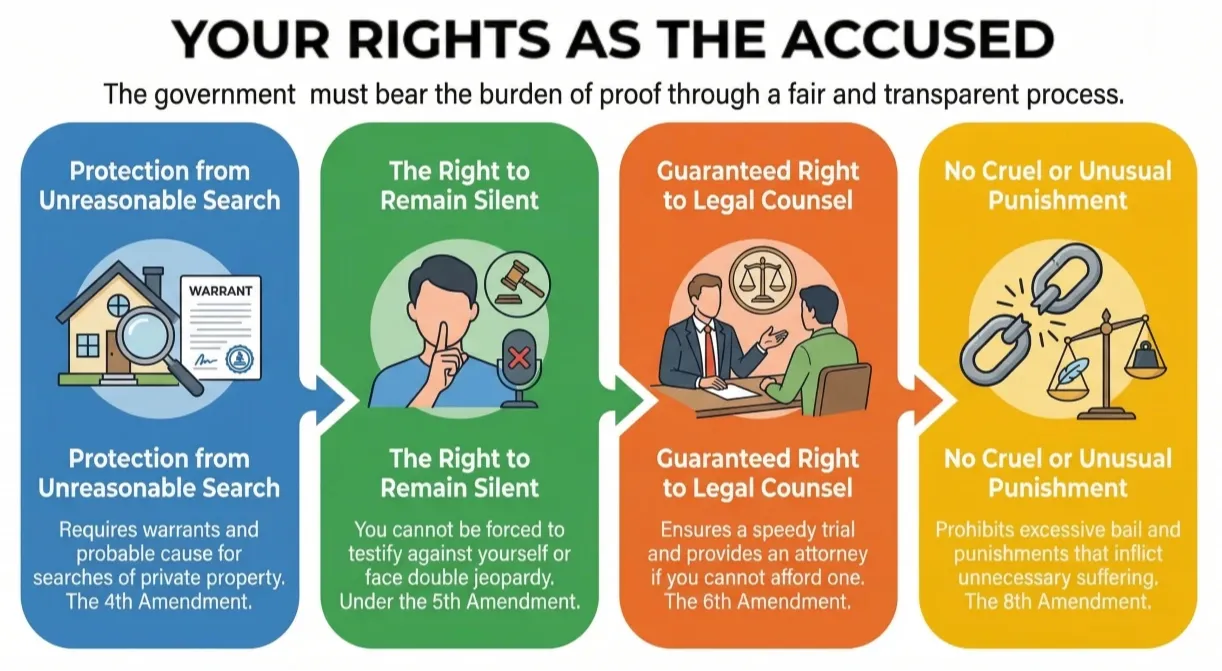
The Fourth Amendment protects people from unreasonable searches and seizures by the government. Law enforcement generally cannot search a person's home, car, or belongings without a warrant issued by a judge.
To obtain a warrant, police must demonstrate probable cause, meaning they must have a reasonable basis to believe that evidence of a crime will be found.
There are exceptions to the warrant requirement. Police can search without a warrant if a person consents, if evidence is in plain view, or in certain emergency situations. But the basic principle is clear: the government cannot simply intrude into a person's private space without legal justification.
Evidence obtained through an unlawful search can be thrown out of court under a legal doctrine called the exclusionary rule, established in Mapp v. Ohio (1961).
The Fifth Amendment: Due Process and Self-Incrimination
The Fifth Amendment contains several important protections for the accused. It guarantees due process of law, meaning the government must follow fair procedures before depriving a person of life, liberty, or property.
It protects against double jeopardy, meaning a person cannot be tried twice for the same crime after being acquitted. And it protects against self-incrimination, meaning no one can be forced to testify against themselves in a criminal case.
The protection against self-incrimination is the basis for the Miranda warning, required after the Supreme Court's 1966 decision in Miranda v. Arizona. Before interrogating a suspect in custody, police must inform them of their right to remain silent, that anything they say can be used against them in court, and that they have the right to an attorney.
The Sixth Amendment: The Right to a Fair Trial
The Sixth Amendment guarantees several rights that together define what a fair criminal trial looks like. The accused has the right to a speedy and public trial, preventing the government from holding people indefinitely without bringing them to court.
They have the right to an impartial jury of their peers. They have the right to be informed of the charges against them, to confront and cross-examine witnesses, and to compel witnesses to testify on their behalf.
Perhaps most significantly, the Sixth Amendment guarantees the right to legal counsel. In Gideon v. Wainwright (1963), the Supreme Court ruled that this right means the government must provide an attorney to any defendant who cannot afford one in a serious criminal case.
This decision recognized that the right to a fair trial is meaningless if a person must face the resources of the government without any legal help.
The Eighth Amendment: Protection from Cruel Punishment
The Eighth Amendment prohibits excessive bail, excessive fines, and cruel and unusual punishment. Bail is the money a defendant pays to be released from jail while awaiting trial, with the promise that they will appear in court.
Setting bail so high that no one could possibly pay it would effectively imprison people before they have been convicted of anything, which the Eighth Amendment prohibits.
The prohibition on cruel and unusual punishment has been applied most significantly to the death penalty. The Supreme Court has ruled that the death penalty cannot be applied to certain categories of defendants, including those who were under 18 at the time of their crime. It has also ruled that certain methods of execution may violate the Eighth Amendment if they inflict unnecessary suffering.
A System Built on Fairness
These rights exist not to make it easy for criminals to escape justice, but to ensure that the government bears the burden of proving guilt through a fair process.
A system that shortcuts these protections in the name of efficiency or public safety is a system that will inevitably convict innocent people and abuse the power it holds over citizens. The rights of the accused are, in this sense, rights that protect everyone.