Equal Protection Under the Law

The promise of equal protection under the law is one of the most powerful ideas in the American constitutional tradition. It holds that the government must treat all people equally and cannot discriminate against individuals or groups without sufficient legal justification.
Though this principle was written into the Constitution after the Civil War, its full meaning has been worked out gradually through more than a century of court decisions, legislation, and social struggle.
The Fourteenth Amendment
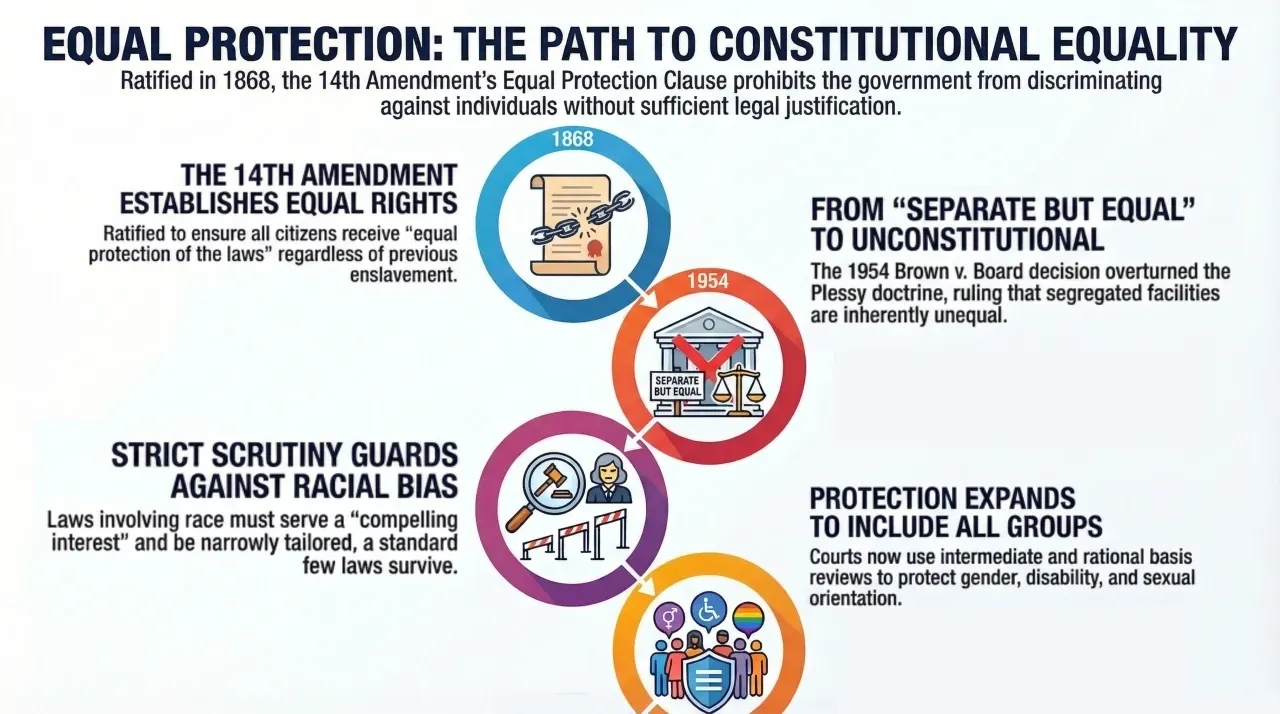
The Equal Protection Clause is found in the Fourteenth Amendment, ratified in 1868 in the aftermath of the Civil War and the abolition of slavery. It states that no state shall "deny to any person within its jurisdiction the equal protection of the laws." The amendment was designed primarily to ensure that formerly enslaved people would have the same legal rights as white citizens, but its language is broad enough to cover any group that faces discrimination under the law.
For much of its early history, the Equal Protection Clause was interpreted narrowly. In Plessy v. Ferguson (1896), the Supreme Court infamously ruled that racial segregation was constitutional as long as the separate facilities provided were equal, establishing the "separate but equal" doctrine that would be used to justify segregation for nearly sixty years.
Brown v. Board of Education
The most significant turning point in equal protection law came with Brown v. Board of Education (1954), in which the Supreme Court unanimously overturned Plessy and ruled that racially segregated public schools were inherently unequal and unconstitutional. Chief Justice Earl Warren's opinion held that separating children by race generated a feeling of inferiority that could not be undone simply by providing equal physical facilities. The decision did not end segregation overnight, but it demolished the legal foundation on which it rested and launched the modern civil rights movement.
Levels of Scrutiny
Over time, the Supreme Court developed a framework for analyzing equal protection claims that applies different levels of scrutiny depending on the type of classification involved.
When the government treats people differently based on race or national origin, the Court applies strict scrutiny, the highest level of review. To survive strict scrutiny, the government must show that the classification serves a compelling interest and is narrowly tailored to achieve that goal. Very few laws survive this standard, which is why racial classifications in law are almost always struck down.
In 2023, the Supreme Court clarified that the Equal Protection Clause generally prohibits the use of race in college admissions, signaling a shift toward a 'colorblind' interpretation that has since been applied to challenge diversity initiatives in both the private sector and government contracting.
Gender-based classifications receive intermediate scrutiny, a somewhat lower standard that still requires the government to show that the distinction serves an important interest and is substantially related to achieving it.
In 2026, gender scrutiny has expanded into intense debates over transgender rights, with courts weighing whether state-level restrictions on gender-affirming care constitute unconstitutional sex discrimination.
Most other classifications, like age or economic status, receive only rational basis review, the most lenient standard, under which a law is upheld as long as there is any reasonable justification for it.
Beyond Race: Expanding Equal Protection
Since the civil rights era, the Equal Protection Clause has been applied to protect many groups beyond racial minorities. The Supreme Court has used it to strike down laws that discriminated on the basis of gender, disability, and sexual orientation.
In Obergefell v. Hodges (2015), the Court ruled that same-sex couples have a constitutional right to marry, finding that denying them this right violated both equal protection and due process guarantees.
The ongoing question in equal protection law is always the same: when is it acceptable for the government to treat people differently, and when does that differential treatment cross the line into unconstitutional discrimination?
The answer depends on who is being treated differently, why, and whether the justification is strong enough to overcome the Constitution's fundamental commitment to equality under the law.