Civic Participation and Responsibilities
Being a citizen of the United States comes with a remarkable set of rights and protections. But citizenship is not just about what the government owes you. It also carries responsibilities.
These are obligations to participate in and contribute to the democratic system that makes those rights possible. A democracy depends on engaged, informed, and active citizens. Without participation, even the best-designed system of government eventually breaks down.
The Difference Between Rights and Responsibilities
Rights are the freedoms and protections that the government guarantees to citizens. Responsibilities are the obligations citizens have in return.
The social contract at the heart of democratic government is a two-way agreement. The government protects your rights; you contribute to the functioning of the society that makes that protection possible. Some civic responsibilities are legally required. Others are voluntary but considered essential to healthy democratic life.
Legal Obligations
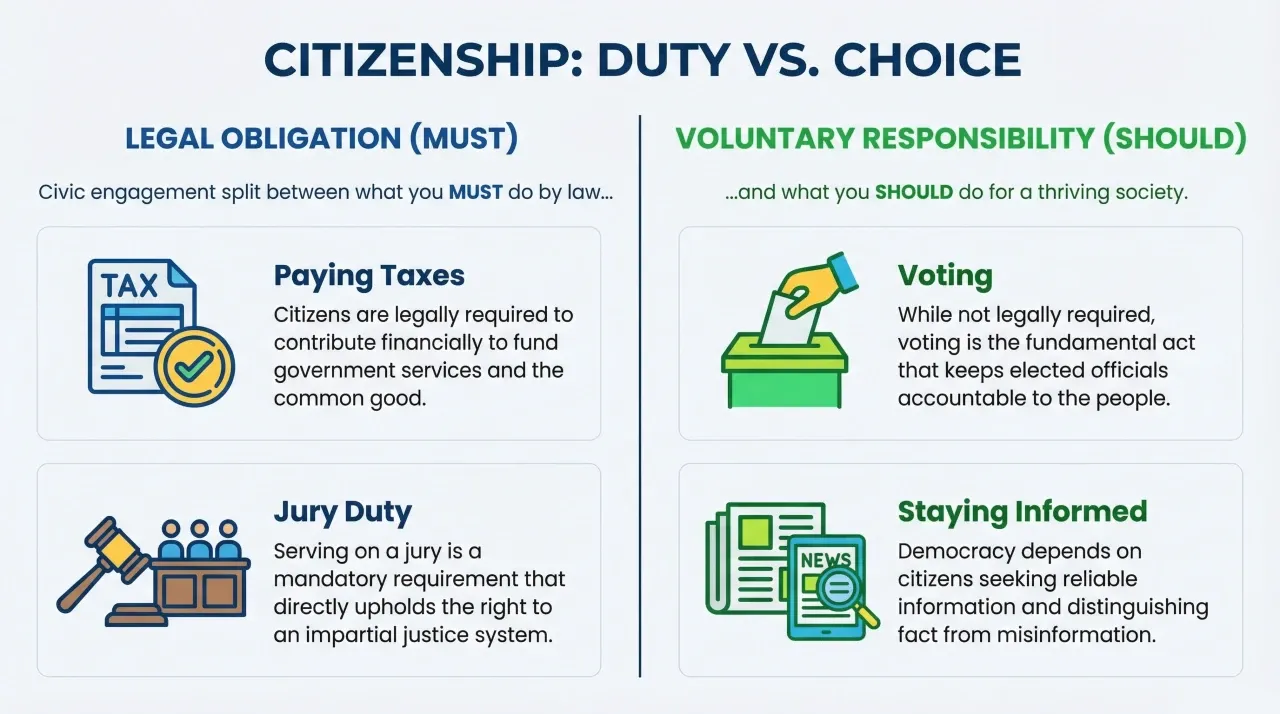
A small number of civic responsibilities are legally required of citizens. The most familiar is paying taxes. The federal government and most state governments require citizens and residents to pay taxes on their income, and various other taxes fund the services government provides. Tax evasion is a crime, and the legal obligation to contribute financially to the common good is one of the most basic requirements of membership in a civic community.
Jury duty is another legal obligation. The Sixth Amendment guarantees every person accused of a crime the right to a trial by an impartial jury of their peers. That system only works if citizens are willing to serve as jurors. When called for jury duty, citizens are required by law to appear and may be required to serve. Many people find jury duty inconvenient, but it is one of the most direct ways ordinary citizens participate in the justice system.
Men between the ages of 18 and 25 are required by law to register with the Selective Service System, which maintains a registry that would be used to administer a military draft if one were ever reinstated. No draft has been called since 1973, but registration remains a legal requirement.
Obeying the law is perhaps the most fundamental civic obligation. Laws exist to protect everyone's rights and make orderly community life possible. A society in which citizens selectively obey only the laws they personally agree with cannot function. At the same time, democratic systems provide legal avenues for challenging laws considered unjust, from voting and advocacy to peaceful protest to pursuing cases through the courts.
Voluntary Responsibilities
Beyond legal obligations, a healthy democracy depends on citizens choosing to participate in ways that go beyond the minimum required by law. Voting is the most important of these voluntary responsibilities. Voting is not legally required in the United States, unlike in some other democracies. But it is widely considered the most fundamental act of democratic citizenship. When citizens don't vote, elected officials become accountable to a smaller and less representative slice of the population, and the democratic process is weakened.
Staying informed is another essential responsibility. Democracy requires citizens who understand the issues their government is grappling with and can evaluate the claims of candidates and officials critically. This means following the news, seeking out reliable sources of information, and developing the ability to distinguish fact from opinion and credible reporting from misinformation. In an era of social media and information overload, this responsibility is more challenging and more important than ever.
Getting involved in the community is another dimension of civic responsibility. This can take many forms — attending a school board meeting, volunteering for a local organization, joining a neighborhood association, writing to a representative, or simply participating in local elections that many people overlook. Democracy is not just a national phenomenon. It happens at every level of government, and local participation is often where individual citizens can have the most direct impact.
Civic Virtue and the Common Good
Underlying all of these responsibilities is a concept known as civic virtue. This is the choice to act in ways that help your whole community, not just yourself. It means being a team player who is willing to compromise and respect people you disagree with. It also means being a good sport by accepting election results even when your favorite candidate loses. Having civic virtue means you follow the rules of our democracy, even when you don't like the outcome.
The founders believed that civic virtue was absolutely essential to the survival of a republic. Benjamin Franklin, when asked what kind of government the Constitutional Convention had produced, reportedly replied, "A republic, if you can keep it."
That phrase captures something important: democracy is not self-sustaining. It requires active, responsible, and engaged citizens to keep it alive. The rights Americans enjoy today exist because generations of citizens took their responsibilities seriously. Maintaining those rights requires the same commitment from every generation that follows.