Citizenship in the United States

Citizenship is more than a legal status. It is the foundation of a person's relationship with their government, determining what rights they hold, what obligations they carry, and what protections the law extends to them.
The United States has one of the most diverse populations in the world, and the question of who is a citizen and how someone becomes one has been at the center of American political debate since the founding.
Birthright Citizenship and the Fourteenth Amendment
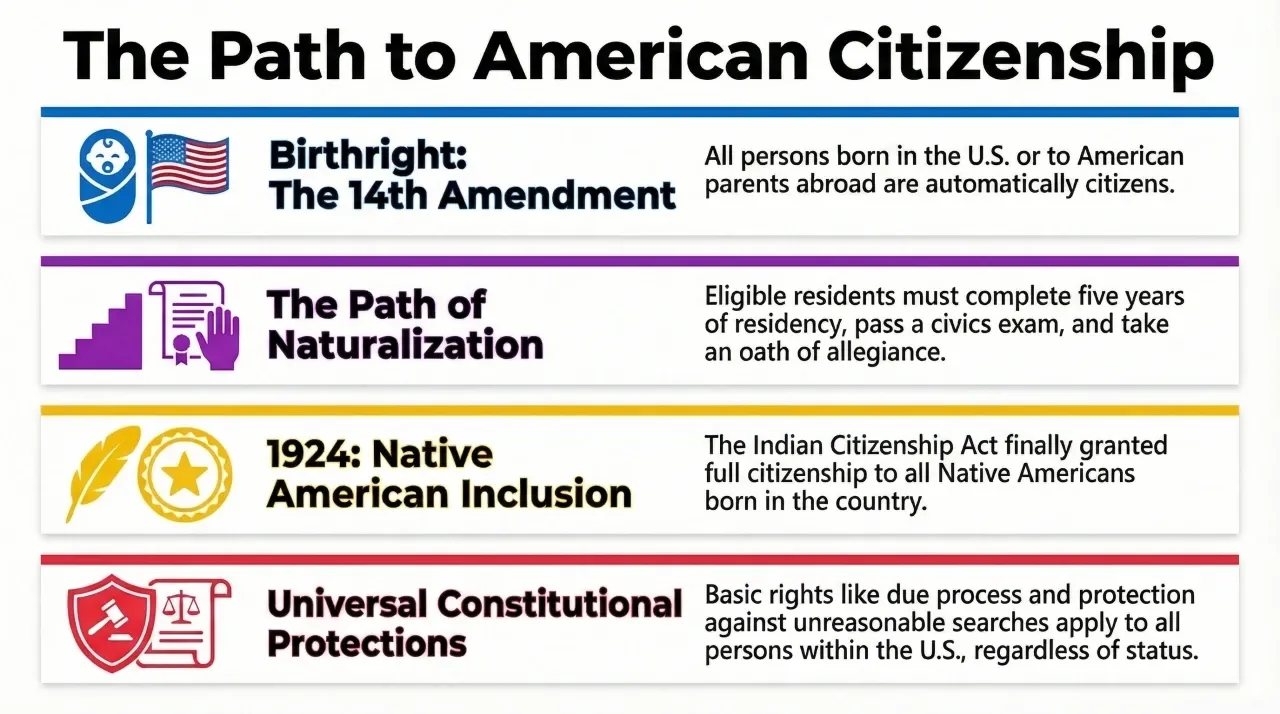
The most common way to become an American citizen is simply to be born in the United States. This principle, known as birthright citizenship, is guaranteed by the Fourteenth Amendment, ratified in 1868.
The amendment states that all persons born or naturalized in the United States and subject to its jurisdiction are citizens. This was a direct response to the Supreme Court's 1857 Dred Scott decision, which had held that Black Americans could never be citizens regardless of whether they were born free or enslaved. The Fourteenth Amendment overturned that ruling and established citizenship by birth as a constitutional guarantee.
Birthright citizenship also extends to children born abroad to at least one American citizen parent, under a principle called jus sanguinis, or "right of blood." The specific rules about how this works depend on whether one or both parents are citizens and whether they have lived in the United States for a required period of time.
Native Americans and Citizenship
The history of citizenship for Native Americans is complex and often overlooked. Despite being the original inhabitants of the land, Native Americans were not automatically considered citizens under the Fourteenth Amendment. For decades, they occupied an unusual legal position, living within the borders of the United States but treated as members of separate sovereign nations rather than as American citizens.
This changed with the Indian Citizenship Act of 1924, which granted full United States citizenship to all Native Americans born in the country. The act came partly in recognition of the tens of thousands of Native Americans who had served in the military during World War I despite having no legal obligation to do so.
Even after 1924, however, some states continued to deny Native Americans the right to vote, a barrier that was not fully eliminated until the Voting Rights Act of 1965.
Citizenship by Naturalization
People who are not born citizens can become citizens through a legal process called naturalization. To be eligible, a person must generally be at least 18 years old, have been a lawful permanent resident, also known as a green card holder, for at least five years, have continuous residence in the United States during that period, and demonstrate good moral character.
Applicants must also pass a civics exam covering American history and government, demonstrate basic English language ability, and take an oath of allegiance to the United States.
Naturalized citizens have virtually all the same rights as native-born citizens, with one notable exception: the Constitution requires that the president be a natural-born citizen, so naturalized citizens cannot hold that office. In all other respects, naturalization confers full citizenship and equal standing under the law.
Loss of Citizenship
American citizenship can be lost, though this is rare. A citizen can voluntarily renounce their citizenship through a process known as expatriation. Citizenship can also be lost by serving in a foreign military that is engaged in hostilities against the United States.
The Supreme Court has ruled that the government cannot strip a person of their citizenship as punishment for a crime or without their consent. Citizenship, once granted, belongs to the individual and cannot simply be taken away by the government against the person's will.
Immigration and the Path to Citizenship
Millions of people come to the United States each year through the immigration system, which provides various pathways to lawful residence and eventually citizenship.
Family-based immigration allows citizens and permanent residents to sponsor certain relatives. Employment-based immigration brings workers with specific skills or job offers. The diversity visa lottery provides a limited number of visas to people from countries with historically low rates of immigration to the United States.
Refugees and asylum seekers who face persecution in their home countries can also be admitted and may eventually apply for citizenship.
The process of immigrating legally can be lengthy and complicated. Wait times for certain visa categories can stretch for years or even decades. This complexity, combined with economic pressures and dangerous conditions in many countries, has led millions of people to enter or remain in the United States without legal authorization.
The Rights of Undocumented People
One of the most debated areas of American immigration law concerns the rights of people living in the United States without legal status. While undocumented immigrants are not citizens and do not have the full range of rights that citizens enjoy, they are not entirely without legal protections.
The Supreme Court has ruled that the Constitution's protections apply to all persons within the United States, not just citizens. This means undocumented immigrants have Fourth Amendment protections against unreasonable searches and seizures, Fifth Amendment due process rights, and Sixth Amendment rights if charged with a crime.
In Plyler v. Doe (1982), the Court ruled that states cannot deny undocumented children access to public education, finding that doing so would impose a lifelong disadvantage on children for circumstances beyond their control.
At the same time, undocumented immigrants do not have the right to vote, cannot receive most federal benefits, and are subject to deportation, the legal process of being removed from the country. The question of how to treat the 12-13 million undocumented people currently living in the United States remains one of the most contentious and unresolved debates in American politics.
Citizenship as a Living Question
The history of citizenship in the United States is a story of gradual expansion, from a narrow definition that excluded women, Black Americans, Native Americans, and many immigrants, to a broader understanding that reflects the country's founding ideals more fully.
That expansion has never been automatic or easy. It has been won through legal battles, political organizing, and sometimes bitter conflict.
The debates over immigration, naturalization, and the rights of non-citizens today are part of that same ongoing story about who belongs in America and what membership in this country truly means.