Government and Foreign Policy
Every country on earth must answer a fundamental question: how should we relate to the rest of the world?
The decisions a government makes about its relationships with other countries, its role in international affairs, and how it protects its citizens from foreign threats are collectively known as foreign policy.
For the United States, a country with global economic interests, military alliances spanning six continents, and a long history of international engagement, foreign policy is one of the most complex and consequential responsibilities of the federal government.
What Is Foreign Policy?
Foreign policy is the set of strategies, goals, and decisions that guide how a country interacts with other nations and international organizations.
It covers an enormous range of activities, from negotiating trade agreements and signing treaties to deploying military forces and imposing economic sanctions. Foreign policy decisions can affect not just relationships between governments but the lives of ordinary people around the world, including American citizens living and working abroad.
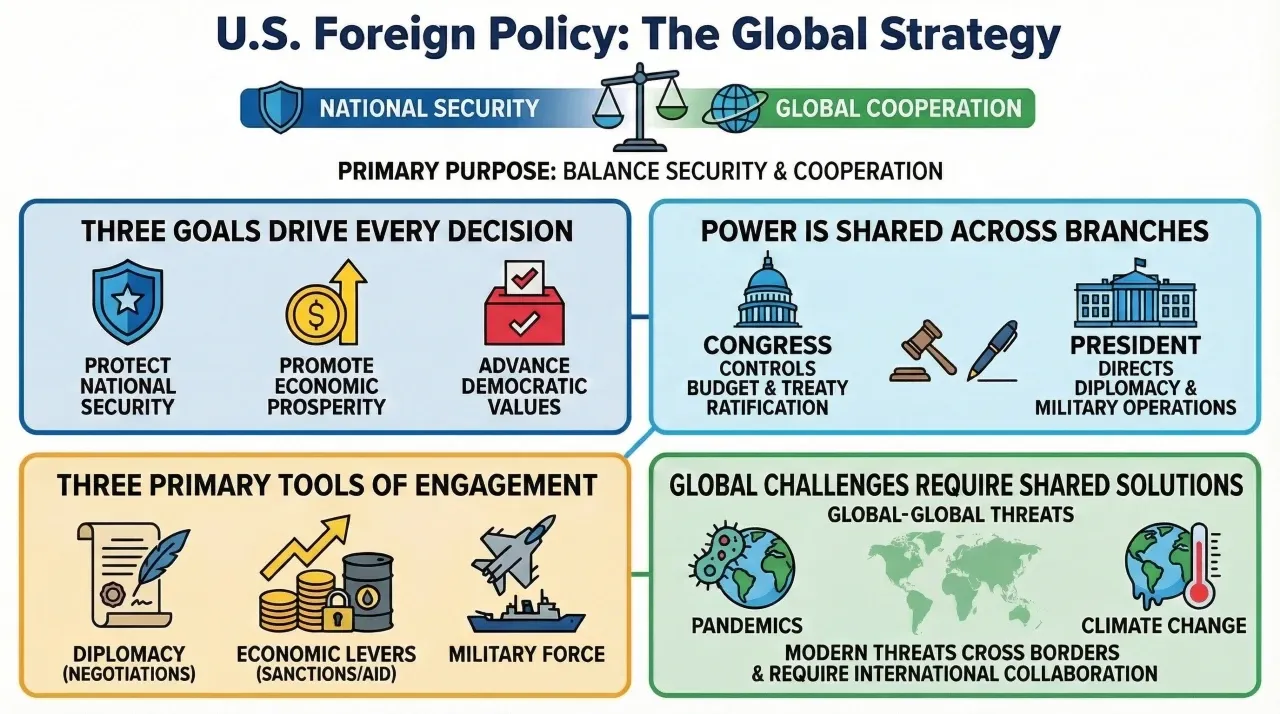
At its core, foreign policy serves several broad goals. Protecting national security is always the first priority, ensuring that the country is safe from military threats, terrorism, and other dangers.
Promoting economic prosperity is another central aim, since trade relationships and economic partnerships affect the livelihoods of American workers and businesses. Advancing democratic values and human rights has also been a stated goal of American foreign policy for much of the country's history, though how consistently this goal is pursued has varied significantly across different administrations.
Who Makes Foreign Policy?
Foreign policy in the United States is shaped by multiple institutions and actors, which sometimes creates tension and disagreement about the right direction to take.
The president plays the central role. As commander in chief and chief diplomat, the president sets the overall direction of American foreign policy, negotiates treaties, directs military operations, and represents the country in dealings with foreign leaders.
The Secretary of State, who leads the State Department, serves as the president's chief foreign policy advisor and manages the day-to-day work of diplomacy. The National Security Council, a group of senior officials that includes the vice president, secretaries of state and defense, and other key advisors, helps coordinate foreign policy across the executive branch.
Congress also plays an important role. The Senate must ratify treaties by a two-thirds vote and confirms the appointment of ambassadors and other senior foreign policy officials. Congress controls the foreign affairs budget, including funding for the military and foreign aid. It also has the sole power to formally declare war, though as discussed earlier, presidents have frequently engaged in military action without a formal declaration.
The Tools of Foreign Policy
Governments have several tools available to pursue their foreign policy goals. Diplomacy is the most fundamental, involving negotiations, treaties, summits between leaders, and the ongoing work of embassies and ambassadors around the world. When diplomacy succeeds, conflicts are resolved peacefully and relationships are strengthened without the need for more forceful measures.
Economic tools include foreign aid, trade agreements, and sanctions. Foreign aid involves providing financial assistance, food, medicine, or other resources to other countries, either to support development, respond to humanitarian crises, or advance strategic interests. Sanctions are economic penalties imposed on a country, government, or individual to pressure them into changing their behavior without resorting to military force.
Military force is the most dramatic foreign policy tool and the one with the most serious consequences. It ranges from a show of military presence intended to deter aggression, to limited strikes on specific targets, to full-scale war. The decision to use military force is always significant, carrying enormous risks and responsibilities.
Foreign Policy in a Complex World
The world the United States navigates today is more interconnected and more complicated than at any point in its history. Climate change, global pandemics, nuclear proliferation, terrorism, and the rise of new economic powers all present foreign policy challenges that cross national borders and cannot be solved by any single country acting alone.
American foreign policy must grapple with all of these issues simultaneously, balancing competing interests, managing alliances, and making difficult choices about when to engage and when to step back. It is, by any measure, one of the most demanding responsibilities of democratic government.