American Foreign Policies

Throughout its history, the United States has approached its role in the world in dramatically different ways. At times it has retreated from international affairs, preferring to focus on matters at home. At other times it has taken an assertive, even aggressive role in shaping events around the globe.
These different approaches reflect not just changing circumstances but competing ideas about what America's place in the world should be and what responsibilities come with being a powerful nation. Several distinct foreign policy traditions have shaped American history and continue to influence debate today.
Isolationism
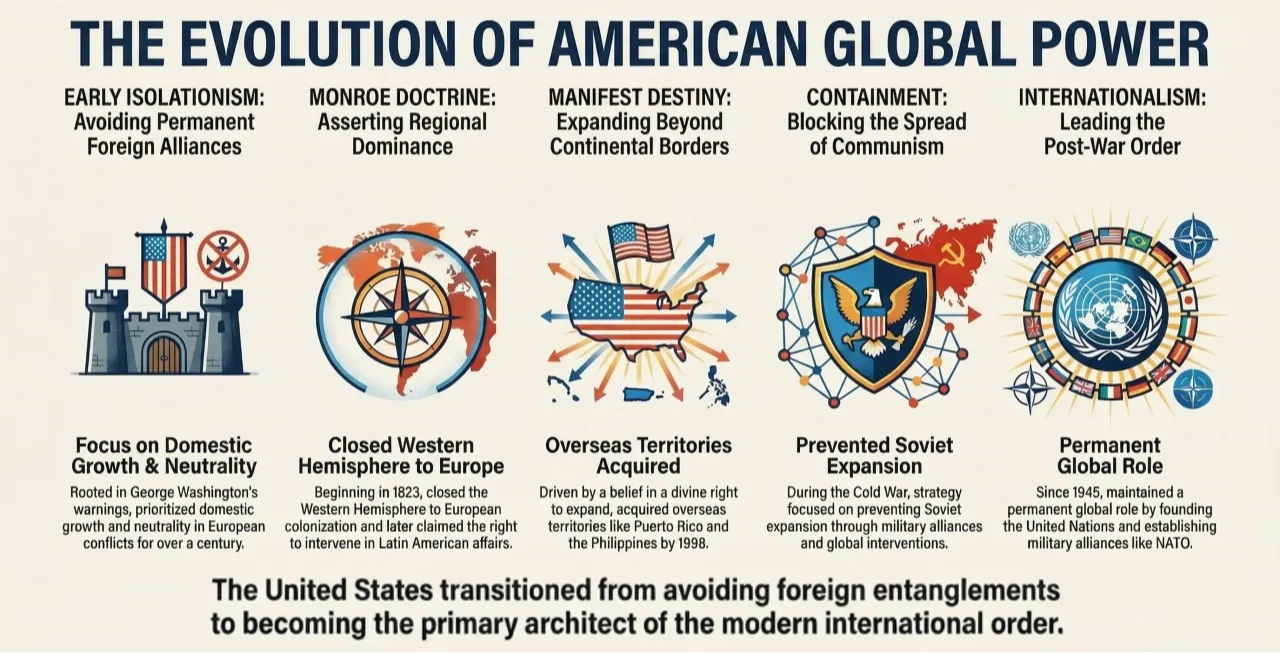
In its early decades, the United States largely avoided entanglement in the affairs of other nations, particularly those of Europe. This approach, known as isolationism, was rooted in George Washington's Farewell Address, in which he warned against permanent alliances with foreign nations and urged the country to focus on its own development. The vast Atlantic Ocean provided a natural buffer, and most Americans saw little reason to involve themselves in the conflicts and politics of distant countries.
Isolationism remained a powerful force in American foreign policy well into the twentieth century. After the enormous human cost of World War I, many Americans were deeply reluctant to become involved in another European conflict.
Congress passed a series of Neutrality Acts in the 1930s designed to keep the United States out of foreign wars. It took the Japanese attack on Pearl Harbor in December 1941 to finally bring the country fully into World War 2 and effectively end isolationism as a dominant foreign policy approach.
The Monroe Doctrine
As the United States grew in power and confidence during the nineteenth century, it began asserting a more active role in its own hemisphere. The Monroe Doctrine, announced by President James Monroe in 1823, declared that the Western Hemisphere was closed to further European colonization and that any attempt by European powers to extend their influence in the Americas would be considered a threat to American security. In return, the United States pledged not to interfere in the internal affairs of European nations.
The Monroe Doctrine was a cornerstone of American foreign policy for more than a century. President Theodore Roosevelt expanded it in 1904 with the Roosevelt Corollary, which claimed the right of the United States to intervene in Latin American countries to stabilize their affairs if they were unable to maintain order themselves. Critics argued this effectively turned Latin American nations into American protectorates and set a troubling precedent for interference in the sovereignty of other nations.
American Imperialism
Around the same time period, America looked beyond the continent to add overseas territories after the Spanish-American War of 1898, including Puerto Rico, Guam, and the Philippines.
This period of overseas expansion reflected a belief that the United States had both the right and the responsibility to extend its influence, its economic interests, and in some cases its democratic values to other parts of the world.
Internationalism Post-World War 2
The experience of World War 2 transformed American foreign policy fundamentally. The United States emerged from the war as the world's dominant military and economic power, and American leaders concluded that isolationism had been a catastrophic mistake. Staying out of European affairs in the 1930s had allowed the rise of fascism and the devastation of global war. This time, the United States would remain deeply engaged in international affairs.
The postwar period saw the United States take a leading role in building a new international order. It helped found the United Nations, created the Marshall Plan to rebuild war-devastated Europe, and established a series of military alliances, most importantly NATO, to deter Soviet aggression. This internationalist approach committed the United States to a permanent, active role in global affairs that it has maintained ever since.
Containment and the Cold War
The dominant foreign policy framework of the second half of the twentieth century was containment, developed in response to the rise of Soviet power after World War II. The theory of containment, articulated most clearly by diplomat George Kennan, held that the United States did not need to go to war with the Soviet Union directly but should focus on preventing the spread of communism to new countries. As long as communism was contained within its existing borders, American strategists believed, it would eventually collapse under the weight of its own contradictions.
Containment shaped American foreign policy for more than four decades, leading to military interventions in Korea and Vietnam, covert operations around the world, and a massive military buildup. When the Soviet Union collapsed in 1991, many American foreign policy leaders saw it as a vindication of the containment strategy.
Foreign Policy After the Cold War
The end of the Cold War left American foreign policy without its organizing framework. The debates of the 1990s and 2000s about what role America should play in a world without a clear superpower rival, how to respond to humanitarian crises, and how to handle the threat of international terrorism reflect an ongoing search for a coherent approach to a changed world.
The September 11 attacks in 2001 produced a dramatic shift toward counterterrorism and the use of military force in Afghanistan and Iraq. More recently, the rise of China as a global economic and military power has again reshaped the foreign policy debate. The questions of how assertive to be, when to act multilaterally through alliances and international organizations, and how to balance idealism with pragmatism continue to define American foreign policy discussions today.