Key Principles of the Constitution
America's Constitution is the supreme law of the land. Every law passed by Congress, every action taken by the president, and every decision made by the courts must be consistent with what the Constitution says. The Constitution is more than a rulebook though. It is built on a set of core principles that reflect the founders' deepest beliefs about government, power, and freedom. Understanding these principles is the key to understanding how American government works.
Popular Sovereignty
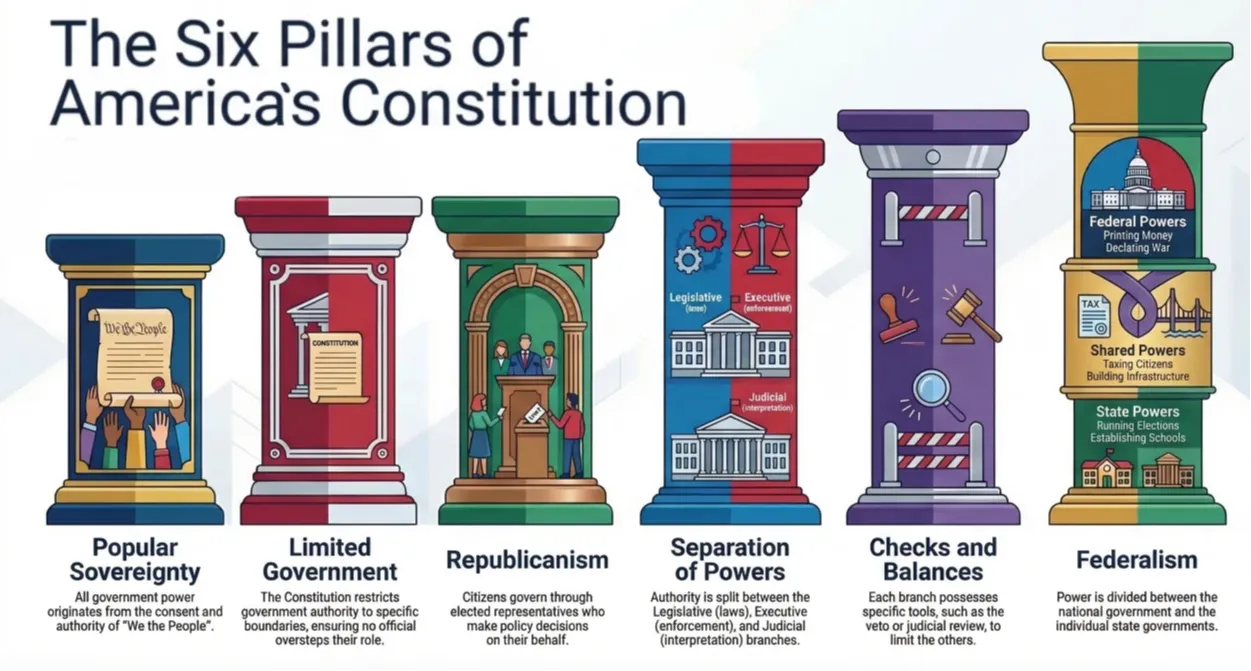
The Constitution opens with three of the most important words in American history: "We the People." Those words reflect the principle of popular sovereignty. This is the idea that all government power comes from the people.
The government does not have authority of its own. It exists only because the people have created it and consented to be governed by it. This principle means that in America, the people are ultimately in charge, and government officials are accountable to the citizens they serve.
Limited Government
Popular sovereignty leads directly to another key principle: limited government. If power belongs to the people, then the government can only exercise the power the people have given it.
The Constitution carefully defines what the government can and cannot do. The Bill of Rights, for example, lists specific freedoms that the government is prohibited from taking away. Limited government is the constitutional guarantee that no branch, no official, and no majority can overstep its boundaries without consequences.
Separation of Powers
To prevent any single person or group from gaining too much control, the Constitution divides government authority among three separate branches.
The legislative branch, Congress, makes the laws. The executive branch, led by the president, carries out the laws. The judicial branch, headed by the Supreme Court, interprets the laws.
Each branch has its own distinct responsibilities, and no branch is supposed to do the job of another. This separation keeps power from becoming dangerously concentrated.
Checks and Balances
Separation of powers alone isn't enough if one branch can simply ignore or dominate the others. So, the Constitution also establishes a system of checks and balances, giving each branch specific tools to limit the power of the other two.
The president can veto laws passed by Congress. Congress can override that veto with a two-thirds majority. The Supreme Court can strike down laws it finds unconstitutional. The president nominates Supreme Court justices, but the Senate must confirm them.
These overlapping powers keep all three branches in balance and prevent any one from becoming too powerful.
Federalism
The Constitution also establishes federalism. This is the division of power between the national government and the state governments. Some powers belong exclusively to the federal government, like printing money and declaring war. Others are reserved for the states, like running elections and establishing schools. Still others are shared between the two levels.
Federalism was a compromise between those who wanted a strong central government and those who feared it, and it remains a defining feature of American governance.
Republicanism
The final key principle is republicanism: the idea that citizens govern themselves through elected representatives rather than directly. Americans don't vote on every law or policy decision. Instead, they elect senators, representatives, and a president to make those decisions on their behalf.
This system makes large-scale democratic governance practical while still keeping government accountable to the people through regular elections.
Together, these principles form the foundation on which the entire American system of government is built. They reflect hard lessons learned from history and a deep commitment to preventing the kind of tyranny the founders had experienced under British rule.