The Articles of Confederation
Before the United States had the Constitution, it had a different governing document. The Articles of Confederation was America's first attempt at a national government.
While it represented an important step in the development of the country, it failed badly enough that the founders scrapped it entirely and started over.
Why the Articles Were Written
When the 13 Colonies declared independence from Britain in 1776, they faced an immediate practical problem. They needed some form of national government to coordinate the war effort, manage foreign relations, and handle matters that individual states could not address alone. But they were deeply suspicious of central authority. They had just fought a revolution against a powerful central government that they felt had trampled their rights, and they had no intention of replacing one tyrant with another.
The result was the Articles of Confederation, drafted in 1777 and ratified by all 13 states in 1781. The Articles created a national government that was deliberately weak. Power was concentrated in a single legislative body, the Confederation Congress, with no separate executive branch and no national court system.
Each state had one vote in Congress regardless of its population, and most important decisions required approval from 9 of the 13 states. Amending the Articles required unanimous consent from all 13, a nearly impossible standard.
What the Articles Allowed
Under the Articles, Congress had some meaningful powers. It could declare war and make peace, conduct foreign affairs, maintain a military, coin money, and operate a postal system. These were the powers most obviously needed at the national level during wartime, and for a time the Articles provided enough structure to see the country through the Revolution.
The Treaty of Paris, which formally ended the Revolutionary War in 1783, was negotiated and signed under the authority of the Articles of Confederation. In this narrow sense, the government created by the Articles accomplished its most immediate goal.
Why the Articles Failed
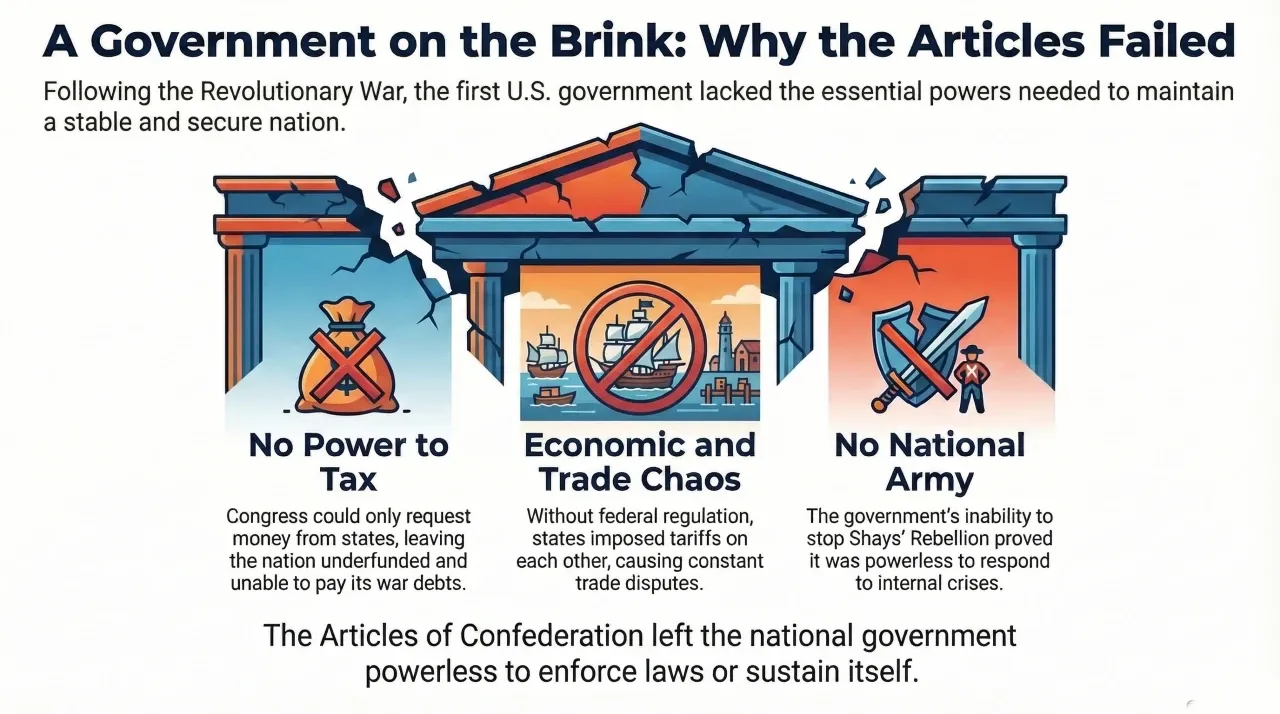
The weaknesses of the Articles became increasingly apparent once the war was over. The most crippling problem was that Congress had no power to tax. It could request money from the states, but it could not make them actually pay. States frequently ignored these requests, leaving the national government unable to pay its debts, including the wages it owed to soldiers who had fought in the Revolution.
The national government also had no power to regulate commerce between states, leading to trade disputes and economic chaos as states imposed tariffs on each other's goods.
Perhaps most alarming was the government's inability to respond to internal crises. In 1786 and 1787, a rebellion broke out in Massachusetts led by Daniel Shays, a Revolutionary War veteran who was facing the seizure of his farm due to debt.
Shays' Rebellion, as it became known, exposed the national government's powerlessness. It had no standing army and no money to raise one quickly. The rebellion was eventually put down by a state militia funded by private merchants, but the episode shocked the country's leaders and made clear that the existing government was dangerously inadequate.
The Road to the Constitution
The failures of the Articles of Confederation convinced the country's most influential leaders that something had to change.
In May 1787, delegates from 12 of the 13 states gathered in Philadelphia, ostensibly to revise the Articles. They quickly concluded that revision was not enough. The Articles were too fundamentally flawed to be fixed. Starting that summer, the delegates drafted an entirely new governing document. This would become the Constitution of the United States.
The Constitution addressed each of the Articles' major weaknesses directly. It created a strong executive branch in the presidency. It established a federal court system. It gave Congress the power to tax, regulate commerce, and enforce its own laws. And it created a system for amending the document that was demanding but not impossible.
The Articles of Confederation were not a failure of vision. The founders who wrote them were genuinely trying to protect the liberties they had just fought for. But they were a valuable lesson in what happens when a government is too weak to do its job.