The Documents and Men Who Shaped America's Constitution
The United States wasn't built in a day, and it wasn't built by one person. The nation that emerged from the American Revolution was shaped by a remarkable collection of individuals and documents that, together, laid the foundation for a new kind of government. Understanding who these people were and what these documents said is essential to understanding America itself.
The Virginia Declaration of Rights (1776)
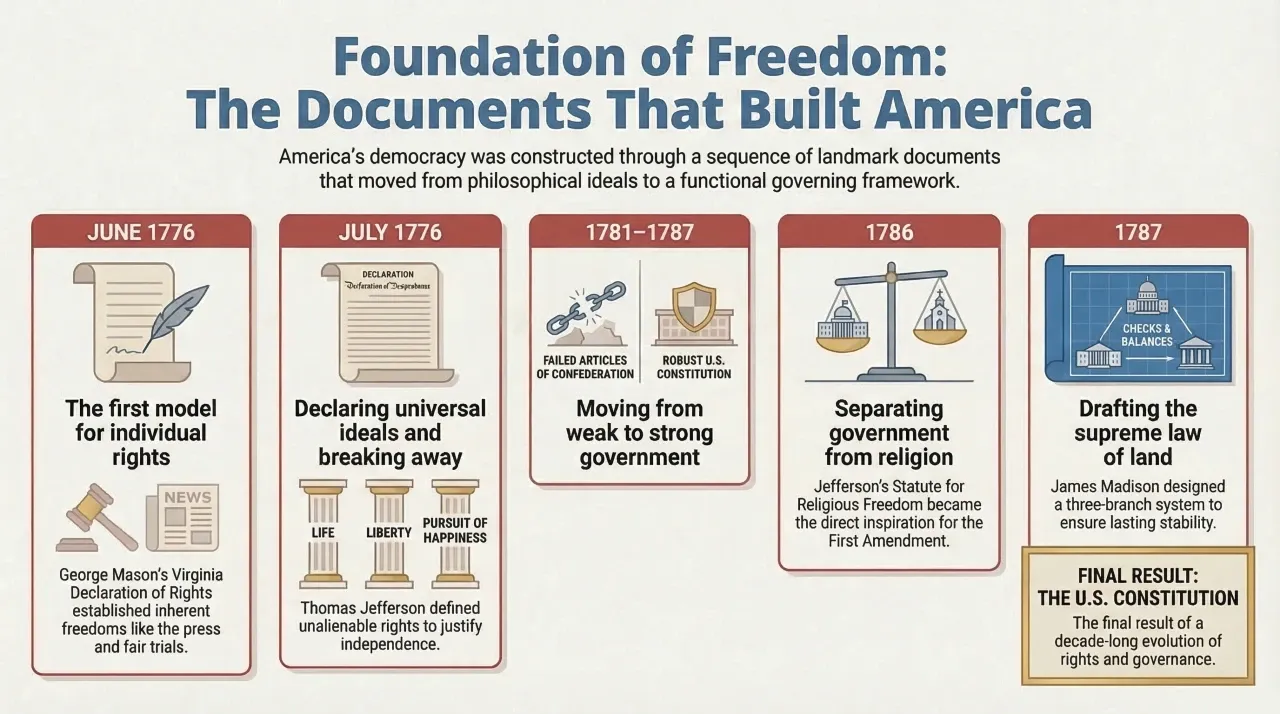
Before Thomas Jefferson wrote the Declaration of Independence, another Virginia statesman named George Mason drafted one of the most important documents in American history. The Virginia Declaration of Rights, adopted in June 1776, declared that all men are by nature equally free and independent and possess inherent rights that cannot be taken from them. It guaranteed freedoms like freedom of the press, the right to a fair trial, and protection against cruel and unusual punishment.
The Virginia Declaration was enormously influential. Jefferson drew from it heavily when writing the Declaration of Independence just weeks later, and it served as a direct model for the Bill of Rights more than a decade after that. Mason's document was one of the first times these principles were written into an actual governing framework rather than just philosophical theory.
The Declaration of Independence (1776)
The Declaration of Independence is the founding statement of American ideals. Written primarily by Thomas Jefferson and adopted by the Continental Congress on July 4, 1776, it announced to the world that the thirteen American colonies were breaking away from British rule. It did more than declare independence... it also explained why.
Drawing heavily on John Locke's philosophy, Jefferson wrote that all men are created equal and endowed with unalienable rights, including life, liberty, and the pursuit of happiness. He argued that governments exist to protect these rights, and when a government fails to do so, the people have the right to alter or abolish it.
The Declaration then listed a long series of grievances against King George III to justify the colonies' decision to separate. It remains one of the most powerful statements of democratic principles ever written.
Jefferson's Virginia Statute for Religious Freedom (1786)
Another landmark document authored by Thomas Jefferson, the Virginia Statute for Religious Freedom was passed by the Virginia legislature in 1786. Jefferson considered it one of his greatest achievements, so much so that he requested it be listed on his tombstone alongside the Declaration of Independence and his founding of the University of Virginia.
The Statute declared that no person should be compelled to attend or support any church, and that no one should suffer discrimination based on their religious beliefs. It established a complete separation between government and religion in Virginia, making it one of the first laws in the world to guarantee religious freedom as a legal right. The Statute became the direct inspiration for the First Amendment's protection of religious freedom when Madison drafted the Bill of Rights just a few years later.
The Articles of Confederation (1781)
America's first constitution was the Articles of Confederation, ratified in 1781. It created a very weak central government, largely because the former colonists were deeply suspicious of powerful central authority after their experience with British rule. Under the Articles, Congress had no power to tax, no power to regulate trade, and no way to enforce its own laws. Each state operated almost like an independent country.
The Articles quickly proved unworkable. The national government couldn't pay its debts, couldn't resolve disputes between states, and couldn't respond effectively to crises. This failure led directly to the Constitutional Convention of 1787.
James Madison and the Constitution (1787)
In the summer of 1787, delegates from 12 of the 13 states gathered in Philadelphia to fix the Articles of Confederation. They ended up doing much more than that. They scrapped the Articles entirely and wrote a new Constitution from scratch. Key figures at the Convention included James Madison, often called the "Father of the Constitution" for his central role in drafting it, George Washington, who presided over the Convention, and Benjamin Franklin, whose wisdom and experience lent the proceedings credibility.
The Constitution created a stronger national government with three branches, a system of checks and balances, and a framework for federalism. It has been amended 27 times since its ratification but remains the supreme law of the land.
A Living Legacy
These documents and the men who created them established a set of ideals that Americans have debated, interpreted, and strived toward ever since.
The tension between the ideals stated in the Declaration and the realities of American life has driven some of the most important movements in the nation's history, from the abolition of slavery to the civil rights movement.
The documents endure because the questions they raise about rights, equality, and the purpose of government never stop being relevant.