The Rights of Englishmen That Shaped Our Constitution
Long before the American Revolution, the seeds of American democracy were being planted in England. The colonists who settled in America brought with them centuries of English legal tradition, and they considered themselves entitled to the same rights that English citizens had fought for and won over hundreds of years. When the British government began to violate those rights in the 1760s and 1770s, the colonists saw themselves as defenders of their own rights.
The Magna Carta (1215)
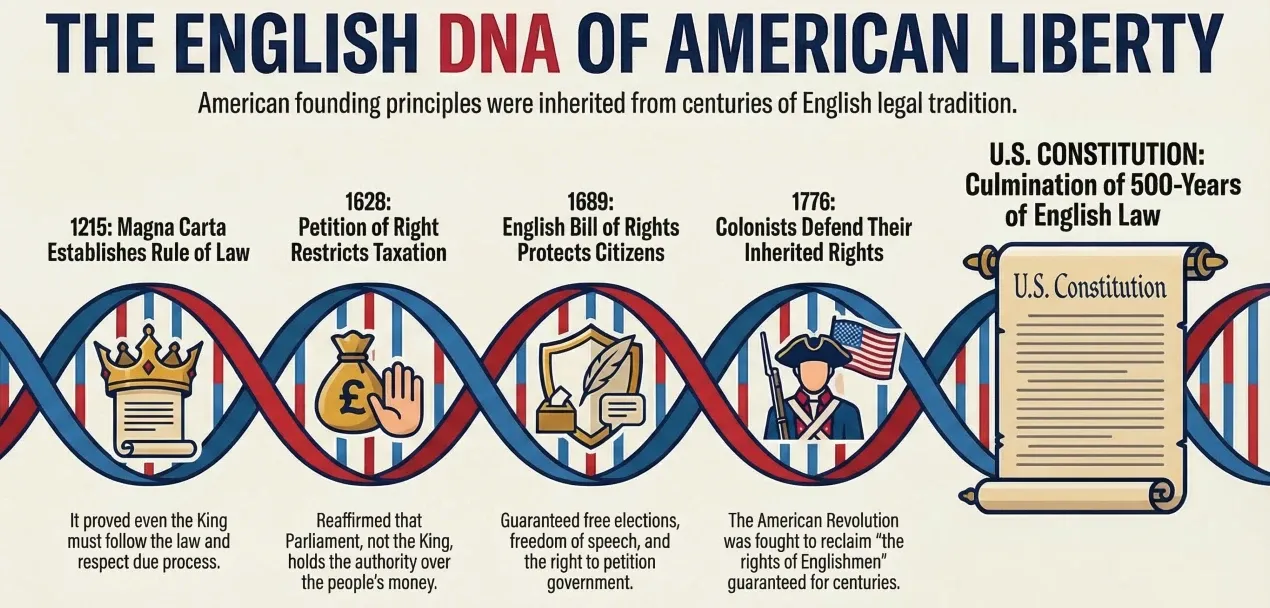
The story begins in 1215, when a group of powerful English barons forced King John to sign a document called the Magna Carta, or "Great Charter." The king had been abusing his power: taxing nobles without their consent, imprisoning people without trial, and generally ruling as though he answered to no one. The Magna Carta established for the first time that even the king was subject to the law.
Two principles from the Magna Carta proved especially important to America's government. First, the idea that no person could be imprisoned without due process, that is a fair legal procedure.
Second, the idea that the king could not levy taxes without the consent of his nobles. These concepts of legal protection and consent of the governed echoed through centuries of English and American political thought.
The Petition of Right (1628)
Four centuries after the Magna Carta, Parliament forced King Charles I to sign the Petition of Right in 1628. The king had again been overstepping his authority. He demanded taxes without Parliament's approval, housed soldiers in private homes, and imprisoned people without cause. The Petition of Right reaffirmed the principles of the Magna Carta and added new protections, further establishing that Parliament, not the king alone, held ultimate authority over taxation and the rights of citizens.
The English Bill of Rights (1689)
The most direct English ancestor of the American Bill of Rights was the English Bill of Rights, passed in 1689 after King James II was removed from power in the Glorious Revolution.
This document placed strict limits on royal power and guaranteed specific rights to English citizens and members of Parliament. It prohibited the king from suspending laws, maintaining a standing army in peacetime without Parliament's consent, or interfering with free elections. It also guaranteed the right to petition the government and protected freedom of speech within Parliament.
The English Tradition in America
When American colonists protested British policies in the 1760s, they frequently invoked these documents. Taxation without representation, quartering of soldiers, and trials without juries were seen as violations of rights that Englishmen had been guaranteed for centuries.
The Declaration of Independence, the Constitution, and the Bill of Rights all reflect this English legal heritage. The founders weren't inventing new ideas about rights and government so much as they were defending and expanding a tradition that stretched back over 550 years.