America's Fundamental Political Principles
America's system of government is built on a set of core principles that were considered radical when they were first put into practice. These principles were drawn from centuries of political thought, historical experience, and hard-fought struggles for freedom. Together they form the philosophical backbone of American democracy.
Popular Sovereignty
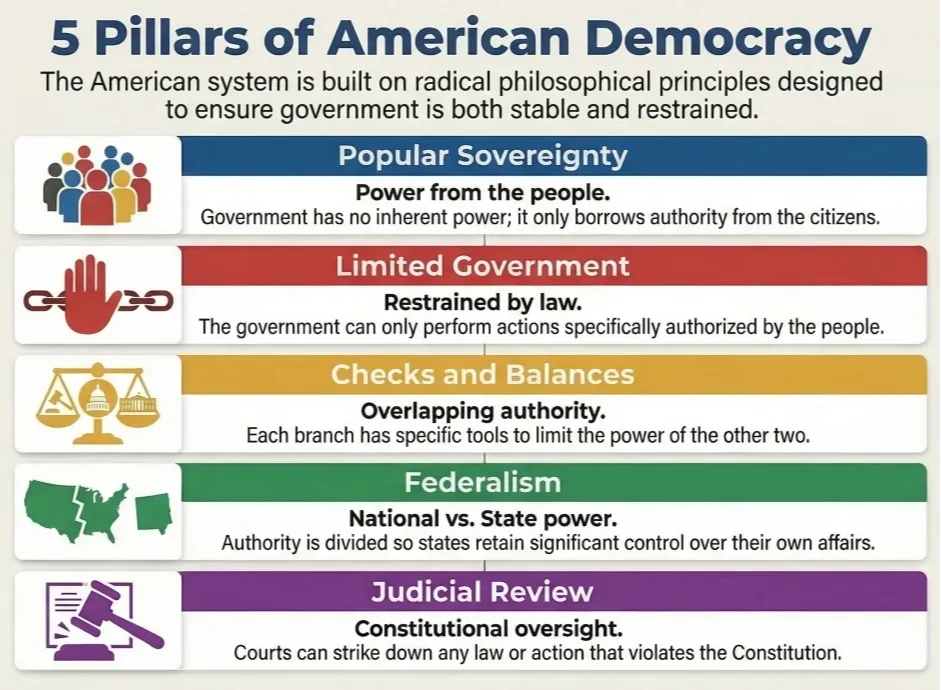
Popular sovereignty is the idea that all political power comes from the people. The government does not have power of its own. It borrows its authority from the citizens it governs. This principle is stated clearly in the Declaration of Independence and embedded in the Constitution's opening phrase, "We the People."
In a system based on popular sovereignty, elections matter, citizen participation matters, and the government is ultimately accountable to the public.
Limited Government
If popular sovereignty says where power comes from, limited government says how much of it the government can exercise. A limited government is one that is restrained by law. It can only do what the people have authorized it to do, and there are things it simply cannot do at all.
The Constitution limits government power in many ways, from the Bill of Rights protecting individual freedoms to the separation of powers preventing any one branch from controlling everything.
Separation of Powers
The idea of separating government into distinct branches (legislative, executive, and judicial) is central to the American system. Each branch has its own responsibilities, and no branch is supposed to do the job of another. This division prevents power from becoming dangerously concentrated and keeps the government functioning in an organized, predictable way.
Checks and Balances
Closely related to separation of powers is the principle of checks and balances. Simply dividing government into three branches isn't enough if one branch can dominate the others. So, the Constitution gives each branch specific tools to limit the power of the other two. Congress can override a presidential veto. The president nominates Supreme Court justices. The courts can strike down laws passed by Congress. These overlapping powers keep all three branches in balance.
Federalism
Federalism is the division of power between the national government and the state governments. Rather than having one all-powerful central government, the United States divides authority so that states retain significant power over their own affairs.
This system was a compromise between those who wanted a strong central government and those who feared it. Federalism allows for local differences while maintaining national unity.
Judicial Review
Judicial review is the power of the courts (especially the Supreme Court) to determine whether laws and government actions are consistent with the Constitution. If a law violates the Constitution, the court can strike it down. This principle wasn't explicitly written into the Constitution but was established by the Supreme Court in the landmark case Marbury v. Madison in 1803. Judicial review gives the judicial branch a powerful check on both Congress and the president.
Together, these principles create a system designed to be both stable and flexible, powerful enough to govern a large nation while limited enough to protect individual rights. They continue to shape every debate about the role of government in American life today.