Democracy in Ancient Athens and Rome

Modern democracy didn't appear out of nowhere. It grew from ideas and experiments that began thousands of years ago in ancient Greece and Rome.
When the founders of the United States sat down to design a new government, they looked at these civilizations for inspiration and for warnings about what could go wrong.
Ancient Athens and the Birth of Democracy
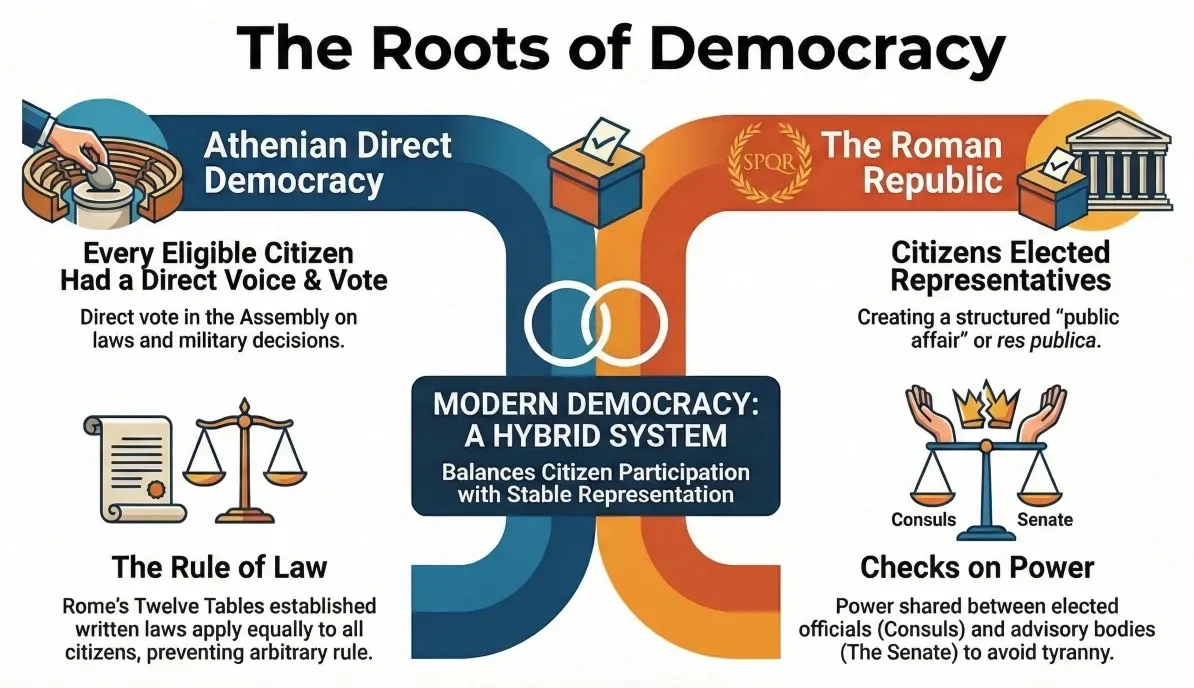
The city-state of Athens in ancient Greece is often credited as the birthplace of democracy. Around 500 BCE, an Athenian leader named Cleisthenes introduced a series of reforms that gave ordinary male citizens a direct voice in government. This system became known as direct democracy, meaning citizens participated in government themselves rather than electing representatives to speak for them.
The centerpiece of Athenian democracy was the Assembly, an open meeting where eligible citizens could gather to debate and vote on laws, military decisions, and public policy. Athens also developed a Council of 500, chosen by lottery, to manage the day-to-day business of government. Another important innovation was the jury system, where large groups of citizens decided legal cases rather than leaving judgment to a single ruler or official.
Athenian democracy was far from perfect by modern standards. Women, enslaved people, and foreigners were excluded entirely. Only free adult male citizens could participate. But the core idea that citizens should have a say in how they are governed was revolutionary and deeply influential.
The Roman Republic
While Athens gave the world direct democracy, ancient Rome contributed a different but equally important model: the republic. A republic is a system in which citizens elect representatives to make decisions on their behalf. Rome established its republic around 509 BCE after overthrowing its last king.
The Roman Republic had several key institutions that would later influence American government. The Senate was a powerful body of elected officials who advised on laws and foreign policy.
Two consuls, elected annually, served as the chief executives of the republic, sharing power to prevent either one from becoming too dominant. Rome also developed a written legal code called the Twelve Tables. This established that laws applied to all citizens equally, a foundational concept in democratic governance.
Rome's system of checks on power, its elected representatives, and its written laws all became models that the American founders studied carefully. The very word "republic" comes from the Latin phrase res publica, meaning "the public thing" or "the public affair."
Lessons for America
Both Athens and Rome eventually declined. Athens lost its independence to Macedonia, and the Roman Republic collapsed into dictatorship under Julius Caesar. The founders of the United States took these cautionary tales seriously. They admired Athenian participation and Roman structure, but they also recognized the dangers of mob rule and unchecked power.
The American system of government blends elements of both: a representative republic with democratic participation, designed with safeguards to protect against the failures that brought down its ancient predecessors.