The Beginnings of Government
How did government begin? It's one of those questions that seems simple at first but gets complicated quickly. Nobody sat down one day and decided to invent government from scratch. Instead, it developed gradually over thousands of years, shaped by necessity, power, and ideas about human nature. Political scientists and historians have proposed several theories to explain how the very first governments came to be.
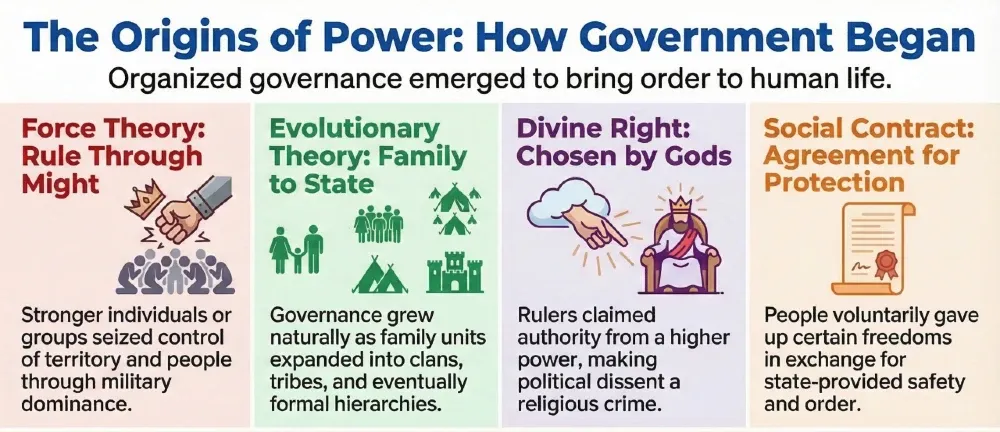
Force Theory
One of the oldest and most straightforward explanations is force theory. According to this idea, governments began when a strong individual or group used force to take control over a territory and its people. In other words, the most powerful person simply took charge and everyone else had little choice but to follow.
Early kingdoms and empires were often built this way, through conquest and military dominance. Force theory doesn't paint a pretty picture of government's origins, but it reflects a reality that played out repeatedly throughout human history. Many of the world's earliest rulers held power simply because they had the strength to take it and keep it.
Evolutionary Theory
Evolutionary theory offers a more gradual explanation. This theory suggests that government grew naturally out of early family and tribal structures. In the earliest human communities, families grouped together into clans, and clans grew into tribes. Within those groups, leaders emerged organically, usually elders or those with the most experience and wisdom.
Over time, as these groups grew larger and more complex, the informal authority of a tribal elder evolved into more structured forms of leadership and eventually into formal government. According to this theory, government developed slowly and naturally as human communities expanded, not through force.
Divine Right Theory
Divine right theory takes a very different approach. According to this idea, certain individuals were chosen by God (or the gods) to rule over others. Their authority came not from the consent of the people or from military power, but from a higher power. This theory was used to justify monarchy for thousands of years across many cultures.
In ancient Egypt, the pharaoh was considered a god himself. In medieval Europe, kings and queens claimed that their right to rule came directly from God, making any challenge to their authority not just politically dangerous but religiously forbidden. Divine right theory gave rulers enormous power and made it very difficult for ordinary people to question or resist their government.
Social Contract Theory
Social contract theory presents perhaps the most influential explanation of government's origins, especially for understanding modern democracy. This theory argues that government was not created by force or divine will, but by an agreement among people.
According to social contract thinkers like Thomas Hobbes, John Locke, and Jean-Jacques Rousseau, people voluntarily gave up some of their freedoms in exchange for the order and protection that government provides. Hobbes believed people entered this agreement out of fear, because without government life would be chaotic and dangerous. Locke argued that people formed governments to protect their natural rights to life, liberty, and property. Rousseau believed the social contract should reflect the will of the people as a whole. These ideas became the philosophical foundation for the American system of government.
The Agricultural Revolution and Early Governments
Whatever theory best explains government's origins, most historians agree that organized government became truly necessary during the Agricultural Revolution, around 10,000 years ago.
As people shifted from nomadic hunting and gathering to settled farming, permanent communities formed and grew into cities. In Mesopotamia, between the Tigris and Euphrates rivers, some of the world's first city-states emerged around 3500 BCE.
These early governments managed resources, settled disputes, organized defense, and created written laws. The Code of Hammurabi, written around 1754 BCE, is one of the earliest examples of a government putting its rules in writing, a major step in the development of organized civilization.
From tribal elders to divine kings to elected representatives, government has taken many forms throughout history. But in every case, it has served the same basic purpose: bringing order and structure to human life together.