The Purposes of Government
Have you ever wondered why governments exist in the first place? Why do we have laws, leaders, and institutions that make decisions for millions of people? The answer comes down to a simple idea: people need structure, protection, and a system for working together. Governments exist to provide all of those things.
Keeping Order and Safety
One of the most basic purposes of government is to maintain order. Without rules and consequences, society would quickly fall into chaos. Imagine a school with no teachers, no rules, and no consequences. It wouldn't take long before things went sideways. The same is true for a country.
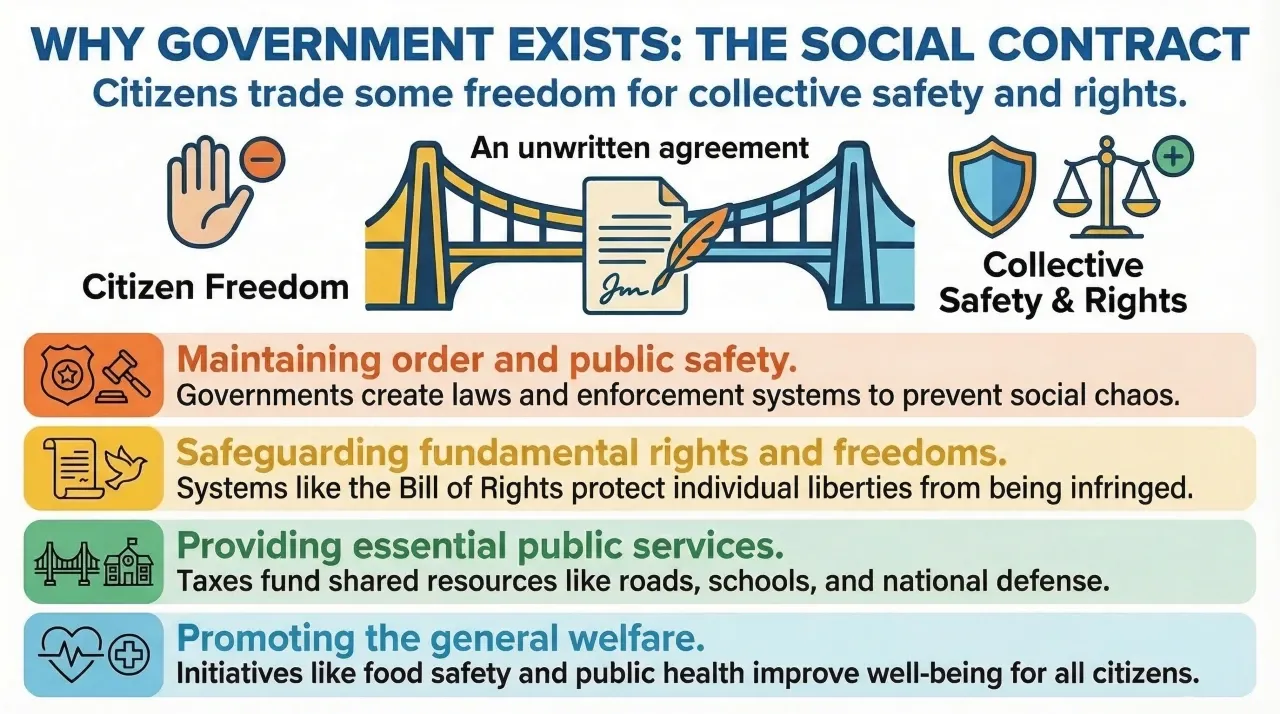
Governments create and enforce laws that help people live together peacefully. Police departments, courts, and prisons are all part of this system. When someone breaks the law, the government steps in to handle the situation and protect the rest of society. This concept, that people give up some freedoms in exchange for safety and order, goes back to early political thinkers like Thomas Hobbes, who believed that without government, life would be chaotic and dangerous.
Protecting Rights and Freedoms
Governments do more than just protect people from criminals. They also protect people's basic rights. In the United States, the Constitution and the Bill of Rights guarantee freedoms like freedom of speech, freedom of religion, and the right to a fair trial. One of the most important jobs of government is making sure those rights are respected, both by other citizens and by the government itself.
This is actually a tricky balance. A government powerful enough to protect your rights is also powerful enough to take them away. That's why the founders of the United States built in checks and balances. These checks are designed to prevent any one person or group from gaining too much power.
Providing Services
Another major purpose of government is to provide services that benefit everyone. These are things that would be difficult (or impossible) for private individuals or businesses to handle on their own. Think about roads, public schools, national defense, or the fire department. Most people couldn't afford to pay for these things individually, and it wouldn't make sense for every neighborhood to build its own army. So the government pools resources through taxes and uses that money to provide shared services.
These public services are sometimes called public goods. These are things that are available to everyone and that one person using doesn't prevent someone else from using as well. National defense is a classic example: protecting one citizen protects all citizens.
Promoting the General Welfare
Beyond safety and services, government also works to improve the overall well-being of its people. This is sometimes called promoting the general welfare, and it's actually written right into the Preamble of the U.S. Constitution. Programs like Social Security, public health initiatives, and food safety regulations are all examples of the government trying to make life better for everyone, not just the wealthy or powerful.
A Social Contract
Underlying all of these purposes is an idea called the social contract. This is the unwritten agreement between citizens and their government. Citizens agree to follow the laws and pay taxes, and in return, the government agrees to protect them, provide services, and respect their rights. This idea was developed by philosophers like John Locke and Jean-Jacques Rousseau, and it became the foundation for modern democratic government.
Government isn't perfect, and people often disagree about how much it should do and how it should do it. At its core though, government exists because people recognized long ago that working together, with rules, institutions, and shared responsibilities, leads to a safer, fairer, and more prosperous society for all.