Federalism & the Division of Power
One of the most distinctive features of American government is that power is not concentrated in one place. Instead, authority is divided between the national government in Washington, D.C., and the governments of the 50 states.
This arrangement, known as federalism, was one of the most debated and carefully crafted aspects of the Constitution. Understanding how power is divided, and what happens when the two levels of government conflict, is essential to understanding how America's government works.
Expressed Powers of the Federal Government
The Constitution grants the federal government a specific set of powers, sometimes called expressed or enumerated powers because they are explicitly listed in the document.
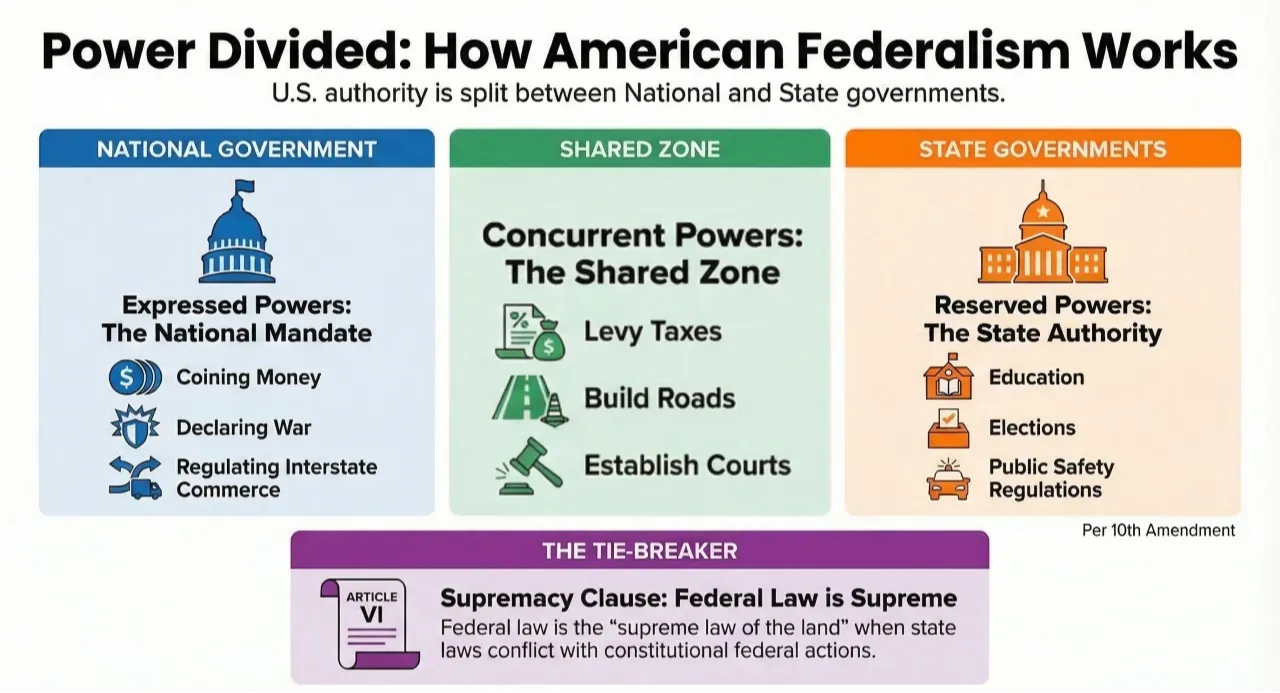
These include the power to levy and collect taxes, regulate commerce between states and with foreign nations, coin money, declare war, raise and maintain a military, establish post offices, and make treaties with other countries.
These powers reflect areas where a unified national approach was considered essential. It would make little sense, for example, for each state to have its own currency or its own foreign policy.
Reserved Powers of the States
The Tenth Amendment to the Constitution states that all powers not granted to the federal government and not prohibited to the states are reserved to the states or to the people.
These reserved powers give states significant authority over many aspects of daily life. States control their own education systems, conduct elections, establish local governments, regulate intrastate commerce, and manage matters related to public health and safety.
This is why things like speed limits, marriage laws, and school curricula can vary significantly from one state to another.
Concurrent Powers
Some powers are shared between the federal government and the states. These concurrent powers include the authority to levy taxes, build roads, establish courts, and borrow money. Both levels of government exercise these powers simultaneously, though federal law takes precedence when conflicts arise.
The Supremacy Clause
When federal and state law conflict, the Constitution provides a clear answer. Article VI contains the Supremacy Clause, which establishes that the Constitution and federal laws made under it are the supreme law of the land.
State laws that contradict federal law are invalid. This doesn't mean the federal government can do whatever it wants though. It can only act within the powers the Constitution grants it. But within those powers, federal authority wins.
Federalism in Practice
The balance between federal and state power has shifted significantly throughout American history. During the Civil War and Reconstruction, federal power expanded dramatically. The New Deal programs of the 1930s further increased the federal government's role in areas like economic regulation and social welfare.
More recently, debates about issues like healthcare, immigration, and education have renewed arguments about where the line between federal and state authority should be drawn.
These debates reflect genuine, ongoing questions about how best to govern a large, diverse nation.
Federalism allows states to serve as what Supreme Court Justice Louis Brandeis called "laboratories of democracy," experimenting with different policies and approaches. At the same time, the supremacy of federal law ensures that certain national standards and rights apply equally to all Americans, regardless of which state they live in.