Checks, Balances &
the Branches of Government
One of the most important decisions the framers made when writing the Constitution was how to organize government power. They had lived under British rule and watched how power without limits could become tyrannical.
They had also seen the problems caused by a national government that was too weak under the Articles of Confederation.
Their solution was to divide government into three separate branches and then give each branch tools to check the power of the others. This system of separation of powers and checks and balances remains one of the defining features of American government.
The Three Branches
The Constitution establishes three distinct branches of the federal government, each with its own responsibilities and powers.
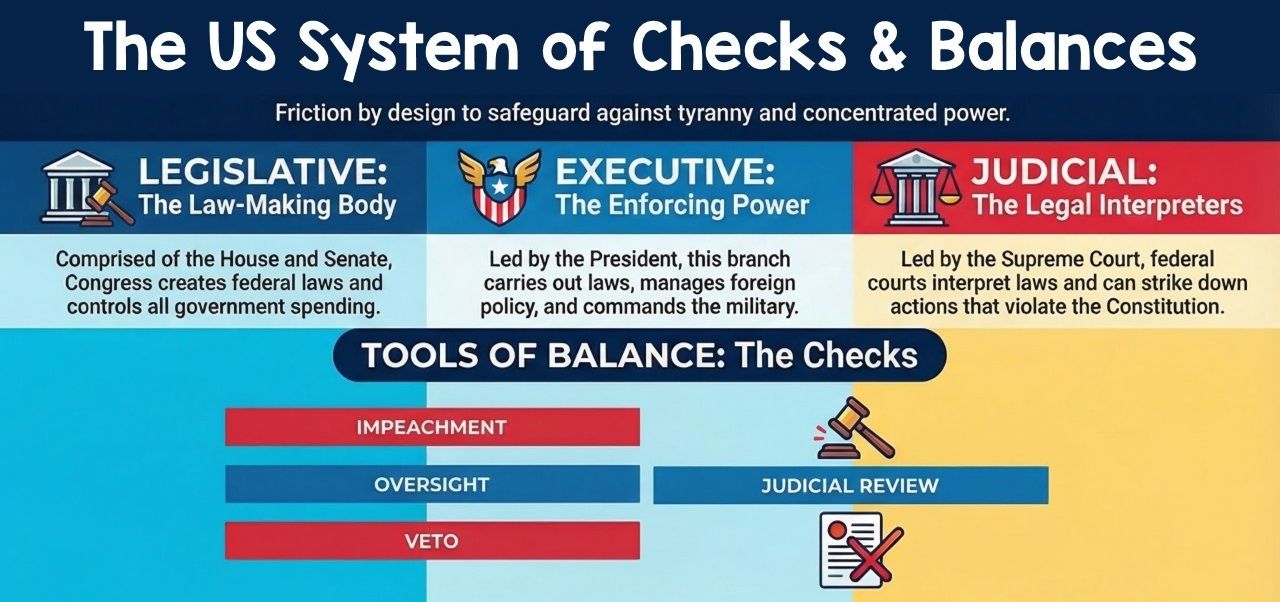
The legislative branch (Congress) is responsible for making federal law. Congress is bicameral, meaning it has two chambers: the Senate and the House of Representatives. The Senate has 100 members, two from each state, serving six-year terms. The House has 435 members, with representation based on each state's population, serving two-year terms. Congress also holds the power of the purse. That means it controls the federal budget and must approve all government spending.
The executive branch is headed by the president, who is responsible for carrying out and enforcing the laws Congress passes. The president also serves as commander in chief of the military, conducts foreign policy, and nominates federal judges and other key officials.
The vice president and the Cabinet, a group of advisors who lead the executive departments, assist the president in managing the executive branch.
The judicial branch is headed by the Supreme Court and includes all the lower federal courts. The judicial branch interprets the law, resolving disputes about what laws mean and whether they are consistent with the Constitution. Federal judges are appointed for life, which is intended to insulate them from political pressure and allow them to make decisions based on the law rather than public opinion.
How Checks and Balances Work
Simply dividing government into three branches would not prevent one branch from dominating the others. So, the Constitution also gives each branch specific powers to check the other two.
Congress checks the president by controlling the budget, confirming presidential appointments, ratifying treaties, and holding the power to impeach and remove the president from office. Congress checks the courts by confirming or rejecting judicial nominees and by having the power to change the size of the federal court system.
The president checks Congress by having the power to veto legislation, which Congress can only override with a two-thirds majority in both chambers. The president checks the courts through the power to nominate federal judges, including Supreme Court justices.
The courts check both Congress and the president through judicial review. This is the power to strike down laws or executive actions that violate the Constitution.
Though not explicitly written into the Constitution, judicial review was firmly established by the Supreme Court in Marbury v. Madison (1803) and has been a cornerstone of American constitutional law ever since.
Why This System Matters
The system of checks and balances reflects the founders' deep suspicion of concentrated power. As James Madison wrote in Federalist No. 51, "If men were angels, no government would be necessary."
Because people are not angels, the Constitution builds in structural safeguards to prevent any single person or group from controlling the entire government.
The system is deliberately designed to create friction. It is hard to get things done without broad agreement. This can be frustrating, but it is also a powerful protection against tyranny.