Understanding the Due Process Clause

One of the most important, and frequently debated, phrases in the Constitution appears in the Fifth and Fourteenth Amendments: "No person shall be deprived of life, liberty, or property, without due process of law."
This is the Due Process Clause, and it serves as one of the Constitution's most powerful protections for individual rights.
Understanding what it means and how it has been applied helps explain some of the most significant legal developments in American history.
What Is Due Process?
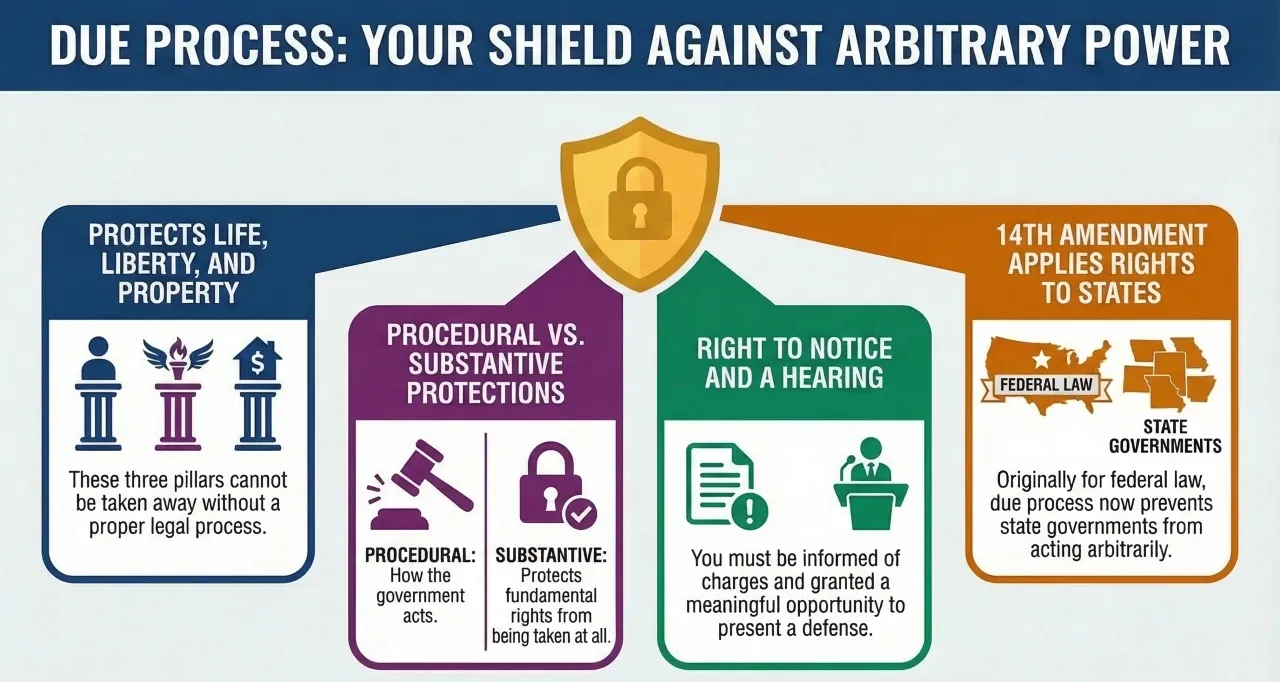
At its most basic level, due process means that the government must follow fair procedures before taking away a person's life, liberty, or property. It is the constitutional guarantee that the government cannot simply arrest you, punish you, or take your belongings without going through a proper legal process.
This includes things like the right to be informed of charges against you, the right to a hearing, the right to present a defense, and the right to an impartial decision-maker like a judge or jury.
The roots of due process go all the way back to the Magna Carta of 1215, which established that even the king could not imprison a person without lawful judgment. The concept traveled from English common law into American constitutional law, where it has been interpreted and expanded over centuries.
There are two distinct types of due process.
Procedural Due Process
Procedural due process focuses on the methods the government uses when it acts against an individual. It asks the question: did the government follow the right steps? Before the government can take a significant action against a person like firing a government employee, revoking a professional license, or imposing a criminal sentence, it must provide notice and an opportunity to be heard.
The specific procedures required depend on what is at stake. Criminal cases require the most extensive protections, including the right to a jury trial and legal representation.
Substantive Due Process
Substantive due process is a more expansive and more controversial concept. It holds that certain fundamental rights are so important that the government cannot take them away at all, regardless of what procedures it follows.
In other words, some things are simply off-limits for the government, no matter how carefully it acts. Courts have used substantive due process to protect rights not explicitly listed in the Constitution, including the right to privacy, the right to marry, and the right to make decisions about one's own family. These applications have made substantive due process one of the most debated doctrines in constitutional law.
The Fourteenth Amendment's Role
The Fifth Amendment's Due Process Clause originally applied only to the federal government. After the Civil War, the Fourteenth Amendment extended due process protections to the states, prohibiting any state from depriving persons of life, liberty, or property without due process of law.
This was enormously significant. Through a legal doctrine called incorporation, the Supreme Court has used the Fourteenth Amendment's Due Process Clause to apply most of the Bill of Rights to state governments, meaning that states must also respect freedoms like freedom of speech, the right against unreasonable searches, and the right to a fair trial.
Why It Matters
The Due Process Clause is one of the Constitution's most flexible and powerful tools for protecting individual rights. It has been at the center of landmark Supreme Court cases involving everything from criminal procedure to civil rights to personal liberty.
At its core, it stands for a simple but profound idea: in a free society, the government cannot act arbitrarily against its citizens. That means, for example, the government can’t just pick a person out of a crowd and take their house because a leader feels like it.
Power must be exercised according to established rules, and individuals must have a meaningful opportunity to defend their rights.