The Amendment Process

One of the greatest challenges the framers faced when writing the Constitution was building in a way to change it.
They knew they couldn't anticipate every future problem or circumstance, so the Constitution needed to be able to evolve. At the same time, they didn't want it to be so easy to change that it could be altered carelessly or in the heat of the moment.
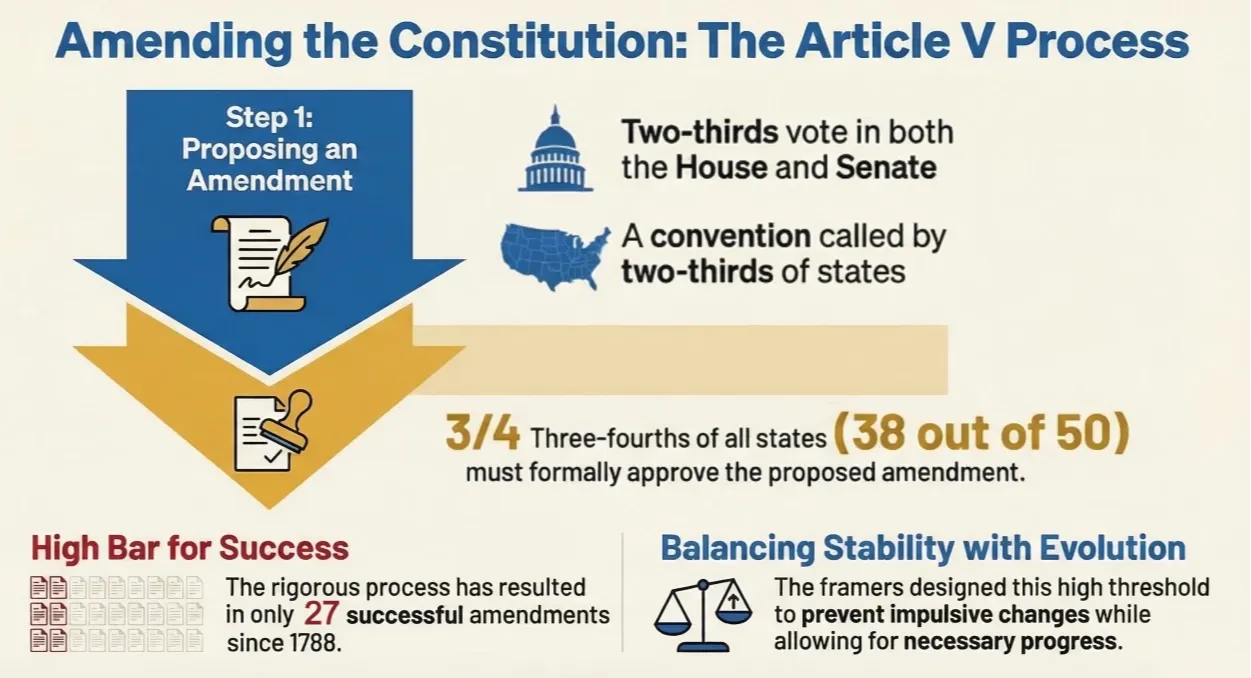
The result was Article V of the Constitution, which establishes a deliberately careful, two-step process for amending the nation's founding document.
Step One: Proposal
The first step in the amendment process is proposing the amendment. There are two ways this can happen.
The most common method is through Congress. If two-thirds of both the House of Representatives and the Senate vote in favor of a proposed amendment, it moves forward to the states for consideration.
This high threshold ensures that only amendments with broad support in the national legislature can advance.
The second method has never actually been used. Two-thirds of state legislatures can call for a constitutional convention, at which delegates would propose amendments.
This option was included to give states a way to propose changes without going through Congress, but the fear of an uncontrolled convention that could rewrite the entire Constitution has kept this method from ever being invoked.
Step Two: Ratification
Proposing an amendment is only the first step. To actually become part of the Constitution, an amendment must be ratified (formally approved) by three-fourths of the states. With 50 states, that means 38 states must approve.
There are two ways ratification can occur: either by a vote of each state's legislature, or by special state ratifying conventions. Congress decides which method will be used for each amendment.
The ratification requirement is intentionally demanding. It ensures that no amendment can become law without truly widespread agreement across the country. A change supported by a simple majority, or even a large majority, isn't enough. It must reflect deep, broad consensus.
The 27 Amendments
Since the Constitution was ratified in 1788, it has been amended 27 times. The first ten amendments (the Bill of Rights) were ratified together in 1791. Subsequent amendments have abolished slavery, granted women the right to vote, established the direct election of senators, and limited presidents to two terms, among many other changes.
Each amendment reflects a moment in history when Americans decided the Constitution needed to be updated to better reflect their values and circumstances.
A Balanced Design
The amendment process reflects the founders' careful thinking about stability and change. A constitution that could be easily amended would offer little protection against shifting political winds. One that could never be amended would become outdated and unresponsive to the needs of a changing society. By setting the bar high but not impossibly so, Article V strikes a balance that has allowed the Constitution to endure for more than two centuries while still adapting to the needs of a growing and changing nation.