The Bill of Rights
When the Constitution was ratified in 1788, many Americans felt something was missing. The new document created a powerful national government, but it didn't explicitly protect the rights of individual citizens.
The Anti-Federalists had argued loudly that without such protections, the government could trample on the very freedoms the Revolution had been fought for. In response, James Madison drafted a series of amendments that became the Bill of Rights. These first 10 amendments, ratified in 1791, remain among the most important guarantees of individual freedom in America's history.
The First Amendment
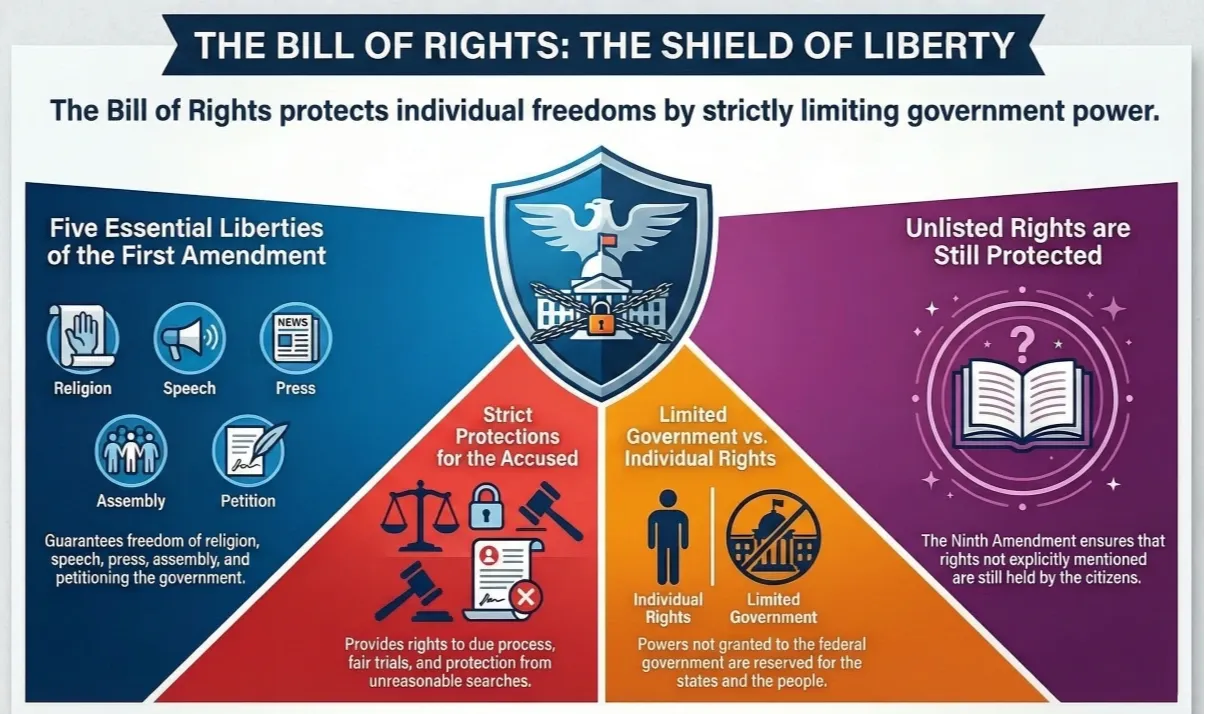
The First Amendment protects five fundamental freedoms: religion, speech, the press, assembly, and petition.
The government cannot establish an official religion or prevent people from practicing their faith. It cannot silence citizens or the press. It cannot stop people from gathering peacefully or from asking the government to address their grievances.
These freedoms are the foundation of a democratic society. Without them, citizens cannot effectively participate in self-governance.
The Second and Third Amendments
The Second Amendment protects the right to keep and bear arms, a provision rooted in the founding era's concern about standing armies and the importance of citizen militias.
The Third Amendment prohibits the government from forcing citizens to house soldiers in their homes during peacetime. This was a direct response to one of the colonists' major grievances against British rule.
The Fourth, Fifth, Sixth, and Eighth Amendments
Several amendments in the Bill of Rights focus specifically on the rights of people accused of crimes. The Fourth Amendment protects against unreasonable searches and seizures, requiring law enforcement to obtain a warrant supported by probable cause before searching a person's home or belongings.
The Fifth Amendment guarantees due process of law and protects against self-incrimination. This means no one can be forced to testify against themselves, something often referred to as “pleading the Fifth.”
The Sixth Amendment guarantees the right to a speedy and public trial, an impartial jury, and legal representation. The Eighth Amendment prohibits excessive bail and cruel and unusual punishment.
The Ninth and Tenth Amendments
The final two amendments address the broader relationship between rights and government power.
The Ninth Amendment clarifies that the rights listed in the Constitution are not the only rights people have. The government cannot use the absence of a right from the list as an excuse to violate it.
The Tenth Amendment reserves to the states and the people all powers not specifically granted to the federal government, reinforcing the principle of federalism.
Why the Bill of Rights Matters
The Bill of Rights was a statement of the framers' values. It said clearly that in America, the government serves the people, and there are limits to what it can do to them.
In the years since, these ten amendments have been at the center of some of the most important legal and social debates in American history, from freedom of speech to the rights of the accused to the limits of government surveillance.
They continue to define the boundaries between government power and individual liberty today.