Federalists & Anti-Federalists Debate Ratifying the Constitution
When the Constitutional Convention finished its work in September 1787, the debate over American government was just getting started. The new Constitution still had to be ratified. That means it needed to be approved by at least 9 of the 13 states. Not everyone was convinced it was a good idea.
The ratification debate divided Americans into two camps: the Federalists, who supported the new Constitution, and the Anti-Federalists, who opposed it. Their arguments shaped the final form of the Constitution and raised questions about government and liberty that Americans are still debating today.
The Federalists
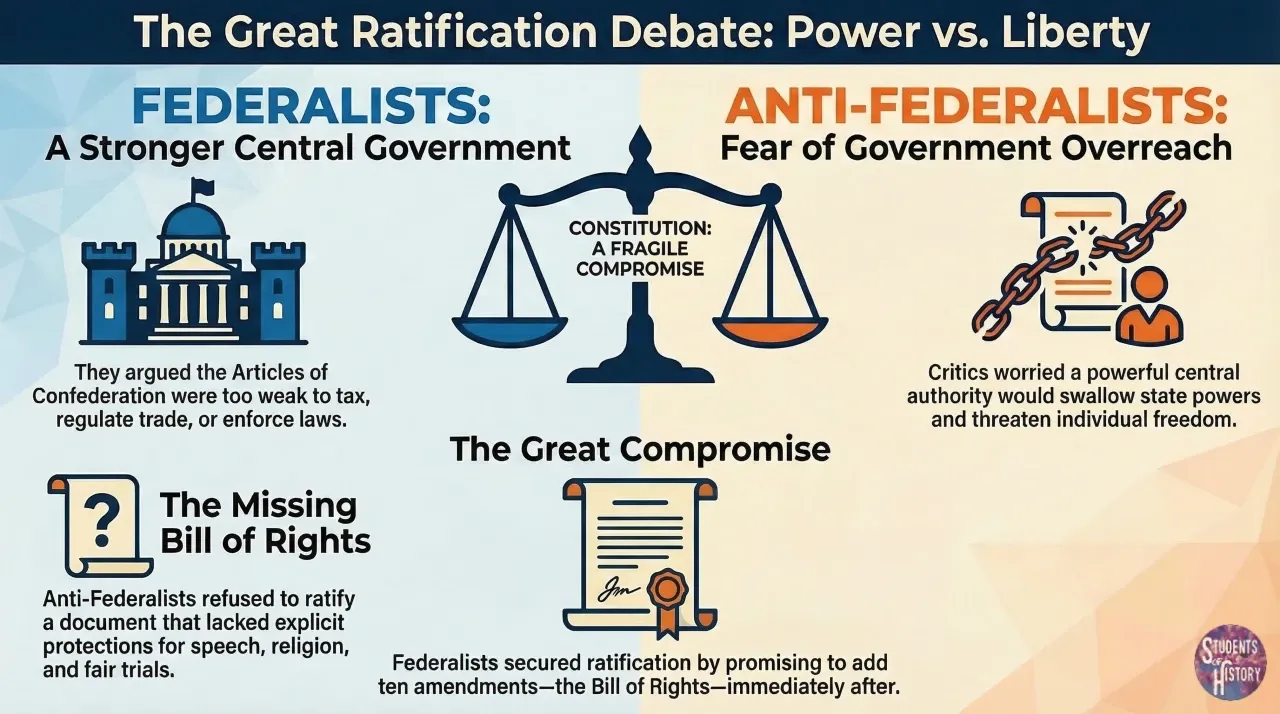
The Federalists believed the new Constitution was necessary to save the young nation. Under the Articles of Confederation, the national government was too weak to function effectively. It couldn't collect taxes, couldn't regulate trade between states, and couldn't enforce its own laws. The country was struggling with debt, economic instability, and the inability to respond to threats. Something had to change.
The most influential Federalist arguments appeared in a series of 85 essays known as The Federalist Papers, written by Alexander Hamilton, James Madison, and John Jay under the shared pen name "Publius."
These essays argued that a stronger national government was not a threat to liberty. It was the only way to protect it. Madison, in Federalist No. 51, argued that the Constitution's system of checks and balances would prevent any branch from becoming tyrannical. Hamilton, in Federalist No. 70, argued for a strong executive as essential to effective government.
The Federalists also pointed out that the Constitution included protections against the abuse of power, including the separation of powers and the requirement that representatives be elected by the people.
The Anti-Federalists
The Anti-Federalists were not simply obstructionists. They had serious, thoughtful concerns about the new Constitution. Their central fear was that a strong central government would eventually swallow up the power of the states and threaten the liberties of individual citizens. They looked at history and saw that large, powerful governments tended toward tyranny.
One of the Anti-Federalists' most significant objections was the absence of a bill of rights. The Constitution as written in 1787 contained no explicit protections for individual freedoms like freedom of speech, freedom of religion, or the right to a fair trial.
Anti-Federalist writers, including a figure known as Brutus (believed to be New York judge Robert Yates), argued that without these protections, the new government could easily overreach and strip citizens of their most basic rights.
The Anti-Federalists also worried about the power of the federal courts, the length of terms for senators, and the concentration of power in the executive branch.
The Compromise
The debate between Federalists and Anti-Federalists was fierce, and ratification was far from guaranteed. In several key states, the vote was extremely close. The turning point came when Federalist leaders agreed to support adding a bill of rights to the Constitution after ratification. This promise helped win over enough skeptics to secure ratification in crucial states like Massachusetts, Virginia, and New York.
True to their word, James Madison drafted ten amendments to the Constitution. These became the Bill of Rights after the Constitution was ratified in 1791. In this sense, the Anti-Federalists won an important victory. Their insistence on explicit protections for individual liberty produced one of the most important parts of the American constitutional framework.
The Federalist vs. Anti-Federalist debate reminds us that the Constitution was the product of argument, compromise, and competing visions of what America should be.