Interest Groups and Lobbying
While elected politicians are the most visible part of American democracy, they are not just listening to the concerns of the people who voted for them.
Interest groups are organizations that represent the views of specific groups of people or industries. They play a powerful and sometimes controversial role in shaping public policy.
What Is an Interest Group?
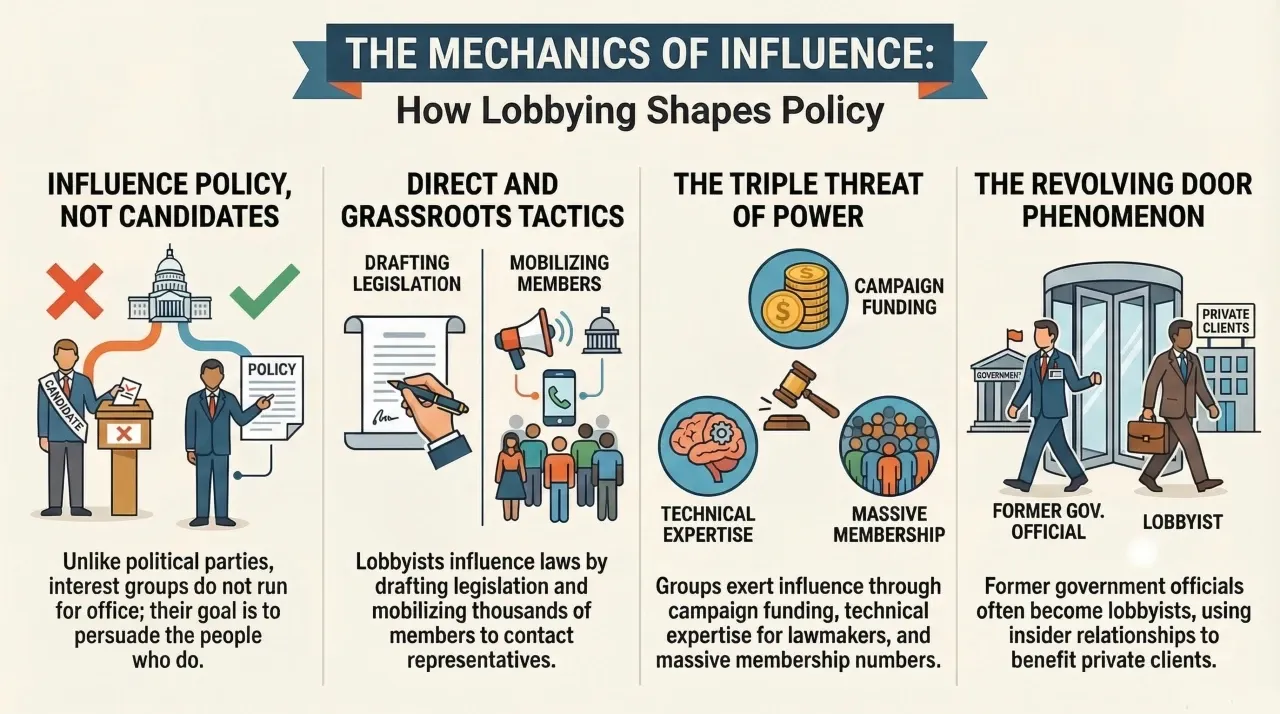
An interest group is an organization that tries to influence government policy on behalf of its members or a particular cause. Unlike political parties, interest groups do not run candidates for office. Their goal is not to win elections but to influence the people who do. Interest groups come in an enormous variety of forms.
Some represent specific industries, like the American Petroleum Institute or the Pharmaceutical Research and Manufacturers of America. Others represent professional groups, like the American Medical Association or the American Bar Association. Many represent ideological causes, like the American Civil Liberties Union or the National Rifle Association.
Still others advocate for specific populations, like AARP, which represents older Americans, or the NAACP, which advocates for civil rights.
What unites all of these organizations is the goal of persuading government officials to adopt policies favorable to their members and interests.
What Is Lobbying?
Lobbying is the direct effort to influence the decisions of government officials. The term comes from the lobbies of legislative buildings, where advocates would gather to buttonhole lawmakers on their way to votes. Today, lobbying is a sophisticated, well-funded profession.
Professional lobbyists are hired by interest groups, corporations, unions, and other organizations to represent their interests before Congress, federal agencies, and state legislatures.
Lobbyists use a variety of tactics to advance their clients' interests. Direct lobbying involves meeting personally with lawmakers and their staff, providing information and arguments in favor of specific policies, drafting legislation, and testifying at congressional hearings.
Grassroots lobbying involves mobilizing an organization's members to contact their representatives, attend public meetings, and make their views known at the local level. Coalition building involves forming alliances with other organizations that share a common interest on a particular issue.
The right to lobby is protected by the First Amendment, which guarantees the right to petition the government. Lobbying is a legal and constitutionally protected activity, though it is subject to regulations requiring disclosure of who is lobbying, on whose behalf, and how much money is being spent.
Why Interest Groups Are Influential
Interest groups have several tools that make them genuinely powerful in the political process. Money is the most obvious. Through political action committees, interest groups can contribute to the campaigns of friendly candidates and spend money on advertising that supports or opposes specific politicians. This financial power gives interest groups access to elected officials that ordinary citizens often cannot match.
Expertise is another significant source of influence. Government officials must make decisions on an enormous range of complex issues, and they rarely have time to become experts on all of them. Interest groups provide research, data, and technical expertise that lawmakers and their staff genuinely rely on. A senator voting on a complex piece of healthcare legislation may rely heavily on information provided by medical industry groups, patient advocacy organizations, and insurance industry lobbyists.
Criticisms of Interest Groups and Lobbying
Interest groups are one of the most criticized features of American democracy. The central concern is that wealthy, well-organized interests have far more influence over government than ordinary citizens. Industries that can afford teams of professional lobbyists and large campaign contributions have a structural advantage in shaping legislation that ordinary people simply cannot match. Critics argue this creates a system where policy outcomes reflect the preferences of the powerful rather than the public good.
The revolving door phenomenon adds to these concerns. Former government officials frequently become lobbyists after leaving office, using their relationships and insider knowledge on behalf of private clients. Similarly, lobbyists sometimes move into government positions, raising questions about whose interests they truly serve.
Supporters of interest groups argue that they are a legitimate and important part of democracy, giving organized groups of citizens a voice in government and providing lawmakers with valuable information. The debate about how much influence interest groups should have and how they should be regulated is an ongoing and important one in American political life.