How a Bill Becomes a Law

You've probably heard the phrase "someone should pass a law about that."
Turning an idea into an actual law is a long, complicated process with many steps and many opportunities for a bill to stall, be changed, or fail entirely.
The process is deliberately challenging. The founders wanted lawmaking to require broad agreement, not just a simple majority in a single moment. Here is how it works.
Step 1: The Idea
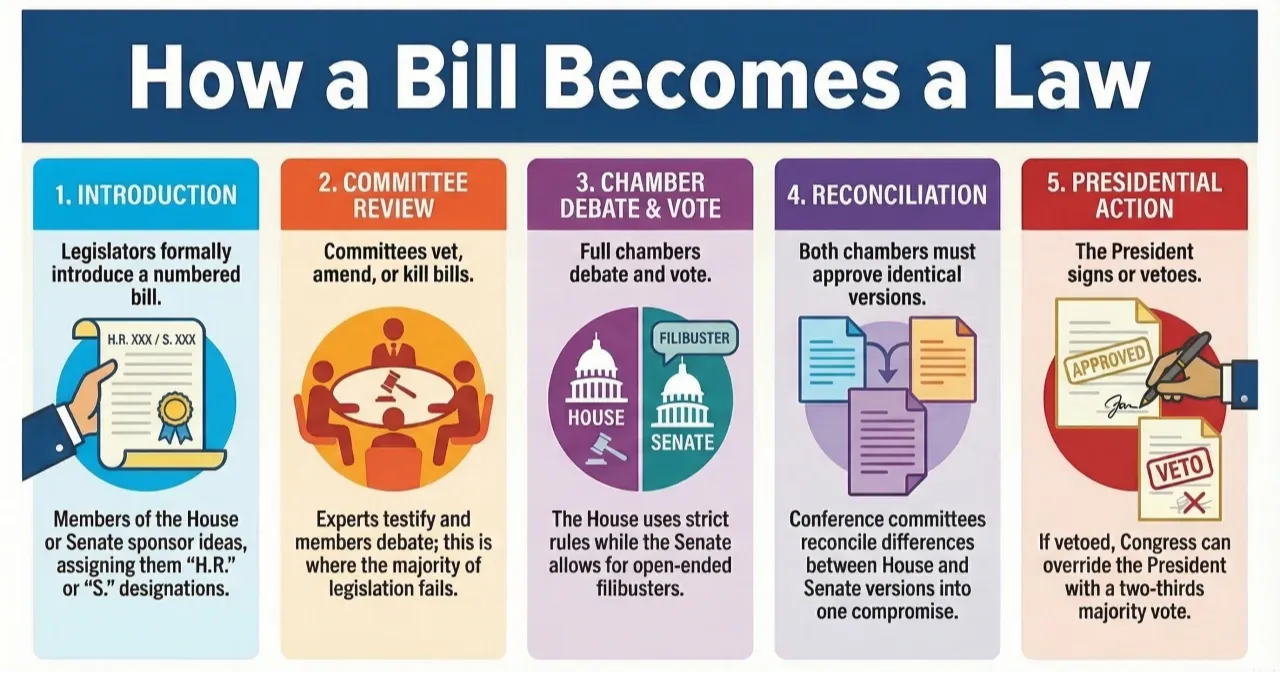
Every law starts as an idea. That idea can come from almost anywhere: a concerned citizen, an interest group, the president, or a member of Congress. But only members of Congress can actually introduce legislation. A senator introduces a bill in the Senate; a representative introduces one in the House. Most bills can start in either chamber, though bills that raise revenue must originate in the House.
When a bill is introduced, it is given a number. House bills get an "H.R." designation, Senate bills get an "S." designation. Then, it officially enters the legislative process.
Step 2: Committee Review
Once introduced, a bill is assigned to the committee that oversees its subject area. A bill about agriculture goes to the Agriculture Committee. A bill about the military goes to the Armed Services Committee. This is where most of the real work happens... and where most bills die.
The committee holds hearings, bringing in experts, government officials, and citizens to testify about the bill. Members debate its merits and often amend it, making changes to improve it or build support. If the committee approves the bill, it moves forward. If the committee ignores it or votes it down, the bill is effectively dead.
Step 3: Floor Debate and Vote
Bills that make it out of committee go to the full chamber for debate and a vote. In the House, debate is tightly controlled. The Rules Committee sets strict time limits. In the Senate, debate can be much more open-ended. Senators can even engage in a filibuster. A filibuster is speaking for an extended period to delay or block a vote. Ending a filibuster requires 60 votes, a threshold called cloture.
During floor debate, members can propose amendments to the bill. Eventually, the chamber votes. If a majority votes in favor, the bill passes that chamber and moves on.
Step 4: The Other Chamber
Here is where things get more complicated. After passing one chamber, a bill must go through the entire process again in the other chamber: committee review, debate, and a vote. The other chamber may pass the bill as written, reject it, or pass its own amended version.
If both chambers pass different versions of the same bill, a conference committee is made up of members from both the House and Senate. They meet to work out the differences and produce a single compromise version. Both chambers must then vote to approve the compromise.
Step 5: The President
Once both chambers have passed identical versions of a bill, it goes to the president. The president has four options. Signing the bill makes it law. Vetoing it sends it back to Congress with the president's objections.
If Congress remains in session and the president takes no action for 10 days, the bill automatically becomes law. If Congress adjourns within those 10 days and the president takes no action, the bill dies. This is called a pocket veto.
A presidential veto is not necessarily the end. Congress can override a veto with a two-thirds majority vote in both chambers, turning the bill into law without the president's signature. Overrides are rare, but do happen.
A Deliberately Difficult Process
From start to finish, the path from idea to law is full of obstacles. Most bills never make it past committee. Many that do fail on the floor. Others pass one chamber but stall in the other.
The small percentage that survive the entire process and become law represent ideas that have built enough support to clear every hurdle. That difficulty is a feature, not a bug. It ensures that the laws governing the country reflect something close to genuine consensus rather than the will of a temporary majority.