Congressional Leadership
Congress is a large and complex institution with hundreds of members, competing interests, and an enormous workload.
To function effectively, it needs organized leadership, including people who set the agenda, manage debate, build coalitions, and guide legislation through the process.
Congressional leadership has evolved over time into a structured system of elected officers and party leaders who shape how each chamber operates.
Leadership in the House of Representatives
The most powerful position in the House is the Speaker of the House. The Speaker is elected by the full membership of the House, which in practice means the Speaker is always a member of the majority party. That is whichever party with more than half the seats.
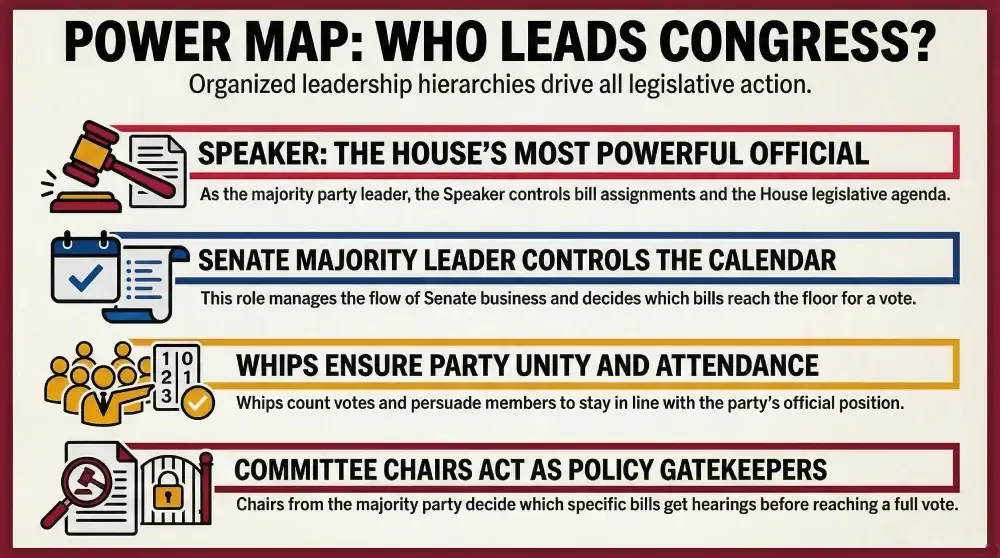
The Speaker presides over House sessions, controls the flow of legislation, assigns bills to committees, and plays a central role in setting the House's legislative agenda. The Speaker is also second in the line of presidential succession, after the vice president.
Below the Speaker, each party has its own leadership structure. The majority party's leader on the floor is the Majority Leader, who works closely with the Speaker to advance the party's legislative priorities and coordinate voting strategy.
The Majority Whip assists the Majority Leader by counting votes, persuading members to support the party's position, and ensuring members are present for important votes. The term "whip" comes from fox hunting, where a "whipper-in" kept the hounds from straying. This is an apt metaphor for the job of keeping party members in line.
The minority party (the party with fewer seats) has its own parallel leadership. The Minority Leader serves as the chief spokesperson and strategist for the minority party, leading opposition to the majority's agenda. The Minority Whip performs the same vote-counting and persuasion function for the minority side.
Leadership in the Senate
The Senate's leadership structure is similar in some ways but distinct in others. The Constitution designates the Vice President of the United States as the President of the Senate. However, the vice president rarely presides over Senate sessions and only votes in the case of a tie.
In the vice president's absence (which is most of the time) the Senate is presided over by the President pro tempore, a largely ceremonial position traditionally held by the most senior member of the majority party.
Real day-to-day leadership in the Senate falls to the party floor leaders. The Majority Leader is the most powerful figure in the Senate, controlling the legislative calendar, deciding which bills come to the floor for a vote, and managing the flow of Senate business. The Minority Leader leads the opposition party's strategy and serves as its chief spokesperson. Both parties also have whips in the Senate, performing the same vote-counting role as their House counterparts.
The Role of Committees
Much of Congress's actual work happens not on the floor of either chamber but in committees. These are smaller groups of members who specialize in particular policy areas.
Committee chairs, who are always members of the majority party, hold significant power over legislation in their area. They control the committee's agenda, decide which bills get hearings, and play a central role in shaping legislation before it ever reaches a full floor vote.