The Legislative Branch

Of the three branches of the federal government, the legislative branch is the one most directly connected to the American people.
It is the branch closest to the voters, the most responsive to public opinion, and the one the Constitution's framers considered most central to a functioning democracy. Article I of the Constitution, which establishes the legislative branch, is the longest article in the document. This reflects just how important the founders considered it.
A Bicameral Legislature
Congress, the legislative branch of the federal government, is bicameral, meaning it is divided into two separate chambers. The upper chamber is the Senate, and the lower chamber is the House of Representatives. Both chambers must pass a bill before it can become law, and each has its own distinct rules, responsibilities, and character.
This two-chamber design was not accidental. It was the result of one of the most important compromises at the Constitutional Convention of 1787. Larger states wanted representation based on population, while smaller states wanted equal representation regardless of size. The solution, known as the Great Compromise, gave the country both: a House where representation is based on population and a Senate where every state has equal representation.
The House of Representatives
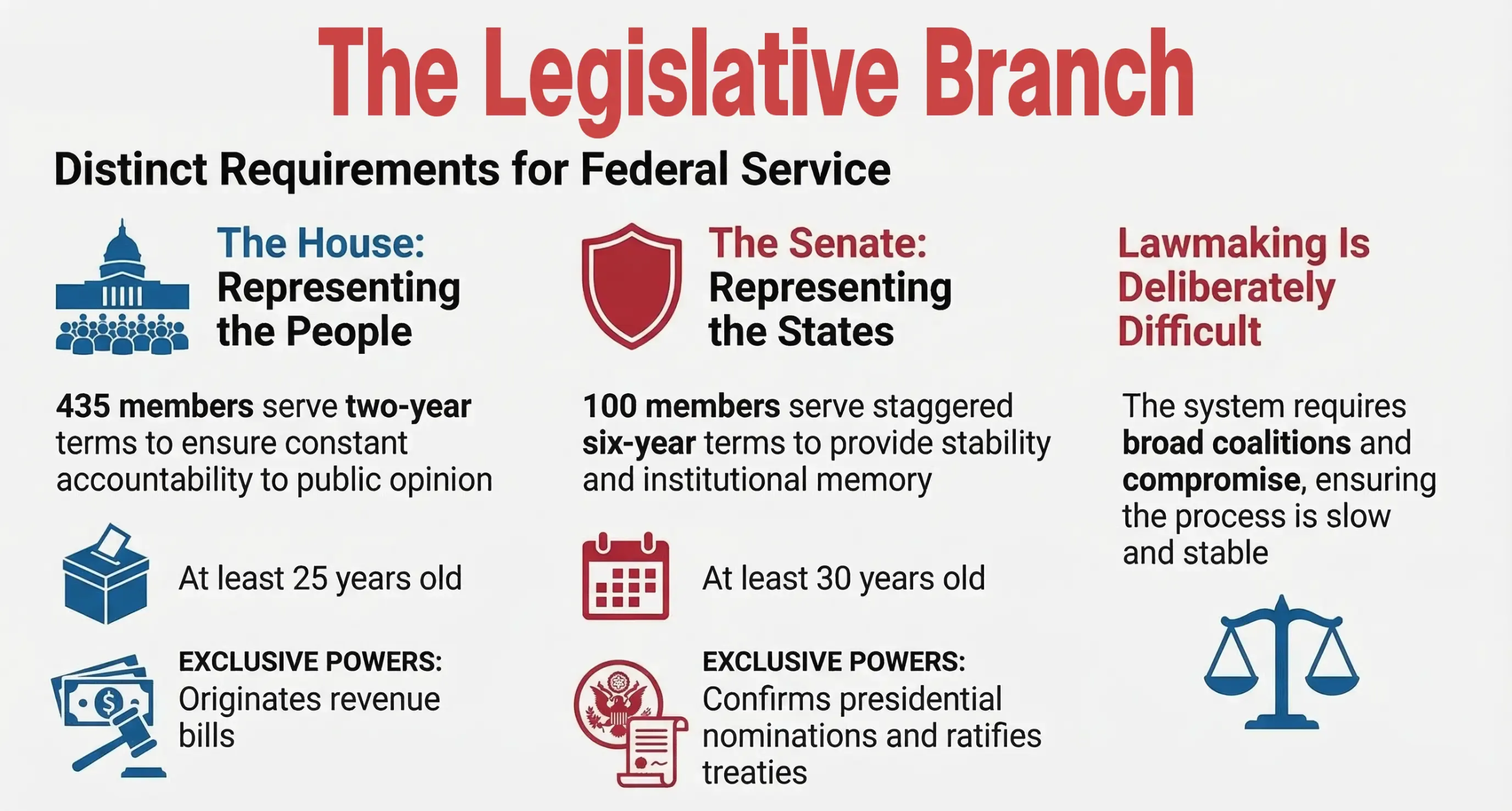
The House of Representatives has 435 voting members, with each state's share determined by its population. California, the most populous state, has 52 representatives. Several smaller states have just one.
Representatives serve two-year terms, meaning the entire House faces election every two years. This short term was intentional. The founders wanted the House to be highly responsive to public opinion and closely accountable to voters.
To serve in the House, a person must be at least 25 years old, a United States citizen for at least seven years, and a resident of the state they represent. The House has some unique powers not shared with the Senate, including the exclusive authority to introduce revenue bills and the sole power to impeach federal officials.
The Senate
The Senate has 100 members, with two from each state, regardless of population. Senators serve six-year terms, with roughly one-third of the Senate up for election every two years. This staggered system ensures continuity. The entire Senate never faces election at once, providing stability and institutional memory.
To serve in the Senate, a person must be at least 30 years old, a citizen for at least nine years, and a resident of the state they represent.
The Senate has its own exclusive powers as well. It confirms presidential nominations for federal judges, Cabinet members, and ambassadors. It ratifies treaties with foreign nations by a two-thirds vote. And it serves as the jury in impeachment trials, with a two-thirds vote required to remove an official from office.
Congress as a Whole
Together, the two chambers form one of the most powerful legislative bodies in the world. Congress controls the federal budget, makes the nation's laws, declares war, oversees the executive branch, and has the power to amend the Constitution.
It is also an intensely human institution. It is shaped by personality, ambition, negotiation, and compromise. Getting anything done in Congress requires building coalitions across sometimes very different interests and perspectives, which is by design.
The founders wanted lawmaking to be deliberate and difficult, not fast and easy.