Landmark Campaign Finance Cases
In American elections, running a campaign takes money and a lot of it. Campaign finance laws have been established to control how that money is used.
The Supreme Court has played a major role in shaping what the government can and cannot regulate when it comes to political money.
Several landmark court cases have fundamentally changed the campaign finance landscape, often by striking down laws that Congress passed and expanding the definition of protected political speech.
Buckley v. Valeo (1976)
The first major Supreme Court ruling on campaign finance came just two years after Congress overhauled FECA in the wake of Watergate.
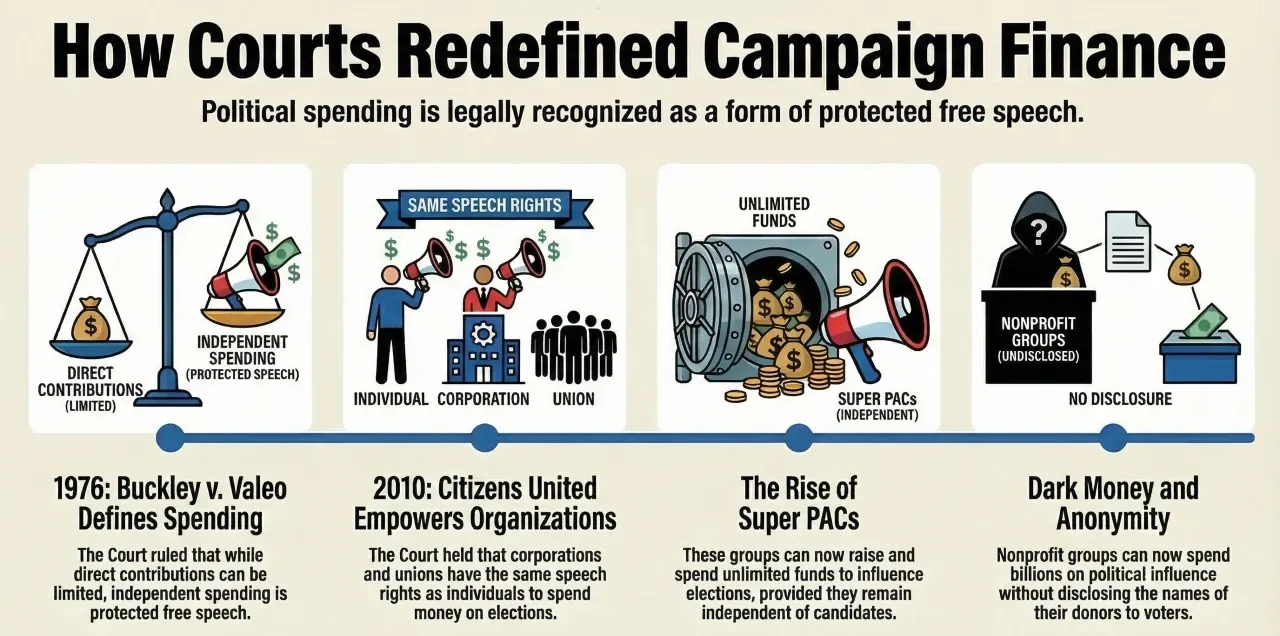
In Buckley v. Valeo, the Court considered whether the contribution and spending limits in FECA violated the First Amendment's guarantee of free speech. The Court drew a crucial distinction between contributions and expenditures. Contribution limits - caps on how much individuals could give directly to a candidate - were upheld as a legitimate way to prevent corruption.
Spending limits (restrictions on how much a candidate or individual could spend on political expression) were struck down as unconstitutional violations of free speech. The Court reasoned that spending money to communicate political views is itself a form of protected speech.
This ruling established the basic framework that has governed campaign finance ever since: the government can limit direct contributions to candidates, but it faces a much higher bar when trying to restrict independent political spending.
Emily's List v. FEC (2009)
Emily's List is an organization dedicated to electing Democratic women who support abortion rights. In this case, the organization challenged FEC regulations that limited its ability to raise and spend funds on political activities.
The U.S. Court of Appeals for the D.C. Circuit ruled in Emily's List's favor, striking down FEC rules that restricted how much money the organization could raise in large donations for certain political activities.
The decision reinforced the principle established in Buckley that independent political spending is broadly protected by the First Amendment and that the government's ability to regulate such spending is limited.
Citizens United v. FEC (2010)
Citizens United v. FEC is arguably the most consequential, and controversial, campaign finance decision in American history.
The case began when Citizens United, a conservative nonprofit organization, wanted to air a film critical of Hillary Clinton and advertise it during the 2008 primary season. The FEC blocked the film's distribution, citing provisions of the McCain-Feingold Act that restricted certain corporate-funded political communications close to an election.
The Supreme Court, in a 5-4 decision, ruled that the government could not restrict independent political expenditures by corporations, associations, or labor unions. The Court held that political speech does not lose its First Amendment protection simply because it comes from a corporate or organizational source rather than an individual. The ruling struck down a key provision of McCain-Feingold and opened the door to unlimited independent political spending by corporations and other organizations.
The decision led directly to the creation of super PACs. These groups can raise and spend unlimited money to support or oppose candidates, as long as they don’t work directly with them.
Recognizing political spending as a protected form of free speech unleashed a flood of special interest money into American politics. A major consequence has been the rise of 'dark money'. This is political spending by nonprofit groups that are not required to disclose the names of their donors to the public. This has allowed billions of dollars from wealthy individuals and corporations to influence elections while remaining completely anonymous to voters.
The Ongoing Debate
These court cases reflect a fundamental tension in American democracy: the tension between preventing corruption and protecting free political expression. Every attempt to limit money in politics runs up against the First Amendment's guarantee of free speech, and the courts have consistently held that political spending is a form of protected expression.
At the same time, modern campaigns are incredibly complex. Billions of dollars flow through candidates, parties, super PACs, and nonprofit organizations. This raises serious questions about whether ordinary citizens can compete with wealthy donors and special interests for political influence.
These questions have no easy answers, but understanding the legal landscape helps explain why campaign finance works the way it does.