Campaign Funding and Spending
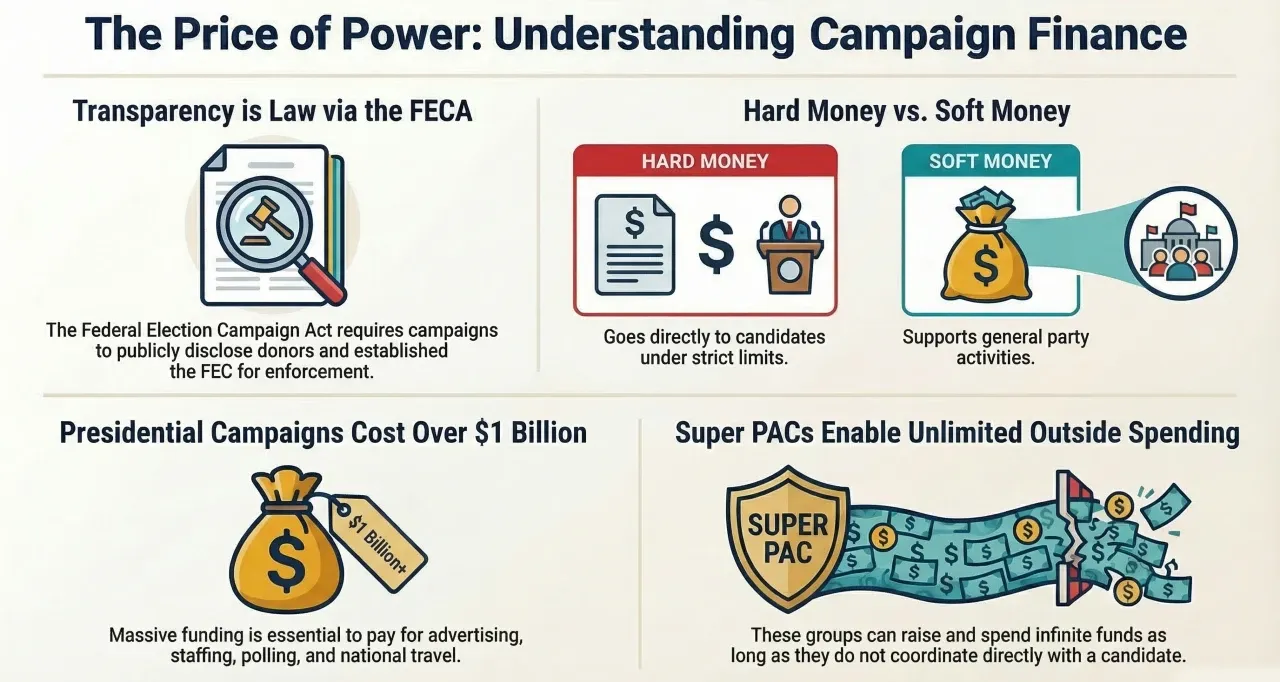
Running for office in the United States is expensive, sometimes extraordinarily so. Presidential campaigns routinely spend over a billion dollars. Even races for the House of Representatives can cost millions.
Where does all that money come from, and what rules govern how it is raised and spent?
Campaign finance is one of the most complex and controversial areas of American politics, touching on fundamental questions about free speech, democracy, and the influence of money on government.
Why Campaign Finance Matters
Money is essential to modern campaigns. It pays for advertising, staff, travel, polling, and get-out-the-vote operations. Candidates who can raise more money generally have significant advantages over those who cannot.
This reality raises an obvious concern: if wealthy individuals, corporations, or special interest groups can pour unlimited money into campaigns, do they gain disproportionate influence over elected officials?
This tension between free political expression and the prevention of corruption has driven campaign finance law and debate for decades.
The Federal Election Campaign Act
The foundation of modern federal campaign finance law is the Federal Election Campaign Act (FECA), originally passed in 1971 and significantly amended in 1974 following the Watergate scandal. FECA established several key principles that continue to shape campaign finance today.
First, it created mandatory disclosure requirements, meaning campaigns must publicly report who donates to them and how much. Transparency was seen as a way to allow voters to follow the money and hold candidates accountable.
Second, FECA established limits on how much individuals and organizations could contribute directly to candidates. These contribution limits were intended to prevent any single donor from having outsized influence over a candidate. Third, FECA created the Federal Election Commission (FEC), an independent agency responsible for enforcing campaign finance laws and overseeing disclosure.
FECA also established a system of public financing for presidential campaigns, allowing candidates who agreed to spending limits to receive federal matching funds. This system, largely abandoned by major candidates in recent decades as private fundraising has skyrocketed, represented an attempt to reduce candidates' dependence on large donors.
Hard Money and Soft Money
Campaign finance distinguishes between "hard money" and "soft money". Hard money refers to contributions made directly to a candidate's campaign, subject to legal limits and disclosure requirements. Soft money refers to funds donated to political parties for general activities like voter registration and get-out-the-vote efforts, which for a time were not subject to the same limits as direct candidate contributions.
The Bipartisan Campaign Reform Act of 2002, also known as McCain-Feingold, attempted to close this soft money loophole by restricting large donations to political parties. However, subsequent court decisions opened new avenues for large-scale political spending outside the direct campaign finance system.
Super PACs and Outside Spending
Today, much of the spending in major elections comes not from the candidates' own campaigns but from outside groups like political action committees, super PACs, and nonprofit organizations.
These groups can raise and spend unlimited amounts of money on political advertising and activities, as long as they do not directly coordinate with a candidate's campaign. The rise of these outside spending groups has dramatically increased the total amount of money flowing through American elections and raised new questions about transparency and influence.