Reapportionment and Redistricting

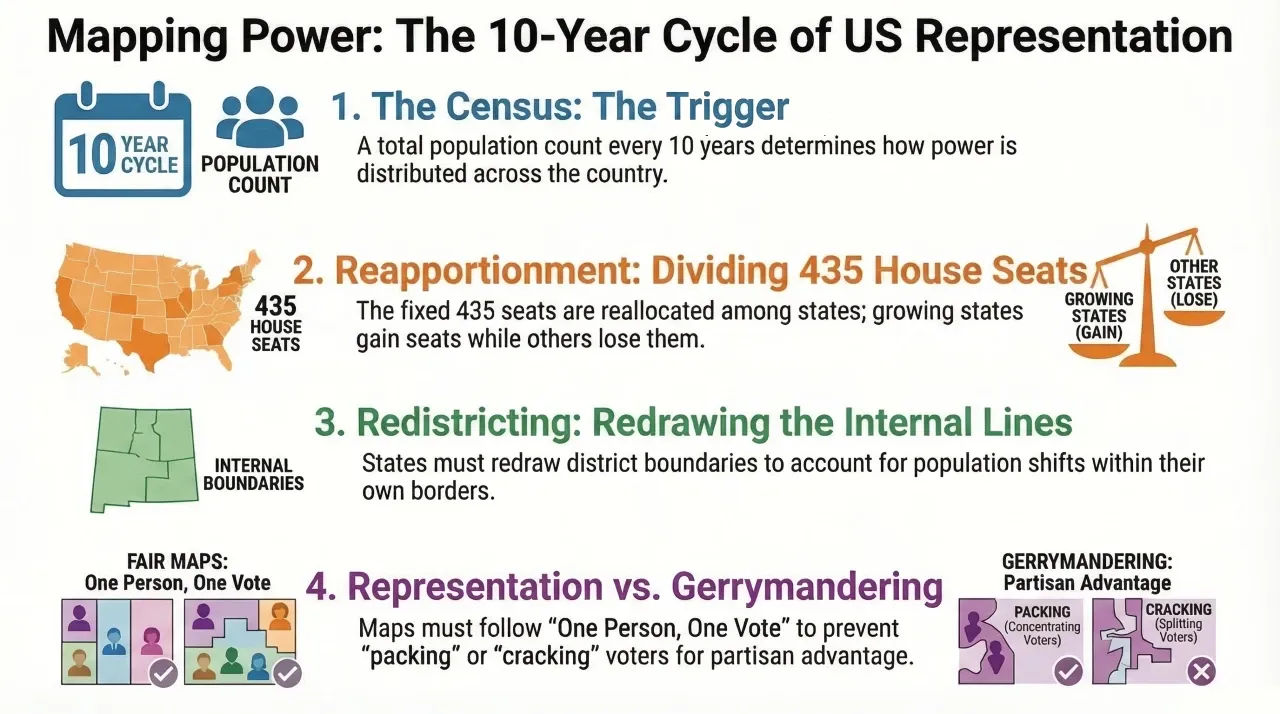
Every ten years, the United States conducts a census that counts every person living in the country. The results of that census trigger a process that determines how political power is distributed across the country for the next decade.
That process, involving reapportionment and redistricting, has enormous consequences for elections and representation. It has also been the source of some of the most contentious political battles in American history.
What Is Reapportionment?
Reapportionment refers to the redistribution of seats in the House of Representatives among the states based on population changes recorded in the census. The Constitution requires that representatives be apportioned among the states according to their populations, and the House has been fixed at 435 members since 1929.
After each census, those 435 seats are reallocated to reflect population shifts. States that have grown in population gain seats; states that have lost population or grown more slowly than others lose seats. After the 2020 census, for example, Texas gained two seats while California lost one for the first time in its history.
The Senate is not subject to reapportionment. Every state has two senators regardless of population, a compromise built into the Constitution.
What Is Redistricting?
Once a state knows how many congressional seats it has, it must draw the district boundaries that determine which geographic areas those seats represent. This process is called redistricting. With a few exceptions, each congressional seat represents a specific district, and the lines of those districts must be redrawn after every census to account for population changes within the state. Redistricting also applies to state legislative districts.
In most states, the state legislature is responsible for drawing congressional district maps. This means that whichever party controls the state legislature after a census has significant influence over how district lines are drawn — and therefore over which party is likely to win those districts in future elections.
Gerrymandering
When district lines are drawn to give one political party an unfair advantage, the result is called gerrymandering. This process is named after Elbridge Gerry, a Massachusetts governor who approved a famously oddly shaped district in 1812. Gerrymandering typically works through two strategies. Packing concentrates voters of one party into as few districts as possible, limiting their influence to a small number of seats. Cracking spreads voters of one party across multiple districts so they are always in the minority, preventing them from winning any of those seats.
The result of effective gerrymandering can be a map where one party wins far more seats than its share of the overall vote would suggest. Both major parties have engaged in gerrymandering when they have had the opportunity, and the practice has been widely criticized as undermining fair representation. Some states have moved to address this by creating independent redistricting commissions rather than leaving the process to partisan legislators.
The "One Person, One Vote" Principle
A key constitutional requirement governing redistricting is the principle of "one person, one vote," established by the Supreme Court in a series of cases in the 1960s, most notably Reynolds v. Sims (1964). This principle holds that legislative districts must be roughly equal in population so that each citizen's vote carries approximately the same weight.
Before these rulings, many states had wildly unequal districts. Some rural districts with small populations had the same representation as urban districts with much larger ones, effectively giving rural voters more power.
The one person, one vote principle requires states to draw districts of roughly equal population, and courts have used it to strike down maps that deviate too far from population equality. It remains one of the foundational requirements of fair redistricting.