Influences on Elections
Winning a modern election requires more than having good ideas or a strong record. It requires persuading voters. This battle for hearts and minds takes place across a complex landscape of media coverage, advertising, public opinion polling, and the internet.
Each of these forces shapes how voters see candidates and issues, often in ways that are subtle and difficult to detect.
Media Coverage
The news media plays a powerful role in shaping public perception of candidates and campaigns. The amount and tone of coverage a candidate receives can significantly affect how voters view them. A candidate who receives extensive positive coverage gains name recognition and credibility. One who is ignored or covered negatively faces an uphill battle regardless of their actual qualifications.
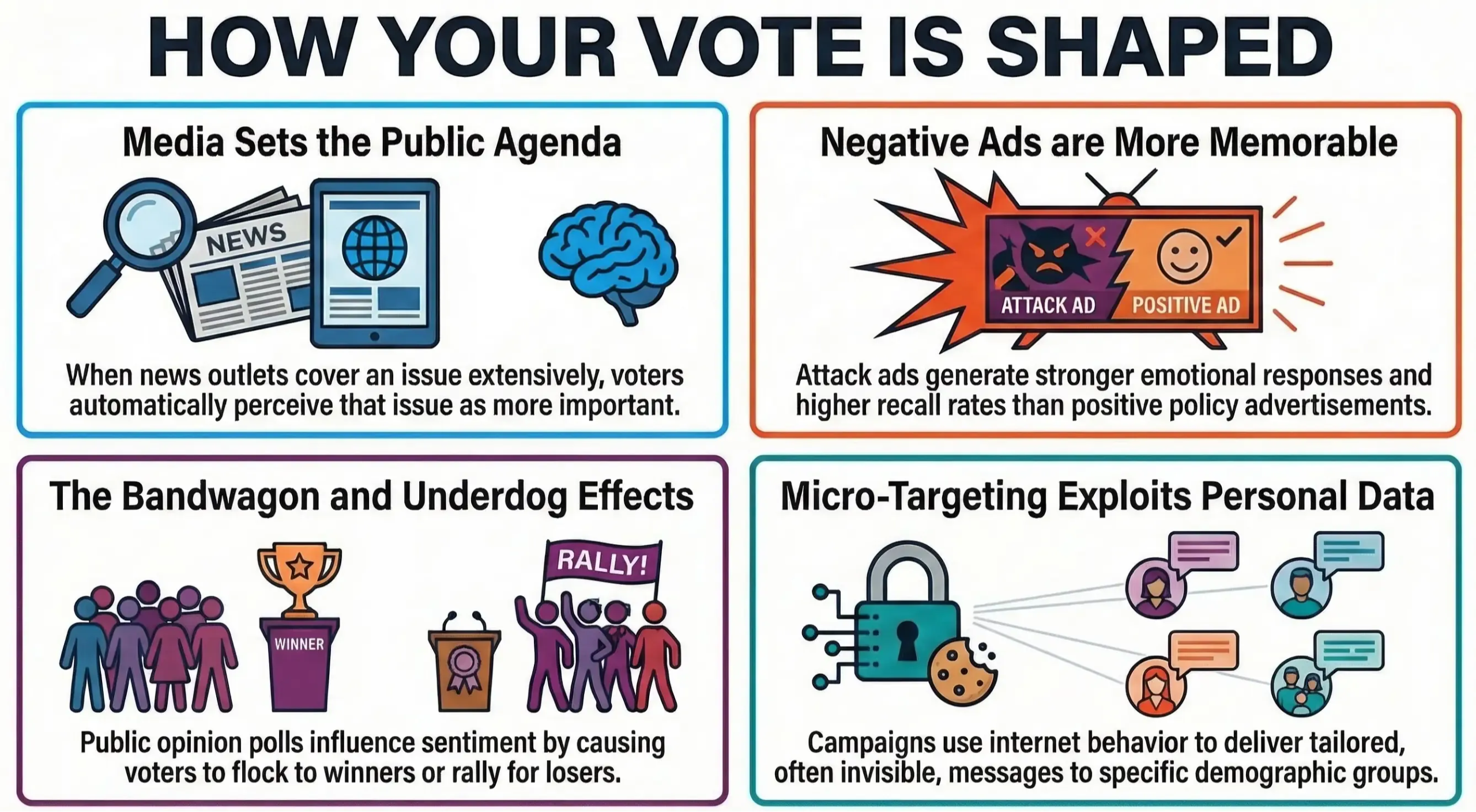
Media coverage also shapes which issues voters consider most important, something political scientists call agenda setting. When news outlets devote significant coverage to a particular issue, voters tend to rate that issue as more important. Candidates who are associated with high-priority issues in voters' minds tend to benefit, while those associated with low-priority issues or negative stories tend to suffer.
The media landscape has changed dramatically in recent decades. Traditional outlets like newspapers and broadcast television have lost audience share to cable news, podcasts, and online news sources.
By 2026, 'alternative media' like long-form podcasts and independent creators have rivaled traditional news outlets in influence, allowing candidates to bypass professional journalists and speak directly to niche audiences for hours at a time.
This fragmentation means voters increasingly consume news from sources that align with their existing views, a trend that can reinforce existing beliefs rather than challenge them.
Campaign Advertising
Political advertising is one of the most direct tools campaigns use to influence voters. Television ads, radio spots, digital ads, and mailers allow campaigns to craft carefully controlled messages and deliver them to specific audiences.
Campaign ads generally fall into two categories: positive ads that highlight a candidate's qualifications and policy positions, and negative ads (sometimes called attack ads)that focus on an opponent's record, character, or positions.
Research consistently shows that negative advertising works. Attack ads are more memorable and tend to generate stronger emotional responses than positive ones. Critics argue they also lower the overall quality of political discourse and contribute to voter cynicism. Regardless, they remain a staple of modern campaigns at every level.
Public Opinion Polls
Public opinion polls are surveys designed to measure how voters feel about candidates, parties, and issues. They are a constant presence during election season, with new polls released almost daily in the final weeks of a major campaign. Polls serve several purposes. They help campaigns identify where they stand and where they need to focus resources. They help journalists frame their coverage and lastly, they give voters a sense of where the race stands.
Polls can also influence elections, not just measure them. When voters see that their preferred candidate is far behind in the polls, some may decide their vote is wasted and stay home. Others may rally to support an underdog. This bandwagon effect, where people support whoever appears to be winning, and the related underdog effect can both be driven by polling data.
The accuracy of polls has also come under scrutiny in recent election cycles, raising questions about how reliable they are as predictors of actual outcomes.
Internet-Based Communications
The internet has fundamentally transformed how campaigns communicate with voters. Social media platforms allow candidates to speak directly to millions of supporters without any filter from traditional media.
A tweet, post, or video can reach a massive audience instantly and for free, a development that has leveled the playing field in some ways but also created new challenges.
Online political advertising allows campaigns to target specific groups of voters with remarkable precision, delivering different messages to different audiences based on their demographics, interests, and online behavior.
This micro-targeting raises important questions about transparency. Voters may not realize they are being shown a tailored message that other voters never see.
Social media has also accelerated the spread of misinformation. False or misleading claims can go viral before fact-checkers have a chance to respond, shaping public opinion in ways that are difficult to correct.
Beyond misinformation, AI is now used for 'hyper-personalized' messaging, where algorithms can generate thousands of slightly different versions of an ad to appeal to the specific anxieties or interests of individual voters based on their browsing history.
At the same time, the internet has expanded opportunities for grassroots organizing, small-dollar fundraising, and civic engagement in ways that have genuinely democratized political participation.
Taken together, these forces (media coverage, advertising, polling, and the internet) form the environment in which modern elections are decided. Being an informed voter means understanding how these influences work and approaching political information with a healthy dose of critical thinking.