Voter Turnout in Elections
Democracy depends on citizen participation, and the most basic form of participation is voting. But in the United States, large numbers of eligible voters sit out every election. Why is that and what factors influence it?
What Is Voter Turnout?
Voter turnout refers to the percentage of eligible voters who actually cast a ballot in a given election. It is typically calculated by dividing the number of votes cast by the total number of people eligible to vote.
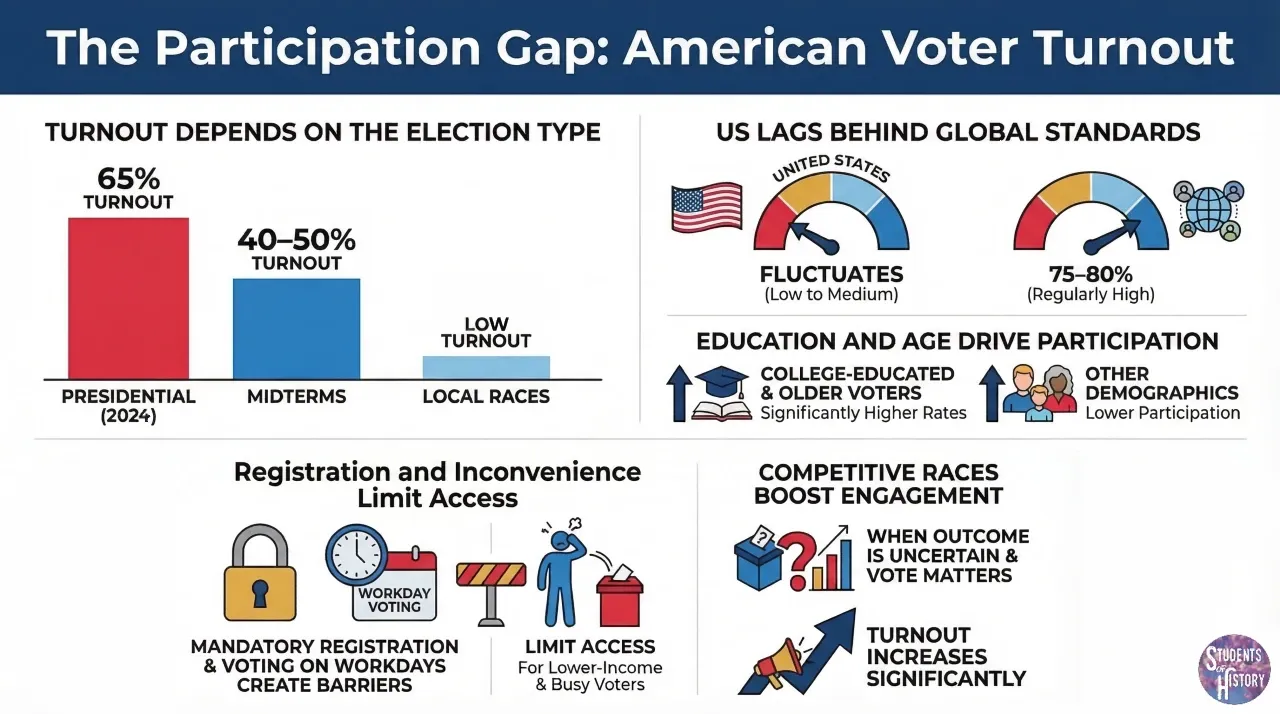
Turnout varies significantly depending on the type of election. Presidential elections consistently draw the highest turnout. In the 2024 presidential election, 74% of the voting-age population was registered to vote and 65% actually voted.
Midterm elections, held two years into a presidential term, typically see turnout in the 40-50% range. Local elections often draw even smaller percentages, sometimes in the single digits.
By international standards, American voter turnout is relatively low. Some established democracies regularly see turnout of 75-80% or higher. This gap has prompted significant debate about what drives turnout and what, if anything, should be done to increase it.
Factors That Increase Turnout
Several factors tend to increase the likelihood that a person will vote. Higher levels of education are strongly associated with higher turnout. College-educated citizens vote at significantly higher rates than those without a college degree. Older citizens also vote at higher rates than younger ones, which is one reason politicians pay close attention to the concerns of retirees.
Competitive elections drive higher turnout. When voters believe the outcome of an election is uncertain and their vote could make a difference, they are more motivated to participate.
A highly contested presidential race will almost always produce better turnout than one where the outcome seems predetermined. Strong get-out-the-vote efforts by campaigns and civic organizations also make a meaningful difference, particularly among groups that historically vote at lower rates.
Factors That Decrease Turnout
Several factors work against participation. Voter registration requirements present a barrier in many states. Unlike some countries where citizens are automatically registered, Americans must actively register to vote. Those who are not registered simply cannot vote, no matter how motivated they might be on election day.
Inconvenience also plays a role. Voting in the United States typically requires taking time out of a workday, traveling to a polling location, and waiting in line. For people working multiple jobs, caring for children, or lacking reliable transportation, these obstacles can be significant.
States with limited early voting options, few polling locations, or strict voter ID requirements tend to see lower turnout, particularly among lower-income and minority voters.
Political disengagement is another factor. Many Americans feel that their vote doesn't matter, that politicians don't represent their interests, or that the political system is too broken to fix through elections. This sense of alienation is a powerful deterrent to participation.
Why Turnout Matters
Low voter turnout has real consequences for democracy. When only a fraction of eligible voters participate, elected officials are accountable to a narrow slice of the population rather than the public as a whole.
Groups that vote at higher rates tend to have more influence over policy outcomes, while those who stay home have less.
Increasing voter turnout through easier registration, expanded voting access, and civic education is widely seen as a way to make American democracy more representative and responsive to all of its citizens.