The Electoral College
Every four years, Americans go to the polls to vote for president. But they are not actually voting directly for a candidate. They are voting for a group of electors who will then cast the official votes for president.
This system, known as the Electoral College, is one of the most distinctive and most debated features of American democracy. It was created by the founders as a compromise, and over 200 years later it continues to generate arguments about fairness and the meaning of democracy.
Why the Electoral College Was Created
When the Constitutional Convention met in 1787, the delegates debated for a long time about how to elect the president.
A direct popular vote was one option, but many delegates were skeptical. They worried that voters in a large, geographically dispersed country would not have enough information about candidates from distant states to make informed choices.
Others were concerned that a purely popular vote would give too much power to the most populous states. Some delegates also had reservations about giving ordinary citizens too much direct power over the selection of the executive.
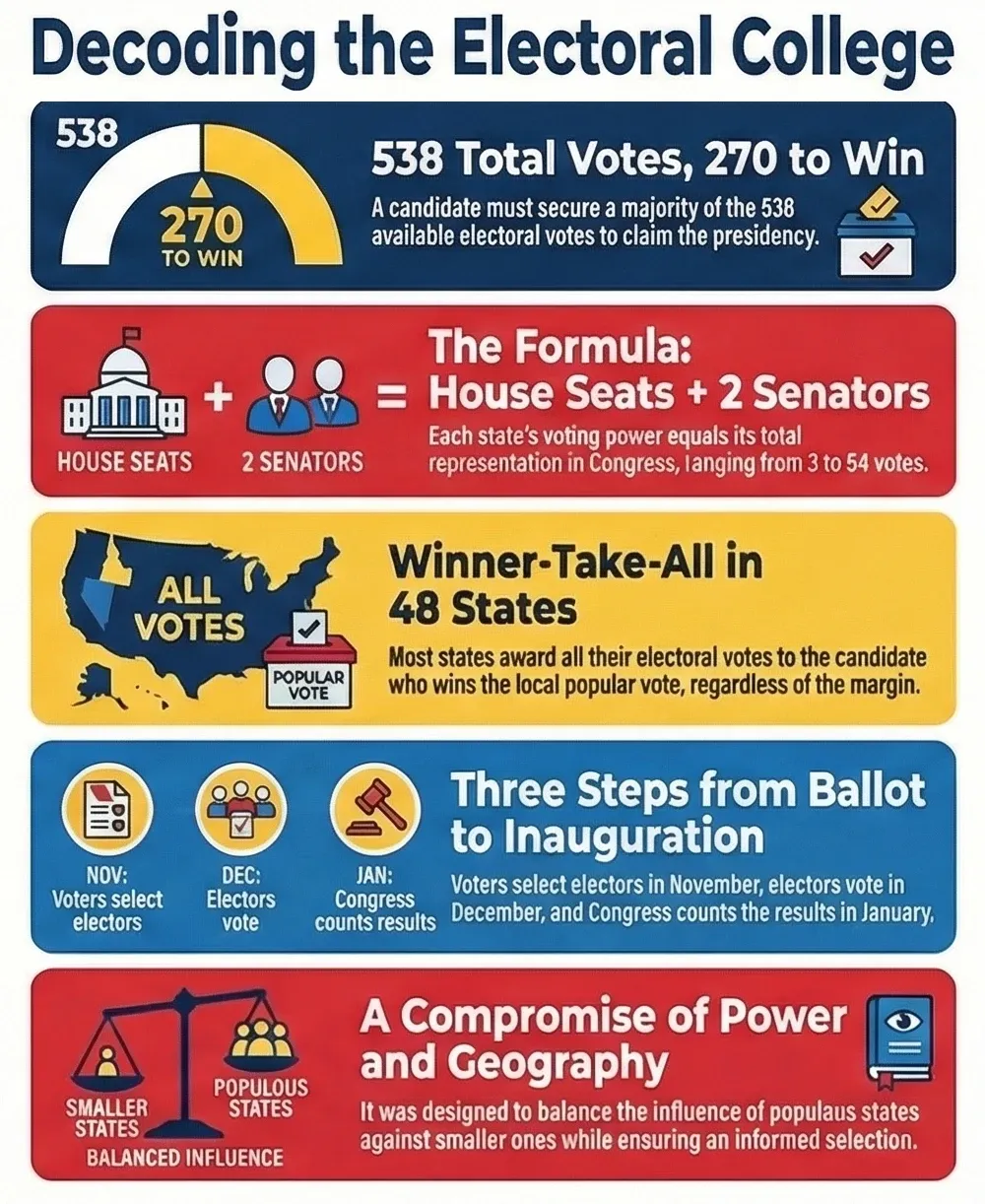
The Electoral College was the compromise that emerged. It created an indirect system in which voters choose electors, who then formally elect the president. The founders saw electors as informed citizens who would exercise independent judgment in selecting the best candidate for the nation's highest office.
In practice, this vision of independent electors has never really worked as intended, and today electors almost always vote for the candidate who won their state's popular vote.
How It Works
Each state has a number of electoral votes equal to its total representation in Congress: the number of House seats plus two senators. California, the most populous state, has 54 electoral votes. Several small states and the District of Columbia have just three. There are 538 total electoral votes, so a candidate needs at least 270 to win the presidency.
In 48 states and the District of Columbia, electoral votes are awarded on a winner-take-all basis. Whichever candidate wins the popular vote in that state receives all of its electoral votes, regardless of the margin of victory. Maine and Nebraska are the two exceptions, using a system that allows their electoral votes to be split between candidates based on results in individual congressional districts.
On Election Day, when voters cast their ballots for president, they are technically selecting a slate of electors pledged to their preferred candidate. After the election, the winning electors in each state meet in their state capital in December to cast their official electoral votes. Congress then counts those votes in January, and the candidate with a majority is declared the winner.
Faithless Electors
In most elections, electors simply vote for the candidate they are pledged to support. Occasionally, however, an elector votes for a different candidate, either in protest or out of personal conviction. These are called faithless electors.
Most states have laws requiring electors to vote for their pledged candidate, and the Supreme Court ruled in 2020 that states have the authority to enforce these laws and remove or penalize faithless electors.
Arguments for the Electoral College
Supporters of the Electoral College make several arguments in its favor. It preserves the role of states in the presidential selection process, consistent with the federal structure of American government.
It encourages candidates to build broad geographic coalitions rather than simply running up vote totals in the most populous urban areas. It tends to produce clear winners with definitive mandates, avoiding the messy scenarios that might arise from extremely close nationwide popular vote totals. And in most elections, the Electoral College result reflects the national popular vote, delivering a clear and accepted outcome.
Arguments Against the Electoral College
Critics of the Electoral College raise equally serious concerns. The winner-take-all system in most states means that votes cast for the losing candidate in any state have no effect on the outcome.
A Democrat in Wyoming and a Republican in California effectively have no influence on the presidential race, since their states reliably go to the other party. This creates the phenomenon of swing states. A small number of competitive states receive the vast majority of candidate attention and campaign resources, while most of the country is largely ignored.
The most pointed criticism is that the Electoral College can produce a president who lost the popular vote nationwide. This has happened five times in American history, most recently in 2016.
Critics argue that a system in which the candidate with fewer votes can win the presidency is fundamentally undemocratic. Defenders respond that the United States is a federal republic, not a pure democracy, and that the Electoral College reflects the federal character of the nation.
The debate over the Electoral College is ultimately a debate about what kind of democracy America wants to be, and it shows no signs of being resolved anytime soon.