The Nomination and Election Process

Every four years, Americans tune in to watch presidential election results roll in on election night. But the process that produces those two names on the ballot is long, complex, and begins well before anyone casts a vote.
Declaring Candidacy
The road to elected office begins when a person formally announces they are running. For major offices like the senate or presidency, this often happens a year or more before the general election.
Declaring candidacy triggers a series of legal requirements, including registering with the Federal Election Commission and beginning to report campaign contributions and expenditures.
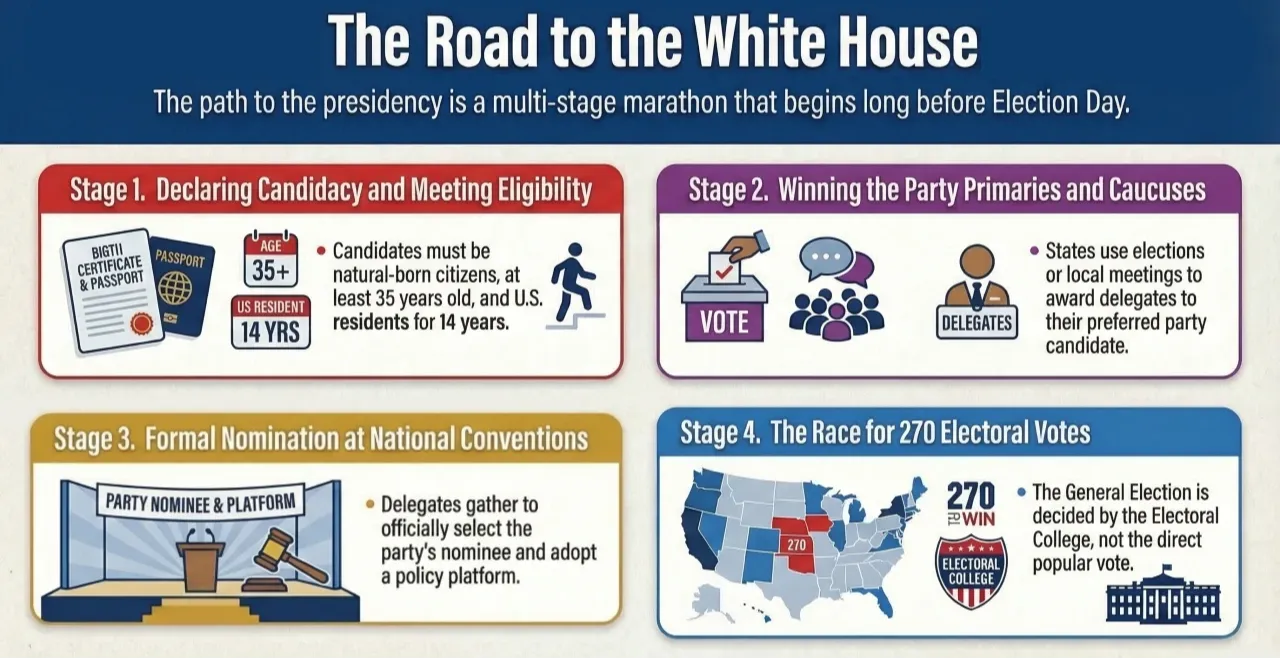
For most offices, candidates must also meet basic eligibility requirements. The president, for example, must be a natural-born citizen, at least 35-years-old, and a resident of the United States for at least 14 years.
The Primary Process
Before a candidate can represent a political party in the general election, they must first win their party's nomination. This happens through a series of primary elections and caucuses held in each state. A primary is a state-run election in which voters choose their preferred party candidate. A caucus is a local meeting where voters gather to discuss candidates and indicate their preferences through a show of hands or by physically grouping together.
Primary elections come in several forms. In a closed primary, only registered members of a political party can vote in that party's primary. In an open primary, any registered voter can participate regardless of party affiliation. Some states use a hybrid system.
The results of primaries and caucuses determine how many delegates each candidate receives, and it is the delegates (not the voters directly) who formally nominate the candidate at the party's national convention.
National Conventions
Each major party holds a national convention, typically in the summer before the general election. Delegates from every state gather to formally nominate the party's presidential and vice-presidential candidates and adopt the party platform: the official statement of the party's positions on major issues.
In most modern elections, the nominee is effectively decided before the convention begins, making the convention more of a celebration and campaign launch than a genuine decision-making event. But historically, conventions have sometimes been contested affairs where the outcome was uncertain until the final vote.
The General Election
General elections are held on the first Tuesday after the first Monday in November. In presidential elections, voters are technically voting for a slate of electors rather than directly for the president. These electors make up the Electoral College, the system established by the Constitution for selecting the president.
Each state receives a number of electoral votes equal to its total number of senators and representatives in Congress. With a few exceptions, states award all of their electoral votes to whichever candidate wins the popular vote in that state. A candidate needs 270 electoral votes to win the presidency.
For other offices (senators, representatives, governors, state legislators) the winner is simply the candidate who receives the most votes in the general election, a straightforward winner-take-all system.