The Expressed Powers of Congress
The Constitution does not give Congress unlimited authority to do whatever it thinks is best for the country. Instead, it grants Congress a specific list of powers. These are called expressed or enumerated powers because they are explicitly written out in the document.
These powers are found primarily in Article I, Section 8, and they define the scope of what Congress is authorized to do on behalf of the American people.
The Power to Tax and Spend
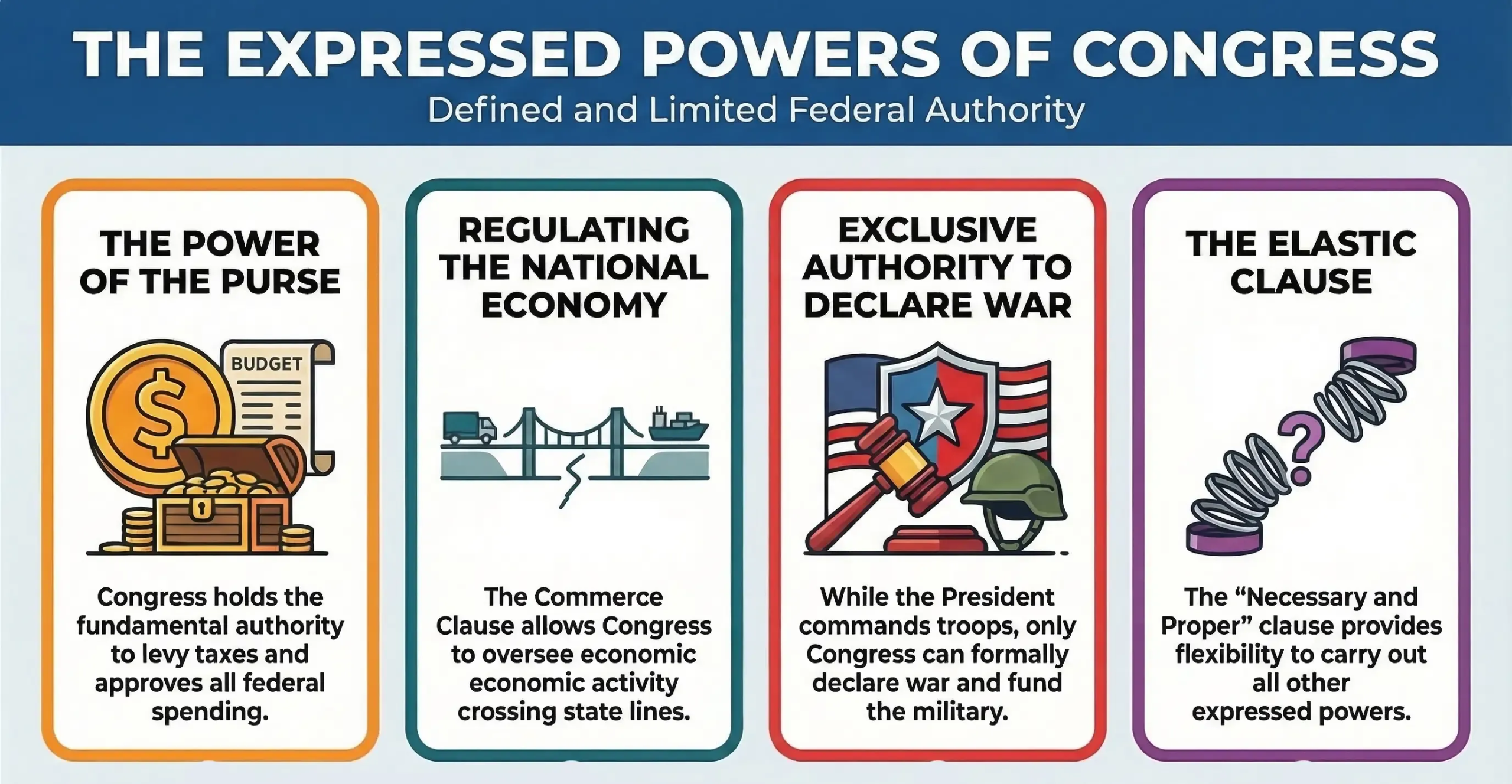
The most fundamental power Congress holds is the power of the purse. It has the authority to levy taxes and decide how federal money is spent. No federal program can be funded without congressional approval, which gives Congress enormous leverage over the rest of the government.
The Sixteenth Amendment, ratified in 1913, specifically authorized Congress to collect an income tax, which today provides the largest share of federal revenue.
Congress also has the power to borrow money on behalf of the United States, which it does by authorizing the national debt. In recent years, standoffs over raising the debt limit have become a major point of conflict between Congress and the president.
Regulating Commerce
One of Congress's most far-reaching expressed powers is the authority to regulate commerce with foreign nations and among the states.
Known as the Commerce Clause, this power has been interpreted broadly over time to justify a wide range of federal legislation, from civil rights laws to environmental regulations to labor standards. The basic idea is that when economic activity crosses state lines or affects the national economy, Congress has the authority to regulate it.
Coining Money
Congress has the exclusive power to coin money and regulate its value. This means that only the federal government, not individual states or private entities, can produce legal currency.
Congress also has the power to punish counterfeiting. This centralized control over currency was one of the major improvements over the Articles of Confederation, under which states had issued their own currencies, creating economic chaos.
Declaring War and Supporting the Military
Only Congress has the formal power to declare war, though the president serves as commander in chief once war is underway. Congress also has the power to raise and support armies, maintain a navy, and make rules governing the military.
In practice, the relationship between congressional war powers and presidential military authority has been a source of tension throughout American history, particularly as presidents have engaged in military conflicts without formal declarations of war from Congress.
Establishing Post Offices and Roads
Among the more mundane but practically important expressed powers is Congress's authority to establish post offices and post roads.
In the early republic, this power was essential to knitting together a vast and geographically dispersed nation. Today it serves as the constitutional basis for the United States Postal Service and, more broadly, for federal investment in infrastructure.
The Necessary and Proper Clause
At the end of Article I, Section 8, comes one of the most significant (and most debated) provisions in the entire Constitution: the Necessary and Proper Clause, sometimes called the Elastic Clause.
This clause grants Congress the power to make all laws "necessary and proper" for carrying out its expressed powers. It gives Congress flexibility to address situations the founders could not have anticipated, and it has been used to justify a broad expansion of federal authority over time. Critics argue it gives Congress too much latitude; supporters argue it is essential to effective governance in a changing world.