Understanding Political Beliefs and Ideologies
Why do people hold the political beliefs they do? Why does one person strongly support government-funded healthcare while another believes the government should stay out of it entirely? Why do some people prioritize individual freedom while others emphasize community responsibility?
The answer lies in political ideology: a person's set of beliefs about the role of government and what policies are best for the country. While ideology can feel deeply personal, it is almost always shaped by a combination of life experiences and demographic factors.
What Is Political Ideology?
A political ideology is a set of beliefs about how society should be organized and what government should do. It provides a framework for evaluating political issues and candidates.
In the American context, ideology is most commonly described on a spectrum from liberal on the left to conservative on the right, with moderate in the middle. But ideology is complex. Most people don't fit neatly into any single category and their views on different issues may not always be consistent.
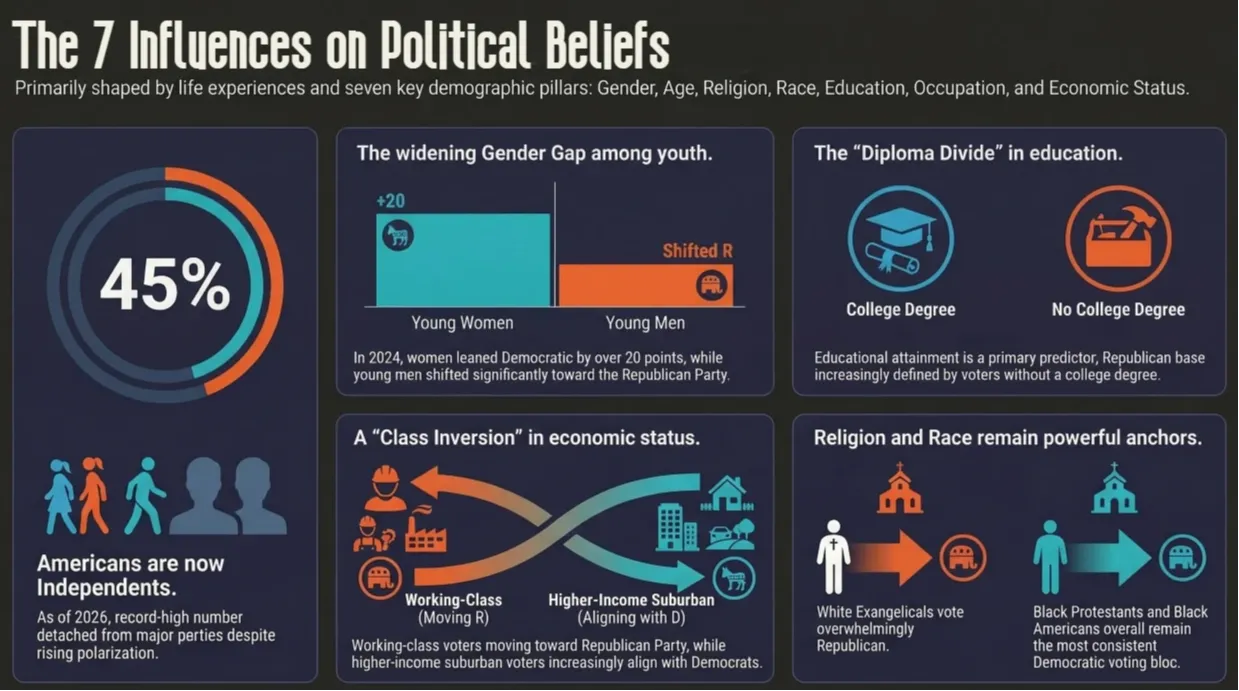
As of 2026, a record-high 45% of Americans now identify as political independents, reflecting a growing detachment from both major parties even as those who remain partisan become more polarized.
Research in political science has shown that seven characteristics most influence how people think about politics.
Gender
Research consistently shows differences in political views between men and women, a phenomenon political scientists call the gender gap. Women in the United States tend to lean more toward the Democratic Party and liberal positions, while men lean more toward the Republican Party and conservative positions.
These differences show up on issues like social services, gun control, and foreign policy. While the gender gap is a long-standing feature, recent elections have seen it widen into a chasm among younger generations. In 2024, young women leaned Democratic by over 20 points, while young men shifted significantly toward the Republican Party.
Age
Age is one of the strongest predictors of political ideology. Younger voters tend to lean more liberal, while older voters tend to lean more conservative. This pattern shows up consistently in polling data and election results.
Some political scientists argue that people become more conservative as they age because they accumulate property and wealth they want to protect. Others point to generational experiences. People who came of age during periods of social upheaval or economic crisis often carry those experiences into their political views for the rest of their lives.
Religion
Religious beliefs and practice have a significant influence on political ideology. People who attend religious services regularly tend to lean more conservative, particularly on social issues like abortion and same-sex marriage.
The relationship between religion and politics also varies by religious tradition. White evangelical Christians, for example, vote overwhelmingly Republican, while Black Protestants vote overwhelmingly Democratic. Catholics and mainline Protestants are more evenly divided. People who identify as having no religious affiliation tend to lean liberal.
Race and Ethnicity
Race and ethnicity are among the most powerful predictors of political party affiliation in the United States. Black Americans vote Democratic at very high rates, a pattern that has been consistent since the Civil Rights era of the 1960s.
Hispanic and Latino Americans also lean Democratic, though with more variation across different national origin groups. Asian Americans have shifted toward the Democratic Party in recent decades. White Americans are more divided, but have leaned Republican in presidential elections since the 1960s.
Education
Educational attainment has become an increasingly important dividing line in American politics. College-educated voters, particularly those with advanced degrees, have moved toward the Democratic Party. Americans without a college degree have moved toward the Republican Party.
The 'diploma divide' is one of the most reliable predictors of voting behavior, with the 2024 election cementing a trend where the Republican base is increasingly defined by working-class voters without a college degree.
Occupation
The kind of work a person does can also shape their political views. Teachers, social workers, artists, and academics tend to lean liberal. Those in business, agriculture, law enforcement, and the military tend to lean more conservative.
Occupation influences ideology in part because different jobs expose people to different experiences, communities, and economic interests that shape how they think about government's role.
Economic Status
Income and wealth are closely related to political ideology, though the relationship is more complicated than it might seem.
Higher-income Americans traditionally leaned Republican, partly because of preferences for lower taxes and less regulation. Lower-income Americans have traditionally leaned Democratic, partly because of support for social programs and worker protections.
By 2026, a 'class inversion' has become more apparent, though. Many lower-income and working-class voters have moved toward the Republican Party, while higher-income suburban voters have increasingly aligned with Democrats.
The Big Picture
No single factor determines a person's political ideology. Most people's views are shaped by a combination of all these influences, along with personal experiences, family upbringing, media consumption, and the community they live in.
Understanding these demographic patterns doesn't mean putting people in boxes. It means recognizing that political beliefs don't develop in a vacuum. They are the product of lived experience, and that experience looks different for everyone.