America's Two-Party System

Walk into any polling place in America and you'll notice something that might seem strange compared to other democracies: almost every serious candidate on the ballot belongs to one of just two parties: the Democrats or the Republicans.
While other countries often have four, five, or even a dozen major parties competing for power, the United States has been dominated by two parties for most of its history. This is not an accident. It is the result of history, law, and the structure of American elections.
A Brief History
Political parties appeared in America almost as soon as the Constitution was ratified. The first major divide was between the Federalists, led by Alexander Hamilton, who supported a strong central government, and the Democratic-Republicans, led by Thomas Jefferson, who favored states' rights and limited federal power.
Over the following decades, parties rose, split, merged, and disappeared. The Whig Party replaced the Federalists, only to collapse in the 1850s over the issue of slavery. The Republican Party emerged in 1854, and Abraham Lincoln became its first president in 1860.
Since the Civil War, Democrats and Republicans have dominated American politics. Third parties have occasionally gained significant followings. Theodore Roosevelt's Progressive Party in 1912 is one of the most notable examples. However, none has been able to break the two-party stranglehold on national politics.
Why Two Parties?
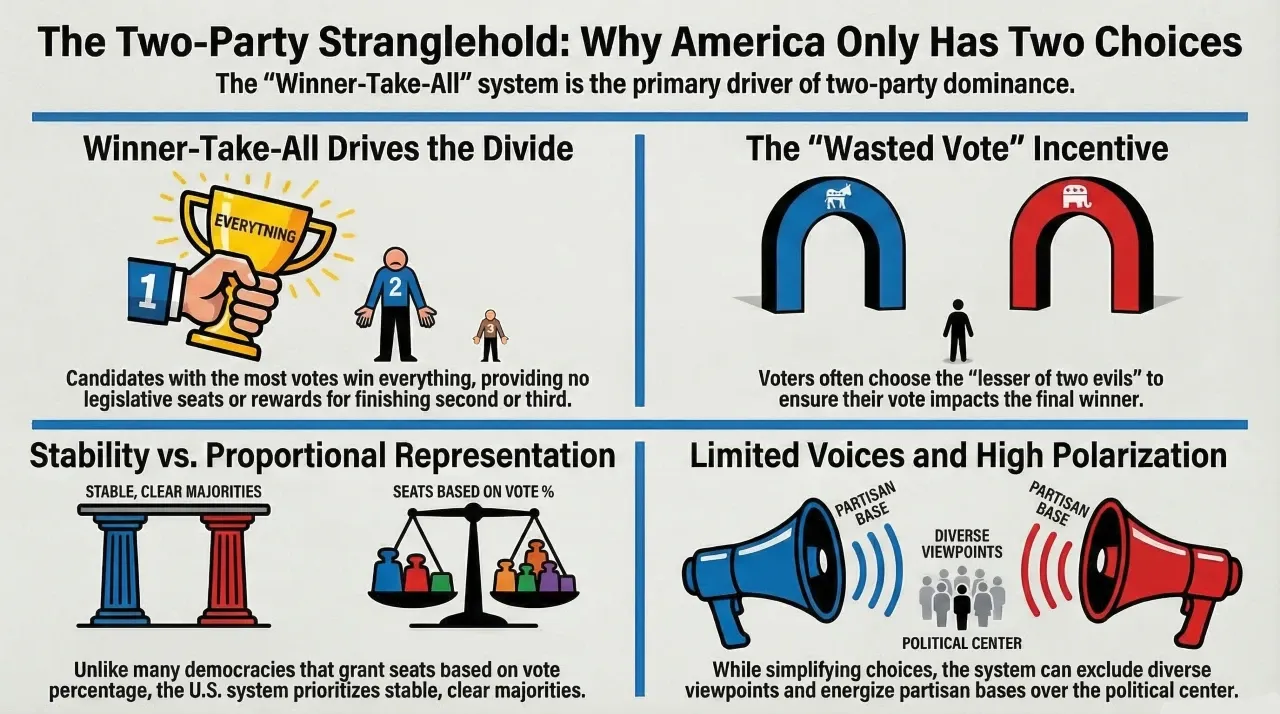
The persistence of two parties in America is largely a result of the winner-take-all electoral system used in most American elections. In a winner-take-all race, the candidate with the most votes wins everything. There is no reward for finishing second or third.
This structure creates a powerful incentive for voters to choose between the two candidates most likely to win, rather than "waste" their vote on a third-party candidate with little chance of victory. Over time, this pushes political competition toward two dominant parties.
Many other democracies use proportional representation, where parties receive seats in the legislature based on the percentage of the vote they receive. Under that system, a party that wins 15% of the vote gets about 15% of the seats. This makes it worthwhile to support smaller parties. The American system offers no such reward, which is one reason why third parties struggle to gain lasting traction.
The Advantages of a Two-Party System
The two-party system has some genuine strengths. It tends to produce stable governments with clear majorities, making it easier to pass legislation and govern effectively.
It also simplifies choices for voters. Rather than sorting through a long list of parties and platforms, most voters can align with one of two broadly defined options. Lastly, it encourages compromise. Since both parties must appeal to a wide range of voters to win national elections, they are often pushed toward the political center.
The Disadvantages of a Two-Party System
At the same time, the two-party system has real drawbacks. Many Americans feel that neither party fully represents their views, leaving them choosing between the lesser of two evils rather than a candidate they genuinely support.
The system can also lead to extreme polarization, as each party works to energize its base rather than appeal to the middle. Third-party and independent candidates face enormous structural barriers, limiting the range of voices and ideas in the political debate. And when the two parties are deeply divided, the winner-take-all nature of the system can make compromise and cooperation very difficult.
Where Things Stand Today
The Democratic and Republican parties of today look very different from their predecessors of even 50 years ago. The parties have sorted ideologically, with Democrats becoming more consistently liberal and Republicans more consistently conservative.
This sorting has contributed to increased polarization in American politics. Whether the two-party system will continue to define American politics indefinitely, or whether a major realignment is on the horizon, remains one of the most interesting questions in American political life.