What Is a Political Party?
If you follow the news, you've probably heard the terms Democrat and Republican thrown around constantly. But have you ever stopped to think about what a political party actually is and why we have them?
Political parties are one of the most important (and most misunderstood) parts of American democracy. They shape who runs for office, what policies get debated, and how government functions on a day-to-day basis.
Defining a Political Party
A political party is an organized group of people who share similar political beliefs and work together to win elections and influence government policy.
Unlike an interest group, which focuses on a specific issue or cause, a political party is broad. They take positions on a wide range of issues and their ultimate goal is to place its members in public office.
When a party wins enough elections, it gains the power to shape legislation, appoint officials, and set the direction of government.
What Political Parties Do
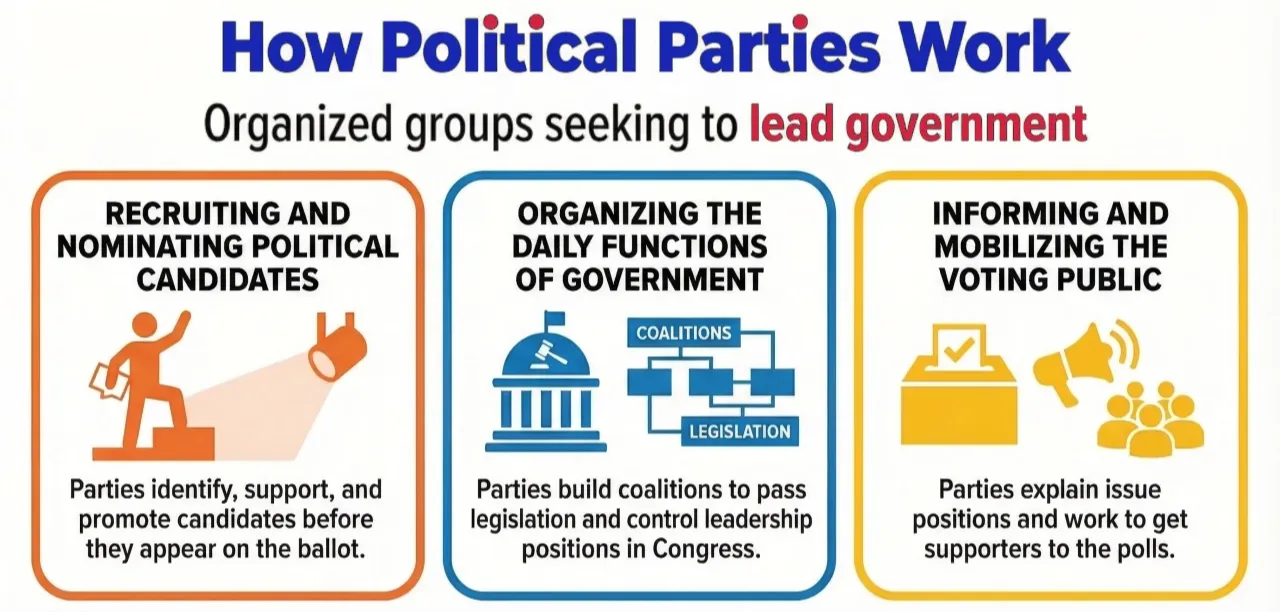
Political parties serve several important functions in a democracy. First and foremost, they recruit and nominate candidates for public office. Before voters ever see a name on a ballot, the party has usually played a major role in identifying, supporting, and promoting that candidate. Parties provide candidates with organizational support, fundraising help, and name recognition.
Parties also help organize government. In Congress, members of the same party work together to advance shared legislative goals. The majority party in each chamber controls the leadership positions and sets the legislative agenda. Without this kind of organization, it would be much harder to build the coalitions necessary to pass legislation.
Another key function is informing and mobilizing voters. Parties reach out to citizens, explain their positions on issues, encourage people to register to vote, and work to get their supporters to the polls on election day.
For many voters, party affiliation serves as a useful shorthand. Knowing a candidate's party gives a general sense of where they stand on major issues.
Finally, parties serve as a link between citizens and government. They provide a way for ordinary people to get involved in the political process, whether by volunteering for a campaign, attending a party caucus, or running for a local office.
Party Organization
Political parties in the United States are organized at multiple levels. At the national level, each major party has a national committee that oversees party strategy, fundraises, and organizes the national convention where the presidential nominee is formally selected.
Below that, state party committees manage elections and party affairs within each state. At the local level, county and city party organizations handle grassroots organizing and local races.
This decentralized structure reflects the broader decentralization of American government itself. A party's national platform is its official statement of beliefs and policy positions. This provides general guidance, but individual candidates and state parties often adapt those positions to fit their local context.
Parties and Democracy
Political parties are not mentioned anywhere in the Constitution. In fact, George Washington famously warned against them in his Farewell Address, fearing they would divide the nation.
Despite that warning, parties emerged almost immediately after the Constitution was ratified and have been a central feature of American democracy ever since. Love them or hate them, political parties remain one of the primary ways that citizens organize, compete for power, and try to shape the direction of the country.