The Powers of the President
The presidency is one of the most powerful offices in the world, but presidential power is far from unlimited. The Constitution grants the president a specific set of powers, and other powers have developed over time through law, tradition, and practice.
If you want to understand what the president’s can and can't do, you have to know both their powers and their limits.
Constitutional Powers
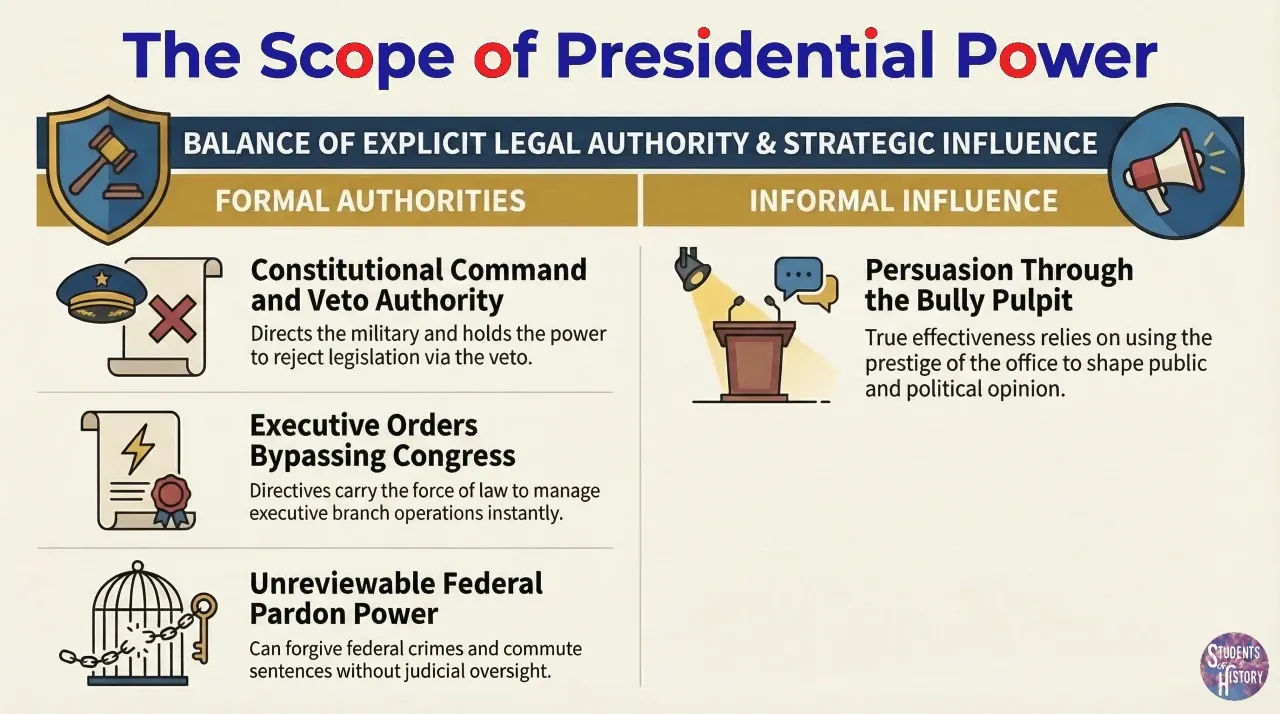
The Constitution is the starting point for presidential power. Article II grants the president several explicit authorities. As commander in chief, the president directs the military. The president has the power to make treaties with foreign nations, subject to Senate ratification, and to appoint ambassadors, federal judges, and other senior officials, subject to Senate confirmation. The president is also required to give Congress information about the state of the union and to recommend legislation for their consideration.
One of the president's most significant constitutional powers is the veto: the ability to reject legislation passed by Congress. A vetoed bill returns to Congress, where it can only become law if two-thirds of both chambers vote to override. Because building a two-thirds majority is very difficult, the veto gives the president substantial leverage over the legislative process even without casting a single vote in Congress.
Executive Orders
One of the most powerful tools available to a president is the executive order. These are formal directives issued by the president that carry the force of law and govern how the executive branch operates.
Executive orders do not require congressional approval, which makes them a fast and flexible way for presidents to act. They have been used throughout American history for major policy changes, from President Lincoln's Emancipation Proclamation to President Truman's desegregation of the military.
Executive orders are not unlimited, however. They must be consistent with the Constitution and with existing laws passed by Congress. For example, in early 2026, the Supreme Court struck down several major tariffs imposed by executive order, ruling that the president had overstepped his authority and that the power to set such taxes belongs to Congress.
This serves as a reminder that while executive orders are a fast way to govern, they are subject to constant oversight by the courts.
The Pardon Power
The Constitution gives the president the power to grant pardons for federal offenses. A pardon forgives a person for a crime and removes the legal penalties associated with it. The president can also grant reprieves, which delay punishment, and commutations, which reduce a sentence without fully erasing the conviction.
This power is broad and largely unreviewable. Courts have generally held that presidential pardons cannot be overturned. However, the power to pardon does not extend to state crimes or to cases of impeachment.
Emergency Powers
In times of national crisis, presidents have claimed broad emergency powers beyond those explicitly listed in the Constitution. These powers are grounded in the president's constitutional duty to "take care that the laws be faithfully executed".
Emergency powers have been used to respond to natural disasters, economic crises, and national security threats. They remain one of the most debated areas of presidential authority, with ongoing disagreements about how far they extend and what limits apply.
The Power of Persuasion
Not all presidential power comes from formal legal authority. Presidential scholar Richard Neustadt famously argued that the president's most important power is the power to persuade. This refers to the ability to convince Congress, the public, foreign leaders, and others to go along with the president's agenda.
A president who can communicate effectively, build coalitions, and use the prestige of the office to shape public opinion can accomplish far more than one who relies solely on formal powers. The bully pulpit (the president's unique platform to speak to the nation) is one of the most valuable tools the office provides.
Presidential Immunity
In 2024, the Supreme Court issued a landmark ruling in Trump v. United States that changed how we understand presidential accountability. The Court ruled that a president has absolute immunity from criminal prosecution for "official acts" that fall within their core constitutional duties (like pardoning someone or talking to the Department of Justice).
For other official acts, they have "presumptive immunity," meaning it is very difficult to prosecute them. However, a president has no immunity for "unofficial acts" done in a private or personal capacity. This means that while a president is protected while doing their job, they can still be held legally responsible for actions taken as a private citizen.
Limits on Presidential Power
Presidential power has real limits. Congress controls the budget and can block the president's legislative agenda. The Senate can reject nominations and refuse to ratify treaties. The courts can strike down executive actions that violate the Constitution. Congress can impeach and remove the president from office.
Public opinion matters too. A president who loses the support of the American people loses much of their ability to govern effectively. The American system was designed to prevent any single person from accumulating unchecked power, and those checks apply to the president as much as to anyone else.