Presidential Leadership and Decision-Making

History has given us presidents who rose magnificently to the challenges of their time and others who seemed overwhelmed by the demands of the office.
What separates effective presidents from ineffective ones? What skills, qualities, and habits of mind does it take to lead the most powerful nation on earth?
These questions have fascinated historians, political scientists, and citizens for as long as the office has existed.
The Weight of the Job
The presidency is unlike any other job. The decisions a president makes can affect millions of lives, shape the course of history, and reverberate for generations. A president must make high-stakes decisions under enormous time pressure, often with incomplete information and no clear right answer.
They must manage crises they did not anticipate, balance competing priorities, and navigate a political environment that is constantly shifting. And they must do all of this while simultaneously playing the many roles the office demands: commander in chief, chief diplomat, party leader, and symbol of the nation.
Communication and Vision
Effective presidents are almost always effective communicators. The ability to articulate a clear vision, inspire confidence, and explain complex issues in terms ordinary citizens can understand is a powerful leadership tool.
Some of history's most admired presidents like Abraham Lincoln, Franklin Roosevelt, and Teddy Roosevelt were known as much for their words as for their policies. Roosevelt's fireside chats, delivered by radio during the Great Depression, helped calm a frightened nation. Lincoln's speeches helped hold a divided country together during its darkest hours.
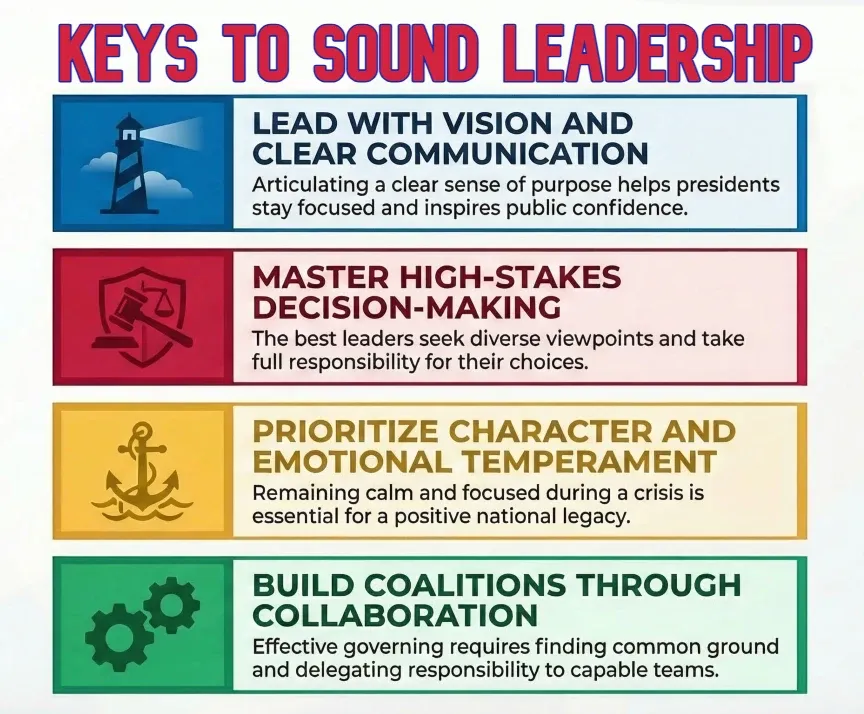
A clear sense of vision also helps presidents set priorities and stay focused amid the constant noise and demands of the office. That means knowing what you want to accomplish and why it matters. Presidents who lack a coherent vision often find themselves reactive, lurching from crisis to crisis without a larger sense of direction.
Decision-Making
Every president develops their own approach to making decisions. Some prefer to surround themselves with advisors who challenge their thinking and present multiple perspectives before reaching a conclusion. Others rely on a tight inner circle of trusted advisors. Some are deliberate and methodical, carefully weighing options before acting. Others are more instinctive, trusting their gut even when the evidence is ambiguous.
Most presidential scholars agree that the best decision-making processes share certain qualities. Good presidents seek out diverse viewpoints, including opinions they may not want to hear. They distinguish between decisions that need to be made immediately and those that can benefit from more deliberation. They accept responsibility for their choices rather than deflecting blame when things go wrong. And they learn from their mistakes, adjusting course when a policy isn't working rather than doubling down out of pride.
Character and Temperament
Beyond skills and strategy, character matters enormously in the presidency. A president's personal integrity, emotional stability, and sense of empathy shape how they treat the people around them and how they respond under pressure. Presidents who are driven by ego or a need for personal validation often make decisions for the wrong reasons. Those with genuine concern for the public good tend to make better choices even in difficult circumstances.
Temperament is particularly important. Good leaders have the ability to remain calm, focused, and clear-headed in a crisis. How a president responds in those moments, whether they panic or project confidence, whether they make rash decisions or measured ones, can define their legacy and have real consequences for the country.
Working with Others
No president governs alone. The most effective presidents build strong teams, delegate responsibility to capable people, and work collaboratively with Congress, foreign leaders, and the public. The ability to find common ground with people who have different interests and build coalitions is essential to getting anything done in the American political system.
Presidents who treat governing as a zero-sum competition, where every political interaction is a battle to be won, often find themselves isolated and ineffective. Those who understand that governing requires give-and-take, and who are willing to compromise without abandoning their core principles, tend to accomplish more.
Legacy
Ultimately, presidential leadership is judged by results. Did the president leave the country better off than they found it? Did they rise to the challenges of their time? Did they protect and strengthen democratic institutions, or weaken them?
History tends to reward presidents who combined strong character, clear vision, effective communication, and sound judgment. Those qualities don't guarantee success, but their absence almost always guarantees failure.