National Security and Foreign Policy
Protecting the American people from threats is the most fundamental responsibility of the federal government. National security describes the policies and institutions devoted to keeping the country safe from external and internal threats.
In the modern world, those threats have grown more varied and more complex than the founders could have imagined.
What Is National Security?
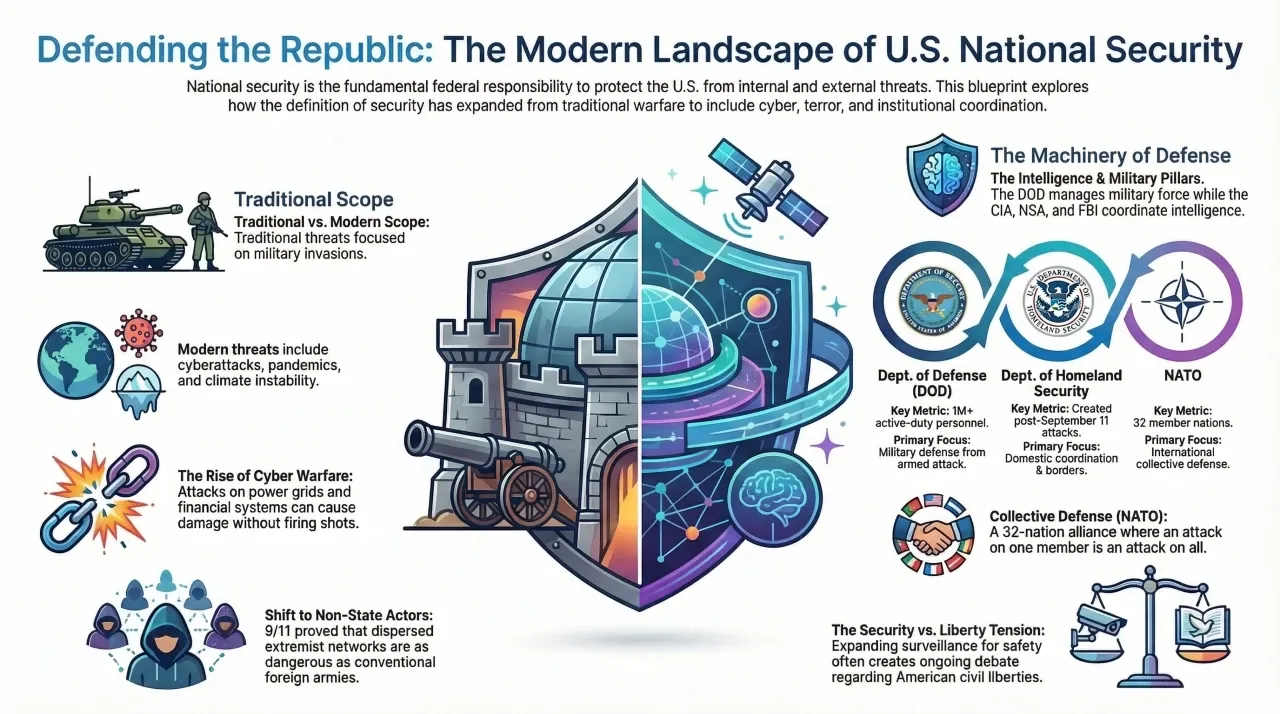
National security refers broadly to the protection of a nation from threats to its survival, safety, and way of life. Traditionally, national security focused almost exclusively on military threats from other countries. The primary concern was preventing invasion or attack from foreign armed forces. This traditional view drove the development of a large standing military, a network of overseas alliances, and an extensive system of intelligence gathering.
In the modern era, the definition of national security has expanded considerably. Terrorism carried out by non-state actors, cyberattacks on critical infrastructure, and climate-driven instability are all now considered national security concerns. This reflects the reality that serious threats to American safety and stability can come from many sources beyond traditional military rivals.
The National Security Apparatus
Managing national security requires a large and complex set of institutions. The Department of Defense, headquartered at the Pentagon, oversees the military and is responsible for defending the country from armed attack. It is one of the largest organizations in the world, employing more than a million active-duty military personnel and hundreds of thousands of civilian workers.
The intelligence community plays an equally important role. The Central Intelligence Agency gathers and analyzes intelligence about foreign governments, terrorist organizations, and other threats abroad.
The National Security Agency focuses on signals intelligence, monitoring electronic communications for information relevant to national security.
The Federal Bureau of Investigation handles domestic counterterrorism and counterintelligence. These agencies and more than a dozen others share information and coordinate their activities through the Office of the Director of National Intelligence.
The Department of Homeland Security, created after the September 11 attacks, coordinates domestic efforts to prevent terrorism, manage border security, and respond to natural disasters and other emergencies. Its creation represented a recognition that protecting the country required better coordination among the many agencies involved in domestic security.
Military Alliances and Deterrence
A central element of American national security strategy has always been the maintenance of military alliances with other countries. The most important is NATO, the North Atlantic Treaty Organization, founded in 1949. NATO is a collective defense alliance in which member countries agree that an attack on one is an attack on all. With 32 member nations spanning North America and Europe, NATO represents one of the most powerful military coalitions in history and has been a cornerstone of Western security for more than seven decades.
The concept of deterrence is also fundamental to national security strategy. Deterrence means maintaining enough military power, and making that power visible enough, that potential adversaries conclude that attacking the United States or its allies would cost more than it could possibly gain.
Nuclear deterrence, the strategy of maintaining a nuclear arsenal large enough to survive any first strike and still inflict unacceptable damage in retaliation, has been a central feature of American national security since the early Cold War.
Terrorism and the Modern Threat Environment
The September 11, 2001 attacks fundamentally changed how Americans think about national security. The attacks demonstrated that the most serious threats to American security did not necessarily come from foreign governments with conventional armies but from dispersed networks of violent extremists operating across national borders.
The response included military operations in Afghanistan and later Iraq, the creation of the Department of Homeland Security, sweeping new surveillance authorities under the USA PATRIOT Act, and a significant expansion of the intelligence community. These measures generated serious debate about the balance between security and civil liberties, a tension that remains unresolved.
Cybersecurity
One of the fastest-growing national security concerns of the modern era is cybersecurity. Critical American infrastructure, including power grids, financial systems, and communications networks, depends heavily on computer systems that are vulnerable to attack. Foreign governments and criminal organizations regularly attempt to penetrate American government and private sector networks to steal information, disrupt services, or plant malware that could be activated in a future conflict.
Cyberattacks represent a new kind of threat that does not fit neatly into traditional frameworks of war and peace. An attack that disables a city's power grid or compromises a financial institution can cause enormous damage without a single shot being fired, making it difficult to determine when a cyberattack rises to the level of an act of war and what an appropriate response looks like.
Balancing Security and Freedom
One of the most enduring tensions in national security policy is the balance between keeping the country safe and preserving the civil liberties that define American democracy.
Effective security sometimes seems to require surveillance, secrecy, and the restriction of certain freedoms. But a government that sacrifices too many liberties in the name of security risks undermining the very values it is supposed to protect.
Finding the right balance between these competing imperatives is one of the most difficult and important challenges in American governance.